April 19th
Annual AK naturalist trip to Pt. Brown, Kruzof island
24 people met at 5:45am at Crescent Harbor, miraculously everyone made it there on time. It was cold, sunny with light northwest winds. The winds were much less intense than they were on Friday. For me, the temperature meant wearing long underwear. Optimistic person that I am, I also brought my shorts. I probably could have exchanged the long pants for short ones in the afternoon, but I wouldn’t have been quite as comfortable.
Unfortunately, I was in charge of the field trip. I’d much rather be the person who periodically during the day leads the exploration instead of feeling like I needed to constantly encourage people to notice what is around them. For the most part, it was okay, but I was a little surprised that people grew tired of sitting, basking and minor independent exploratory forays in the muskeg.
The herring spawn continued to cover the intertidal algae, so the search for intertidal creatures was a bit tougher than during years without spawn. Probably because we lacked a dedicated intertidal person, people were much less interested in exploring the intertidal.
We did the usual walk from the drop off point to the caves then back around and up to the muskeg.
Around 50 Greater Yellowlegs and 4 Black-bellied plovers were on the beach when we arrived. Also saw mallards, Buffleheads, Barrow’s Goldeneyes, Northern Shovelers, and Green winged teal right off shore. Many Brant and 2 Canada geese flew over when we were on the beach and in the muskeg.
Found a variety of tracks this year, probably because I was paying more attention (thanks to Jonathan being around for the class). There were bear tracks along the tide line, as well as otter, mink, deer and mouse. The mouse tracks were found in the sand, under the Sitka alder by the forest. The tracking group found a dead Sea otter on the beach south of Pt. Kamenoi. Niphotrichum canescens var canescens was collected from the sand just below the alders on the beach.
A very simplified synopsis of what Cathy Connor shared with us was that the greywacke is a mixture of volcanic sandstone and mud from an older sea that has lithified. The next oldest rock that she mentioned is the flow of volcanic rock about 600, 000 years ago. The rock on the beach that is brown, white, black freckled (best I can do) is from this oldest volcanic flow. The cave material is from underwater volcanic eruptions that covered the greywacke. The softer material was weathered away by water etc and left the arch formation. The diorite that we find on the beach is probably from the Magoun island area. I asked about the possibility of small rocks being explosively moved with the ash eruptions to other areas (eg. Crow island). She said unlikely, but that the entire basin around Kruzof was probably "leaky" in terms of igneous rock and that small cracks were a more likely source of stray volcanic rocks. Some day perhaps I'll get a clue about geological processes that is more than superficial.
The muskeg vegetation was still mostly in winter mode, most of the sedges were still brown and dry. There were Carex livida starting up and some Empetrum nigrum blooming. I only remember seeing male flowers.
It took awhile, but we found Caddis flies in the reed-like tubes and dragonfly larvae in the ponds. We didn’t find Caddis flies in the ponds with Dragon fly larvae, but it wasn’t an exhaustive search.
Collected a few bryophytes in the muskeg including a small liverwort that on brief inspection looks like a tiny Mylia, but I haven’t confirmed the identification yet.
Racomitrium languinosum from a snag in the muskeg. Collected Riccardia latifrons from the undercut bank of a muskeg pond.
Also collected what seems to be Nitella from a pond. It is smaller and smooth to the touch which distinguished it from Chara. It also lacked the bad smell that stonewort is supposed to have. I haven't found a species key as yet to identify it further.
Friday, April 25, 2008


Sunday, April 20, 2008
April 18th
I had promised to take Jonathan Goff out to the Pt. Brown area before the Saturday field trip so we set out Friday morning around 10am. It was sunny, cold and rather windy out of the northeast. In fact the wind was up enough that I had serious doubts about making it all the way to Kruzof, but thought it was worth trying. I've been getting a bit nervier about zipping through the Apple, Chaichei island route, so we went out that route. Actually it was the way to go in a north wind. Kasiana and Middle island blocked the worst of the waves. Now that I've gone that way a few times, it is alot less nerve wracking. Started out through the passage between Gagarin and Crow island, but saw that the path between us and Kruzof was looking gnarlier than I was interested in. Thought about going through the passage between Crow and Middle island, and around, but I didn't see any advantage to that approach in terms of avoiding the wind.
We decided to go to a beach on Crow island northwest from the Middle island Goodyera beach access. It was relatively steep, but accessible landing that was protected from the wind. The beach was mostly mid sized rocks, so it didn't look to problematic. Sucker beach. It was sunny, calm and covered with herring eggs, in other words quite inviting. Many ravens, eagles and maybe a few crows were in agreement about the beach.
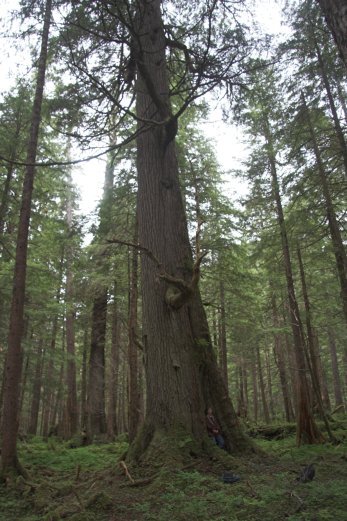
Had a nice wander across the island to the windy, cold northwest side. The center of the island had more cedar than I'm used to seeing on small islands. The yellow cedar had the braided bark that I associate with older trees (of course I don't have any real basis for this impression). Gorgeous trees with lots of typical looking cedar epiphytes. Jonathan found a squirrel tracks and scat in a hummock with devoured spruce cones, I found a tarp shelter. I had a difficult time looking at the ground with the plethora of cedar, but managed to refocus a little bit. Both early and alaska blueberry were in bloom, didn't notice any salmonberry, but there wasn't really much habitat for that shrub.
Went back to the beach, shoved the boat around a little and ate. The beach seemed a little less steep at this point, but still okay. Slight error in judgement. Thought about using the kayak to anchor the skiff out deeper, but didn't think in necessary since we were leaving for Middle island after a short walk to pick up a tote we had seen on a neighboring beach. I wanted to collect some of the herring eggs for the garden, so the tote was a great find.
Shoved the skiff again and wandered off down the beach. Was totally distracted by the lichens in the alder along the way, not to mention the piles of unidentifiable seedlings, young dock leaves and impressive beach combing (batman t-shirt, broken lawn chair). In the back of my mind, I kept thinking I should go check the skiff, as we were beach combing during the beginning of the falling of the tide, but why listen to such voices when the sun is out and there is beach to explore?
The dock leaves were pretty tasty, nice and lemony. I might have to go back to determine which species we were eating. The seedlings weren't identifiable by their growth (cotyledons or taste), so who knows what we had tasted. Should have noticed that I was still on the dense side of my recent cold or perhaps blind without my glasses, when it had to be pointed out that the leaves were still cotyledons. I thought the one I ate had a bit of a mustardy flavor, but Jonathan didn't notice any.
The alders had alot of Ramalina, looked like R. farinacea and R. roesleri, but I haven't looked carefully at the collections. Also found abundant Tuckermanniopsis chlorophylla and Ulota phyllantha and crispa.
Ultimately decided that I couldn't ignore the tide any longer, but alas I had ignored it a bit too long. When we returned to the skiff with our plastic treasures, the skiff wasn't moving quite so freely in the water. There was still water all on all sides, just not quite enough. The water on the deep side was still over our boots, but the stern part of the keel was resting on a rock somewhat larger than the rest of the rocks on the beach. Despite alot of sweat inducing use of levers and implementation of roller logs and removal of cargo, the skiff wasn't moving.
We made the necessary phone calls (needed a bit of ridicule to go with the and proceeded to gather fire wood. Despite being a bit on the dense side, I had at least brought my fire kit. I guess that it was quite useful to get stranded with a fire builder as well. Jonathan had a pretty nice fire going in pretty short order and we had quite a pile of wood in reserve, alot of it drying behind the fire. I was too busy saving lichens from the fire. Found Coptis asplenifolia blooming in the Spruce/Calamagrostis zone just above the beach on one wood gathering foray.
It didn't seem like particularly tough duty, sun, nice fire, pizza, cookies, a nainamo bar, lots of water and a few cokes (salvaged from the skiff) and good company. It was nice getting stranded with someone who wasn't visibly ticked off by my error. I can imagine that many people wouldn't have been so easy going about the situation.
The only bad part of the adventure was going to be getting up at 5am after moving the skiff in the middle of the night. As it turned out, we didn't spend the evening on the beach. Jeff couldn't quite hear me well enough on the phone, so was a bit worried. Jonathan and I were just settling into the log by the fire and a skiff approached. Actually, it was headed to another beach, but soon came our way. I have to admit that I was a little disappointed at being rescued, both from the standpoint that I thought that it would have been kind of interesting and because Jeff was going to end up cleaning up my mess. The good part was that Jonathan made his dinner appointment and we both got some needed sleep.
We broke up the fire, packed up and went back to town. Saw a few Tufted puffins on the west side of Kasiana.
I was planning on heading back out with Jeff to retrieve the skiff, but didn't end up doing that either. I wanted Steve Langhorst to come with us (strength seemed good), he did, but Joanne decided to go along as well, so I stayed home. Steve and Joanne enjoyed the evening boat trip and the opportunity for teasing me about getting stranded with a younger guy. They suggested using an inflatable rock next time and bringing alcohol.
Jeff got home around 2am from the island. The heartless wretch at home was sound asleep at the time, but I guess that was the point of being resuced. Fortuntately, he could sleep in on Saturday. He was treated to multiple Great Horned owls calling. Happily, he enjoyed the evening on the island and didn't have much trouble getting the skiff off the rock. It still took a bit to get it off the rock that had us trapped earlier.
Nice blood red sun setting in the evening. Looking forward to visiting Crow island again, but perhaps will use the kayak to anchor the skiff. Or maybe not.
I had promised to take Jonathan Goff out to the Pt. Brown area before the Saturday field trip so we set out Friday morning around 10am. It was sunny, cold and rather windy out of the northeast. In fact the wind was up enough that I had serious doubts about making it all the way to Kruzof, but thought it was worth trying. I've been getting a bit nervier about zipping through the Apple, Chaichei island route, so we went out that route. Actually it was the way to go in a north wind. Kasiana and Middle island blocked the worst of the waves. Now that I've gone that way a few times, it is alot less nerve wracking. Started out through the passage between Gagarin and Crow island, but saw that the path between us and Kruzof was looking gnarlier than I was interested in. Thought about going through the passage between Crow and Middle island, and around, but I didn't see any advantage to that approach in terms of avoiding the wind.
We decided to go to a beach on Crow island northwest from the Middle island Goodyera beach access. It was relatively steep, but accessible landing that was protected from the wind. The beach was mostly mid sized rocks, so it didn't look to problematic. Sucker beach. It was sunny, calm and covered with herring eggs, in other words quite inviting. Many ravens, eagles and maybe a few crows were in agreement about the beach.
Had a nice wander across the island to the windy, cold northwest side. The center of the island had more cedar than I'm used to seeing on small islands. The yellow cedar had the braided bark that I associate with older trees (of course I don't have any real basis for this impression). Gorgeous trees with lots of typical looking cedar epiphytes. Jonathan found a squirrel tracks and scat in a hummock with devoured spruce cones, I found a tarp shelter. I had a difficult time looking at the ground with the plethora of cedar, but managed to refocus a little bit. Both early and alaska blueberry were in bloom, didn't notice any salmonberry, but there wasn't really much habitat for that shrub.
Went back to the beach, shoved the boat around a little and ate. The beach seemed a little less steep at this point, but still okay. Slight error in judgement. Thought about using the kayak to anchor the skiff out deeper, but didn't think in necessary since we were leaving for Middle island after a short walk to pick up a tote we had seen on a neighboring beach. I wanted to collect some of the herring eggs for the garden, so the tote was a great find.
Shoved the skiff again and wandered off down the beach. Was totally distracted by the lichens in the alder along the way, not to mention the piles of unidentifiable seedlings, young dock leaves and impressive beach combing (batman t-shirt, broken lawn chair). In the back of my mind, I kept thinking I should go check the skiff, as we were beach combing during the beginning of the falling of the tide, but why listen to such voices when the sun is out and there is beach to explore?
The dock leaves were pretty tasty, nice and lemony. I might have to go back to determine which species we were eating. The seedlings weren't identifiable by their growth (cotyledons or taste), so who knows what we had tasted. Should have noticed that I was still on the dense side of my recent cold or perhaps blind without my glasses, when it had to be pointed out that the leaves were still cotyledons. I thought the one I ate had a bit of a mustardy flavor, but Jonathan didn't notice any.
The alders had alot of Ramalina, looked like R. farinacea and R. roesleri, but I haven't looked carefully at the collections. Also found abundant Tuckermanniopsis chlorophylla and Ulota phyllantha and crispa.
Ultimately decided that I couldn't ignore the tide any longer, but alas I had ignored it a bit too long. When we returned to the skiff with our plastic treasures, the skiff wasn't moving quite so freely in the water. There was still water all on all sides, just not quite enough. The water on the deep side was still over our boots, but the stern part of the keel was resting on a rock somewhat larger than the rest of the rocks on the beach. Despite alot of sweat inducing use of levers and implementation of roller logs and removal of cargo, the skiff wasn't moving.
We made the necessary phone calls (needed a bit of ridicule to go with the and proceeded to gather fire wood. Despite being a bit on the dense side, I had at least brought my fire kit. I guess that it was quite useful to get stranded with a fire builder as well. Jonathan had a pretty nice fire going in pretty short order and we had quite a pile of wood in reserve, alot of it drying behind the fire. I was too busy saving lichens from the fire. Found Coptis asplenifolia blooming in the Spruce/Calamagrostis zone just above the beach on one wood gathering foray.
It didn't seem like particularly tough duty, sun, nice fire, pizza, cookies, a nainamo bar, lots of water and a few cokes (salvaged from the skiff) and good company. It was nice getting stranded with someone who wasn't visibly ticked off by my error. I can imagine that many people wouldn't have been so easy going about the situation.
The only bad part of the adventure was going to be getting up at 5am after moving the skiff in the middle of the night. As it turned out, we didn't spend the evening on the beach. Jeff couldn't quite hear me well enough on the phone, so was a bit worried. Jonathan and I were just settling into the log by the fire and a skiff approached. Actually, it was headed to another beach, but soon came our way. I have to admit that I was a little disappointed at being rescued, both from the standpoint that I thought that it would have been kind of interesting and because Jeff was going to end up cleaning up my mess. The good part was that Jonathan made his dinner appointment and we both got some needed sleep.
We broke up the fire, packed up and went back to town. Saw a few Tufted puffins on the west side of Kasiana.
I was planning on heading back out with Jeff to retrieve the skiff, but didn't end up doing that either. I wanted Steve Langhorst to come with us (strength seemed good), he did, but Joanne decided to go along as well, so I stayed home. Steve and Joanne enjoyed the evening boat trip and the opportunity for teasing me about getting stranded with a younger guy. They suggested using an inflatable rock next time and bringing alcohol.
Jeff got home around 2am from the island. The heartless wretch at home was sound asleep at the time, but I guess that was the point of being resuced. Fortuntately, he could sleep in on Saturday. He was treated to multiple Great Horned owls calling. Happily, he enjoyed the evening on the island and didn't have much trouble getting the skiff off the rock. It still took a bit to get it off the rock that had us trapped earlier.
Nice blood red sun setting in the evening. Looking forward to visiting Crow island again, but perhaps will use the kayak to anchor the skiff. Or maybe not.
Sunday, April 13, 2008
April 8th
Had a different sort of experience in a familiar place. Marty Johnson asked me to help transport his Marine Biology class over to the Port Krestof to Pt. Brown beach. There were 3 skiffs , 18 kids and three adults on this adventure. Josh Arnold was the other driver. We met around 7:45am at the work float, at least that was when I arrived, the rest slowly trickled in. The forecast didn't sound that great, but the morning was sunny, calm and rather cool. I took 5 students, two of whom fit in the cabin, the other three sat outside.
Because it was calm, we went the short way through the Apple Islands to Chaichei to Gagarin and on to Kruzof. It was nice just following along instead of thinking, but looking at the chart the path through seems pretty straight forward. Stopped to watch a large group of sea lions, two humpbacks, mixed scoters and Harlequins between Chaichei and Middle island. There were roughly 30 Harlequins which seems like more than I usually see in one spot.
Tried following Marty in closer to the middle of the beach, but decided against it. It was obvious that a larger boat was going to ground out before the water depth was comfortable for boot height. Did see a large number of frosted nudibranches and herring eggs on the eel grass on the way back out. Both Josh and I anchored near where the Allen Marine boats usually drop us off. The steep beach is alot more comfortable for a larger skiff or boat.
The sunny weather didn't last too long, it started snowing mid morning and didn't stop for too long the rest of the day.
The water was murky with eggs and the spawn was thick on the seaweed and rocks. There weren't windrows of herring eggs on the beach, but I suspect that there will be on my next visit. I've been visiting this beach every spring for the last 8 years and this is the second time that I've seen heavy spawn. The eggs were pretty fresh tasting off the rocks. The best to my mind were on the green algae, the brown kelps were a bit too chewy.
It was a more structured visit than I'm accustomed to at this beach. We had several specific tasks to complete, mostly looking at specific habitats and the creatures living in them. I'd rather just wander, but I can see the utility in being more organized.
Noticed several juncos, 2 Varied thrush and a Savannah sparrow while helping the splash zone crew with their survey. They were feeling a bit cheated because of the lack of diverse invertebrates in their zone. Found the Hermit thrush nest in the Aruncus on the cliff. It looked pretty tidy which makes me wonder if it is maintained year to year. The sparrow nests that I've found never look quite that smooth and neat.
Pretty much followed the same ritual as most trips, that is we eventually worked our way around to the caves. One of the large rocks near the cave had a bread crumb sponge about 2-3 ft across. Not sure why I hadn't noticed it on other trips.
Found most of the usual invertebrates including moon snail egg cases and a good variety of sea stars. We did find a creature in the sand that I don't remember finding on this beach previously, a sand lance. Alas, for the sand lance, the shovel that found it, also accidently murdered it.
The herring that we found in the intertidal were some of the largest that I've seen. I didn't measure them, but it seemed that they were approaching 9 -12 inches long. One of the giant herring was being eaten by a sunstar.
Other birds along the beach: one oyster catcher, 20-25 Buffleheads, around 40+ Barrow's goldeneyes, Golden-crowned kinglets (in the spruces) and song sparrows in the intertidal. There were large flocks of gulls by Brent's beach and in Hayward Straits, but it was too snowy and too far to get a good sense of which gulls were in the mixture.
The Cow parsnip was coming up and the Early blueberry blooming, but the rest of the flowering plant world was not visibly responding to spring.
It was snowy and cold enough that the kids lost alot of enthusiasm after lunch, so after they finished their last inventory, we packed up for home. We took the skiffs over to Port Krestof before heading back. Did see a couple of Canada geese, Common mergansers, Surf Scoters and the Buffleheads and Goldeneyes. There was one deer on the beach.
The wind had come with the snow, so the ride back was not as pleasant as the ride out. We went behind Guide Island and around Middle Island and had to slow down considerably. I was very happy not to be driving a lund, I have alot of memories of driving open skiffs in harsh weather that I'd just as soon not refresh. Marty's boat didn't catch up until we stopped on the lee side of Middle island. The weather just got worse for awhile, at one point the snow was heavy enough that I couldn't see where I was going. A compass is a nice thing to have. I did see a Pigeon guillemot near Kasiana in the midst of the snow squall. It was a cold ride back, my toes and fingers were on the numb side. Seemed like it took a couple of hours to completely stop shivering. It took roughly 12 gallons of fuel to make the trip.
Longtails at the north end of the channel both coming and going.
Had a different sort of experience in a familiar place. Marty Johnson asked me to help transport his Marine Biology class over to the Port Krestof to Pt. Brown beach. There were 3 skiffs , 18 kids and three adults on this adventure. Josh Arnold was the other driver. We met around 7:45am at the work float, at least that was when I arrived, the rest slowly trickled in. The forecast didn't sound that great, but the morning was sunny, calm and rather cool. I took 5 students, two of whom fit in the cabin, the other three sat outside.
Because it was calm, we went the short way through the Apple Islands to Chaichei to Gagarin and on to Kruzof. It was nice just following along instead of thinking, but looking at the chart the path through seems pretty straight forward. Stopped to watch a large group of sea lions, two humpbacks, mixed scoters and Harlequins between Chaichei and Middle island. There were roughly 30 Harlequins which seems like more than I usually see in one spot.
Tried following Marty in closer to the middle of the beach, but decided against it. It was obvious that a larger boat was going to ground out before the water depth was comfortable for boot height. Did see a large number of frosted nudibranches and herring eggs on the eel grass on the way back out. Both Josh and I anchored near where the Allen Marine boats usually drop us off. The steep beach is alot more comfortable for a larger skiff or boat.
The sunny weather didn't last too long, it started snowing mid morning and didn't stop for too long the rest of the day.
The water was murky with eggs and the spawn was thick on the seaweed and rocks. There weren't windrows of herring eggs on the beach, but I suspect that there will be on my next visit. I've been visiting this beach every spring for the last 8 years and this is the second time that I've seen heavy spawn. The eggs were pretty fresh tasting off the rocks. The best to my mind were on the green algae, the brown kelps were a bit too chewy.
It was a more structured visit than I'm accustomed to at this beach. We had several specific tasks to complete, mostly looking at specific habitats and the creatures living in them. I'd rather just wander, but I can see the utility in being more organized.
Noticed several juncos, 2 Varied thrush and a Savannah sparrow while helping the splash zone crew with their survey. They were feeling a bit cheated because of the lack of diverse invertebrates in their zone. Found the Hermit thrush nest in the Aruncus on the cliff. It looked pretty tidy which makes me wonder if it is maintained year to year. The sparrow nests that I've found never look quite that smooth and neat.
Pretty much followed the same ritual as most trips, that is we eventually worked our way around to the caves. One of the large rocks near the cave had a bread crumb sponge about 2-3 ft across. Not sure why I hadn't noticed it on other trips.
Found most of the usual invertebrates including moon snail egg cases and a good variety of sea stars. We did find a creature in the sand that I don't remember finding on this beach previously, a sand lance. Alas, for the sand lance, the shovel that found it, also accidently murdered it.
The herring that we found in the intertidal were some of the largest that I've seen. I didn't measure them, but it seemed that they were approaching 9 -12 inches long. One of the giant herring was being eaten by a sunstar.
Other birds along the beach: one oyster catcher, 20-25 Buffleheads, around 40+ Barrow's goldeneyes, Golden-crowned kinglets (in the spruces) and song sparrows in the intertidal. There were large flocks of gulls by Brent's beach and in Hayward Straits, but it was too snowy and too far to get a good sense of which gulls were in the mixture.
The Cow parsnip was coming up and the Early blueberry blooming, but the rest of the flowering plant world was not visibly responding to spring.
It was snowy and cold enough that the kids lost alot of enthusiasm after lunch, so after they finished their last inventory, we packed up for home. We took the skiffs over to Port Krestof before heading back. Did see a couple of Canada geese, Common mergansers, Surf Scoters and the Buffleheads and Goldeneyes. There was one deer on the beach.
The wind had come with the snow, so the ride back was not as pleasant as the ride out. We went behind Guide Island and around Middle Island and had to slow down considerably. I was very happy not to be driving a lund, I have alot of memories of driving open skiffs in harsh weather that I'd just as soon not refresh. Marty's boat didn't catch up until we stopped on the lee side of Middle island. The weather just got worse for awhile, at one point the snow was heavy enough that I couldn't see where I was going. A compass is a nice thing to have. I did see a Pigeon guillemot near Kasiana in the midst of the snow squall. It was a cold ride back, my toes and fingers were on the numb side. Seemed like it took a couple of hours to completely stop shivering. It took roughly 12 gallons of fuel to make the trip.
Longtails at the north end of the channel both coming and going.
Thursday, April 03, 2008
Decided that it was time to publish this somewhat half-baked entry from a week ago.
Happy to write that there are 367 plant descriptions completed as of Tuesday, April 1st. Started to work on the lichens which I expect to be challenging, mostly because of the restrictions on technical language. I haven't thought of an appropriate description of isidia yet, maybe columnar reproductive bodies?I'd probably get a few giggles out of that description, which wouldn't necessarily be a bad thing particularly since the text is somewhat dry. I've since moved on to trees and shrubs in the interest of making some forward progress.
Did get to visit Indian river a couple of times this week. There were several skunk cabbage flowers up, each about 6-8 inches tall, but not yet open. No salmonberrry flowers or Coptis asplenifolia blooming.
Collected several bryophytes and a pin lichen in my travels. Found a particularly large Bazzania which prompted reviewing the characteristics of the local species. This large Bazzania didn't have any deciduous leaves that would have immediately identified it as denudata, nor did it have the leaf characteristics of the other two common species, but wasn't large enough to be B. trilobata.
Laid out the Bazzania species side by side on a slide so that I could do some comparison.
Bazzania trilobata is much larger than the other species that I have available, but the difference wasn't as extreme as I expected. Particularly between the newly collected species and B. trilobata. What was apparent was that the leaves of trilobata overlap the stem more than those do of the unknown. There isn't as much overlap as in B. tricreanata or as what is described for pearsonii. The unknown Bazzania is much flatter than are the other species. Both trilobata and the unknown species have multiple slender stems from the underside and fairly regularly 3 toothed leaf tips.
At the moment I'll use the following characteristics to identify Bazzania species.
B. trilobata: size of stems (6mm wide), leaves somewhat overlapping, 3 toothed apex, ventral flagella present
B. denudata: stems to 2mm wide, 3 toothed truncate apex, ventral flagella, leaves deciduous
B. tricrenata: stems usually less than 2mm, leaves mostly overlapping on dorsal surface of stem, acute apex with 1-3 teeth, underleaves wider than long, with 3-4 lobes
B. personii: stems to 1.5 mm, leaves strongly overlapping on dorsal surface, leaf tips acute, underleaves longer than wide, less lobed than in B. tricrenata
I'm leaning toward calling the unknown Bazzania denudata despite the lack of naked stems.
The pin lichen seems to be Chaenotheca brunneola.
trimmed rugosa roses on 4/5
planted seeds of Thalictricum dekvayi var decorum, Aconitum sp. (climbing) and Cremanthodium that Les Brake sent from Wasilla on 4/6. I put the flats in the greenhouse, hopeful for some cool weather to chill the seeds.
4 marbled murrelets on Saturday. Humpback right in front of the house .
about 50 redpolls working the ground near UAS in the grass by the row of pine by the waterfront 4/4?.
Happy to write that there are 367 plant descriptions completed as of Tuesday, April 1st. Started to work on the lichens which I expect to be challenging, mostly because of the restrictions on technical language. I haven't thought of an appropriate description of isidia yet, maybe columnar reproductive bodies?I'd probably get a few giggles out of that description, which wouldn't necessarily be a bad thing particularly since the text is somewhat dry. I've since moved on to trees and shrubs in the interest of making some forward progress.
Did get to visit Indian river a couple of times this week. There were several skunk cabbage flowers up, each about 6-8 inches tall, but not yet open. No salmonberrry flowers or Coptis asplenifolia blooming.
Collected several bryophytes and a pin lichen in my travels. Found a particularly large Bazzania which prompted reviewing the characteristics of the local species. This large Bazzania didn't have any deciduous leaves that would have immediately identified it as denudata, nor did it have the leaf characteristics of the other two common species, but wasn't large enough to be B. trilobata.
Laid out the Bazzania species side by side on a slide so that I could do some comparison.
Bazzania trilobata is much larger than the other species that I have available, but the difference wasn't as extreme as I expected. Particularly between the newly collected species and B. trilobata. What was apparent was that the leaves of trilobata overlap the stem more than those do of the unknown. There isn't as much overlap as in B. tricreanata or as what is described for pearsonii. The unknown Bazzania is much flatter than are the other species. Both trilobata and the unknown species have multiple slender stems from the underside and fairly regularly 3 toothed leaf tips.
At the moment I'll use the following characteristics to identify Bazzania species.
B. trilobata: size of stems (6mm wide), leaves somewhat overlapping, 3 toothed apex, ventral flagella present
B. denudata: stems to 2mm wide, 3 toothed truncate apex, ventral flagella, leaves deciduous
B. tricrenata: stems usually less than 2mm, leaves mostly overlapping on dorsal surface of stem, acute apex with 1-3 teeth, underleaves wider than long, with 3-4 lobes
B. personii: stems to 1.5 mm, leaves strongly overlapping on dorsal surface, leaf tips acute, underleaves longer than wide, less lobed than in B. tricrenata
I'm leaning toward calling the unknown Bazzania denudata despite the lack of naked stems.
The pin lichen seems to be Chaenotheca brunneola.
One of the other liverwort questions that surfaced this week concerned Herbertus. There seems to be 2 species in our area, H. aduncus and H. dicranus. I have to admit that I hadn't much thought about there being 2 species, so I haven't been paying much attention to which is where or for that matter how to tell them apart. One key feature seems to be whether the leaves are falcate or not (H. aduncus is falcate, H. dicranus is not). The collections I have from the class I took from Schofield look very different in growth form. H. dicranus is much larger, it looks a bit more like twine. Unfortunately after reading the species descriptions, I'm not sure if size differences can be relied upon.
Misc. notes:
salmonberries blooming near Galankin dock.
One streptopus amplexifolius popping up on Sunday 4/6trimmed rugosa roses on 4/5
planted seeds of Thalictricum dekvayi var decorum, Aconitum sp. (climbing) and Cremanthodium that Les Brake sent from Wasilla on 4/6. I put the flats in the greenhouse, hopeful for some cool weather to chill the seeds.
4 marbled murrelets on Saturday. Humpback right in front of the house .
about 50 redpolls working the ground near UAS in the grass by the row of pine by the waterfront 4/4?.
Hummingbirds have arrived in town (Harris Island), not seen on Galankin yet.
Tuesday, April 01, 2008
I haven't done well recording my observations the last couple of weeks. Hopefully, I'll recall most of the highlights.
The end of spring break, just before Easter the red polls were abundant around town, I saw several large flocks up Indian River trail and in the commons on Galankin island. In both places the birds were both in the alders and on the ground near the alders. More than once, I stood or sat still and had the flock fly past and around me. It seemed that the birds kept coming back and around, but I'm assuming that the flock was large enough that it took a few minutes for them to pass.
The Pine siskins have been rather thick as well. For the first time this feeding season, siskins came to the feeder. There were also several in the garden on the east side of the house.
It snowed on Easter and several inches on the following Tuesday. Heard my the first Varied thrush on the 24th, they have been vocal ever since. The Song sparrows, Juncos and Winter wrens have also been singing/calling.
The first opening of the herring fishery was on Tuesday (3/25) near Big Gavanski Island. The second was on the eastern shore of Kruzof Island on 3/26. They fished in shallow water right off the shore and caught a tremendous amount of fish. The Infinite Glory caught 3 million pounds in one set which took 4 days to pump to the tenders. The last opening was on Monday the 31st.
I haven't seen any spawn around the south end of town. There have been a few pods of sea lions in the islands, but not much of a congregation.
Mary Willson came over from Juneau on Thursday to give a lecture. We walked up to the first bridge on the Indian River trail, I was hoping to show her the dippers that I've been watching this winter. It was a beautiful sunny day with about 6 inches of snow along the trail. The dippers behaved like I would expect, and weren't to be found on the way up. We did see one from the bridge. The bird was singing and in fact we heard it before we saw it. It was eating insects (?) from the snow on the small gravel bar in the river. It didn't venture much into the water, mostly staying on the snow on the gravel and from the top of a boulder on the bar.
Mary suggested looking on large rootwads or large boulders in or near the river for nests. She said that they sometimes build nests on the top of debris if there isn't suitably steep rock banks.
Found one bright yellow Skunk cabbage flower in a small snow free spot. The top was nipped off, but it was still bright yellow, not bruised looking.
Heard a Steller's jay on the way down near the boundary cut. Didn't see it, but it was rather distinct. Don't belive that I've seen or heard one this winter. I know that they are around, but I don't seem to hang out where they do and none have ventured to Galankin island.
Mary gave an overview of her studies on bird dispersal of fruit/seeds. She worked with red/orange salmonberries and red/yellow elderberries. The take home message for me was that birds are rather fickle and don't clearly prefer a certain color at least not in salmonberries or elderberries. They often prefer red fruit, but will choose orange/yellow fruit if it is easier to obtain. There doesn't seem to be much evidence that bird preference is much of a selection agent for fruit characteristics, at least not for salmonberries or elderberries. The birds are just too variable in their taste. There are more red salmonberries than orange in Southeast, which could account for the preference. However, in Oregon orange salmonberries are more abundant than red ones and the birds still prefer the red ones (at least in aviary experiments).
What was interesting to me was the 25% lipid content of elderberries and red osier dogwood berries. I'm curious to watch how quickly elderberries disappear when they are ripe. Those calories would seem to be quite attractive.
It seems that bears may disperse alot more blueberries than do birds. From what I remember the berries don't spend much time in the digestive track, just moving through in a rather rapid time. Germination was rapid, but there was alot of crowding of seedlings, so survival wasn't great. Not very surprising given the density of seedlings in a pile of bear scat. Seems like going through a smaller digestive tract might be a better deal for a seed. At least in terms of seed density.
I do wonder if the birds prefer red over blue berries. Most of the thrushes in the garden seem to be eating red huckleberries instead of blueberries.
Went to Juneau on Friday on the Fairweather. Beautiful sunny, flat calm day. Lots of scaups, mallards, goldeneyes, common mergansers, cormorants, scoters, 2 Canada geese and a couple of Humpback whales along the way.
Didn't get out much in Juneau, but did notice the willow catkins were out, didn't see any stamens or pistils, but they must be on the way. Briefly visited Mendenhall glacier (the lake was solid with lots of people skiing, walking on it) and the new NOAA lab out at Lena Pt. The labs were impressive, as were the magpies.
The ferry ride back was just as pleasant, but with low clouds instead of sun. Drove through the herring fleet on the way to the terminal. They weren't fishing, just wandering in search of fish. Large group of Common murres and several groups of sea lions were with the boats.
Today found several almost open salmonberry flowers by the Galankin island dock. Not quite open, but very pink.
The end of spring break, just before Easter the red polls were abundant around town, I saw several large flocks up Indian River trail and in the commons on Galankin island. In both places the birds were both in the alders and on the ground near the alders. More than once, I stood or sat still and had the flock fly past and around me. It seemed that the birds kept coming back and around, but I'm assuming that the flock was large enough that it took a few minutes for them to pass.
The Pine siskins have been rather thick as well. For the first time this feeding season, siskins came to the feeder. There were also several in the garden on the east side of the house.
It snowed on Easter and several inches on the following Tuesday. Heard my the first Varied thrush on the 24th, they have been vocal ever since. The Song sparrows, Juncos and Winter wrens have also been singing/calling.
The first opening of the herring fishery was on Tuesday (3/25) near Big Gavanski Island. The second was on the eastern shore of Kruzof Island on 3/26. They fished in shallow water right off the shore and caught a tremendous amount of fish. The Infinite Glory caught 3 million pounds in one set which took 4 days to pump to the tenders. The last opening was on Monday the 31st.
I haven't seen any spawn around the south end of town. There have been a few pods of sea lions in the islands, but not much of a congregation.
Mary Willson came over from Juneau on Thursday to give a lecture. We walked up to the first bridge on the Indian River trail, I was hoping to show her the dippers that I've been watching this winter. It was a beautiful sunny day with about 6 inches of snow along the trail. The dippers behaved like I would expect, and weren't to be found on the way up. We did see one from the bridge. The bird was singing and in fact we heard it before we saw it. It was eating insects (?) from the snow on the small gravel bar in the river. It didn't venture much into the water, mostly staying on the snow on the gravel and from the top of a boulder on the bar.
Mary suggested looking on large rootwads or large boulders in or near the river for nests. She said that they sometimes build nests on the top of debris if there isn't suitably steep rock banks.
Found one bright yellow Skunk cabbage flower in a small snow free spot. The top was nipped off, but it was still bright yellow, not bruised looking.
Heard a Steller's jay on the way down near the boundary cut. Didn't see it, but it was rather distinct. Don't belive that I've seen or heard one this winter. I know that they are around, but I don't seem to hang out where they do and none have ventured to Galankin island.
Mary gave an overview of her studies on bird dispersal of fruit/seeds. She worked with red/orange salmonberries and red/yellow elderberries. The take home message for me was that birds are rather fickle and don't clearly prefer a certain color at least not in salmonberries or elderberries. They often prefer red fruit, but will choose orange/yellow fruit if it is easier to obtain. There doesn't seem to be much evidence that bird preference is much of a selection agent for fruit characteristics, at least not for salmonberries or elderberries. The birds are just too variable in their taste. There are more red salmonberries than orange in Southeast, which could account for the preference. However, in Oregon orange salmonberries are more abundant than red ones and the birds still prefer the red ones (at least in aviary experiments).
What was interesting to me was the 25% lipid content of elderberries and red osier dogwood berries. I'm curious to watch how quickly elderberries disappear when they are ripe. Those calories would seem to be quite attractive.
It seems that bears may disperse alot more blueberries than do birds. From what I remember the berries don't spend much time in the digestive track, just moving through in a rather rapid time. Germination was rapid, but there was alot of crowding of seedlings, so survival wasn't great. Not very surprising given the density of seedlings in a pile of bear scat. Seems like going through a smaller digestive tract might be a better deal for a seed. At least in terms of seed density.
I do wonder if the birds prefer red over blue berries. Most of the thrushes in the garden seem to be eating red huckleberries instead of blueberries.
Went to Juneau on Friday on the Fairweather. Beautiful sunny, flat calm day. Lots of scaups, mallards, goldeneyes, common mergansers, cormorants, scoters, 2 Canada geese and a couple of Humpback whales along the way.
Didn't get out much in Juneau, but did notice the willow catkins were out, didn't see any stamens or pistils, but they must be on the way. Briefly visited Mendenhall glacier (the lake was solid with lots of people skiing, walking on it) and the new NOAA lab out at Lena Pt. The labs were impressive, as were the magpies.
The ferry ride back was just as pleasant, but with low clouds instead of sun. Drove through the herring fleet on the way to the terminal. They weren't fishing, just wandering in search of fish. Large group of Common murres and several groups of sea lions were with the boats.
Today found several almost open salmonberry flowers by the Galankin island dock. Not quite open, but very pink.
Tuesday, March 18, 2008
 Have to make do with a feeble attempt to photograph the blueberry flowers in the garden. These flowers are the first sign (promise?) of more flowers to follow. They don't imply any promise of when the next flowers will bloom, but do give some assurance that spring and summer are coming. The salmonberries buds are fat on the island, but not showing pink yet. The other sign of spring I notice this week was the breeding patches on the Pelagic cormorants. The weather is also rather spring-like, snow, hail, and sun usually within the same hour.
Seemed suitable to acknowledge the first full day of spring by wandering up Indian River trail to check in with the dippers. It also happened to be mostly sunny, with a few light intermittant snow showers. As usual went further than I had intended or perhaps further sideways. Found one dipper on the way up the trail at the gravel bar by the boundary line clearing(?). Found both birds on the way back, not sure if both were there all along or if one was foraging in another reach. Watched one eat a fish, no luck for the other.
Crossed the river a bit lower because the other side was beckoning. It looked a sunny and mossy, so how could I resist? Found a confluence of a small creeklet, so walked up it a little ways. Distracted by an upturned root wad. Even without my glasses, I could see the Schistostega. There wasn't much, what I could see was sporophytes. There was alot of uncolonized soil and several other species (didn't do a very complete inventory, but did notice Pogonatum contortum, Bartramiopsis lescurii). I could vaguely make out the cilia on the sheath of the Bartramiopsis with a hand lens, meant to check it with something more powerful, but my extremely small collection seems to have disappeared. I still wonder if alluvial soils favor establishment of Schistostega. Back near the main river found a pool (12 x 4) with alot of salmon (by the size of the fish (up to 3-4 inches), I'm guessing some were in their second year).
Also heard/watched several flocks of redpolls, working the trees along the river, but on the ground further back in the woods. To my ignorant ear, the redpolls sound alot like siskins and I've been wondering if some of the flocks that I've heard (not seen) in the past that I've assumed were siskins were in fact redpolls.
There seems to be alot of redpolls in the area. This morning in the commons on Galankin there were between 60 and 80 redpolls mostly foraging on the ground. They would fly up as we got close, but fairly quickly went back to ground. I didn't see any siskins in the flock.
Also saw/heard Chickadees, Golden crowned kinglets and winter wrens up the river.
Earlier in the day briefly stopped by Swan lake. I'm fairly certain that there were both Lesser and Greater Scaups around. Still a little hesitant on that one. The female Ring-necked duck, 2 swans, Cackling Goose, Buffleheads, Mallards and a few gulls were also present. I was kind of amazed to see any gulls on the lake, given the activity in the channel and between town and the island.
The rocks by Breast and Turning island were covered with gulls on the way home this evening. Herring?
Commute birds: 4 Pacific loons, Harlequins, Common murre (breeding plummage), Common mergansers, Surf Scoters, Barrow's Goldeneyes, Buffleheads, Mallards, and a Heron or two.
Sunday, March 16, 2008

On Tuesday I finally got around to looking at the roots of the wheat plants I had innoculated with a fungus isolated from Cornus suecica. None of the plants I had innoculated with commercial mycorrhizae had a sign of infection, so I wasn't in a hurry to be disappointed. I was very pleased to see a dark septate hyphae infecting the roots. The pattern of infection was similar to what I've seen in all of the muskeg plants I've looked at so far.
The next step is to attempt to identify the fungus. Extracted DNA or at least went through the process of extracting DNA on Thursday. Extracted from both the Cornus isolate and another from Kalmia which I haven't used for innoculum as yet. It was quite entertaining trying to get the hyphae out of the culture tubes and into the very tiny extraction tubes. Try stuffing spiderwebs into something half the size of a thimble, all the while making sure that everything stays nice and clean. Next time I'll grow the fungus in a petri plate, that would at least be easier to scrape. Next step is choosing the primers.
Wednesday went to Indian River and out to Starrigaven with Scott and a group from University of Portland. It was sunny and cool with fresh snow. Didn't have much time at either place, but it was a nice day to be out. They heard a winter wren or two and saw a Sapsucker and probably heard more about fungi and trees than they ever wanted. I suspect I start to sound a bit loopy when I start talking about how all the growing things in the forest are interconnected in life and death. Maybe that's why mycologists are often thought of as being a bit odd. The group as a whole was most interested in social issues around native land claims and social justice issues, but seemed to enjoy seeing the forest. It was fun watching Oregonians drive in the snow out at Starrigavan, I guess I've come along way (in confidence, not necessarily competence) in terms of snow driving since I moved here.
Longlining opened last Saturday and the channel is full of gulls. Took a few breaks from writing on Friday to look at the multitude. It was intermittantly sunny and cold with the northwest wind. On one of the trips to the ramp I counted the birds. It is alot easier to count that many gulls with a class, or maybe it was just easier to supervise the counting. I saw Herring, Thayers, Mew, Glaucous-winged and one Western Gull. There were also a number of eagles, and a few Common mergansers, Scaup and Barrow's Goldeneyes. On the second trip out, there was more of everything and a few Sea lions. There was one spot that looked like spawning Herring were around. The birds and Sea lions were certainly focusing on that area.
Saturday was sunny again so I walked through the park on my way back from dance class. It was low tide so I spent most of my time on the beach looking at another multitude of gulls. There were a few kittiwakes in the mix, one of which had very bright orange-red legs. I didn't get a good enough look at it to say anything terribly definitive about it except that it was most likely a kittiwake. Did see a Robin in the park as well.
Found a flock of Redpolls in the alders in the commons. Took me a bit to find them after I heard their chatter. They were foraging on the ground instead of the tree tops, perhaps all of the alder seeds have fallen by this point.
The elderberry buds are swollen and purple, the salmonberry buds are swollen, but no pink on the island. One branch of Early blueberry was in bloom on the east side of the house. It looked a little the worse for the cold, kind of dry and bit yellow. Today I found another shrub with healthier looking flowers toward the burn pile.
Sunday, March 09, 2008
Decided that it was time for a walk in the woods regardless of the weather. It was raining rather hard in the morning, but there were variable lengths of breaks in the afternoon. It wasn't an favorable start in terms of weather, as soon as I arrived in town, it started to hail, but didn't last long.
I had been warned at the opera that the Indian River trail was rather slippery, but found it to be fine. I was a bit cautious though after trying to crack my hard head open on the Cross trail. I had at least learned by that mistake to avoid the pools of water on top of ice .
The water was alot higher than it was on my last visit, but then alot of snow has been melting as well. Found a pair of dippers in the reach below the gravel bar on this trip. When I first saw them they were about 1ft or less apart working the center of the stream. One caught a small fish and got it down pretty fast while I watched. I'm assuming by their proximity that they were a pair. I couldn't see any noticable size difference between the two birds, so I'm not positive that they were a pair, but I seem to remember that dippers are rather territorial. Regardless of their relationship, they were working the same reach of the stream rather compatibly.
I didn't see a bird in the other reach that I've seen one on the way up the trail, but did find it on the way down. Not sure if the two birds I've been watching through out the winter are the pair I found today or not or for that matter how many total dippers are residents of this river. Good thing Mary is returning in a couple of weeks to remind me of everything I was supposed to have learned last winter, hopefully I'll have time to take her up the river.
Went as far as the second bridge, was thinking about going to the muskegs, but unfortunately answered my phone on the trail and was called to return to work on the grant. Before I turned around heard a flock of something over the noise of the river. Finally found a mixed flock of siskins and redpolls in the alders in the Polystichum andersonii spot (below the second bridge).
On the way back saw someone's fire through the woods toward the west valley. Curious creature that I am started to walk toward it to investigate, but decided it might not be one of my smarter moves and returned to the trail.
The water wasn't so high that I couldn't walk down the bank in a few spots. Found what I hope is a Mnium on the cut bank (it is probably an Oligotrichum) there are paired teeth, but I still need to make certain there aren't lamellae. With it was a Fissidens, of uncertain species at this point.
Surprised a mink when crossing the river near the owl spot. It scurried off, but lured me into the woods. Was amused by the pink flagging that said "escape route". Seemed like a good route to me. Collected a resupinate fungus from a very rotten snag, not sure that there is any hope of identifying it, but might as wel try.
Lots of Guepiniopsis alpina and a few smaller Panellus fruiting right now. No Coptis yet.
Stopped by Swan lake on the way home (not avoiding work, just waiting for Ian). Hoping to see the Hooded merganser, no luck, but did find two swans on the far side of the lake. The female ring-necked duck, lesser scaups, and the usual residents were around.
Was wrong about the flowers in the garden. Looked a bit closer and found a few snow drops blooming and the crocus leaves were starting to push up.
I had been warned at the opera that the Indian River trail was rather slippery, but found it to be fine. I was a bit cautious though after trying to crack my hard head open on the Cross trail. I had at least learned by that mistake to avoid the pools of water on top of ice .
The water was alot higher than it was on my last visit, but then alot of snow has been melting as well. Found a pair of dippers in the reach below the gravel bar on this trip. When I first saw them they were about 1ft or less apart working the center of the stream. One caught a small fish and got it down pretty fast while I watched. I'm assuming by their proximity that they were a pair. I couldn't see any noticable size difference between the two birds, so I'm not positive that they were a pair, but I seem to remember that dippers are rather territorial. Regardless of their relationship, they were working the same reach of the stream rather compatibly.
I didn't see a bird in the other reach that I've seen one on the way up the trail, but did find it on the way down. Not sure if the two birds I've been watching through out the winter are the pair I found today or not or for that matter how many total dippers are residents of this river. Good thing Mary is returning in a couple of weeks to remind me of everything I was supposed to have learned last winter, hopefully I'll have time to take her up the river.
Went as far as the second bridge, was thinking about going to the muskegs, but unfortunately answered my phone on the trail and was called to return to work on the grant. Before I turned around heard a flock of something over the noise of the river. Finally found a mixed flock of siskins and redpolls in the alders in the Polystichum andersonii spot (below the second bridge).
On the way back saw someone's fire through the woods toward the west valley. Curious creature that I am started to walk toward it to investigate, but decided it might not be one of my smarter moves and returned to the trail.
The water wasn't so high that I couldn't walk down the bank in a few spots. Found what I hope is a Mnium on the cut bank (it is probably an Oligotrichum) there are paired teeth, but I still need to make certain there aren't lamellae. With it was a Fissidens, of uncertain species at this point.
Surprised a mink when crossing the river near the owl spot. It scurried off, but lured me into the woods. Was amused by the pink flagging that said "escape route". Seemed like a good route to me. Collected a resupinate fungus from a very rotten snag, not sure that there is any hope of identifying it, but might as wel try.
Lots of Guepiniopsis alpina and a few smaller Panellus fruiting right now. No Coptis yet.
Stopped by Swan lake on the way home (not avoiding work, just waiting for Ian). Hoping to see the Hooded merganser, no luck, but did find two swans on the far side of the lake. The female ring-necked duck, lesser scaups, and the usual residents were around.
Was wrong about the flowers in the garden. Looked a bit closer and found a few snow drops blooming and the crocus leaves were starting to push up.
Saturday, March 08, 2008

Managed to get sucked into working on a grant application, so didn't get out much this week, in fact I was distracted enough to forget to do the channel count.
I did hear another winter wren singing near the house on Thursday morning. It could have been the same bird I heard earlier in the week, but this one's song was much more assured sounding. At least it sounded more like what I expect from a winter wren song.
The earliest bulbs have started blooming in town at least in the warmer spots. The crocus along the east side of the Franklin building are blooming as are the snow drops by the Pioneer home. No sign of bulbs in my garden, it is usually a couple of weeks later than those in town. The Witch hazel flowers are completely open.
Did get to see the Juneau based Opera to Go production of Henry Purcell's Dido and Aeneas at the Nakahidi. Opera from the 17th century is alot different from the later more familiar (to me) operas. The musical clues are not quite as helpful for the unfamiliar. You always know when the opera is over in a show like Carmen, not so with this one. In fact there weren't any great Bugs Bunny opera moments at all. Bugs should have worked on a Baroque opera or two so that I could familiarize myself with the structure. People don't die quite as dramatically (none of the choke on your own blood stuff with this show) nor did the music really let me or anyone else know that it was done. Reading the libretto would have helped, and since it is quite short it wouldn't have taken much time. The director should have given the audience a few more clues, because without a few ringers in the audience we wouldn't have really known when to clap. I tried to watch the viola players husband for clues, but he wasn't much help.
The company made good use of the space, they didn't use the stage, instead they used the benches below the central exit and the center floor as the stage. They didn't confine themselves to the stage, but used all of the aisles, space in front of the audience on the actual stage and the central exit. They also used the light booth as a platform for the witch, it was an excellent idea and the odd lighting up there added alot to the weird gleeful evil of the character. The audience sat on the sides and on the stage (didn't look comfortable up there, the sides were much more anonymous feeling).
The music was quite nice, particularly the harpsichord (brought from Juneau) and the guitars added something to the strings. The opera lasts about an hour, and it seemed that the directors felt like the audience would feel cheated without a full evening, so after intermission they did a 30 minute version and allegedly a 5 minute version. During the 30 minute version they showed a very odd modern film version of the story (with the singers as the actors) while the singers sang the highlighted sections of the opera from the side. The audience on the stage moved to the sides or usual back during intermission. The 5 minute version was Dido and Aeneas singing one aria.
Operas in english aren't really any easier to understand than those in Italian. In fact I didn't really have much of an idea of what was going on except that I knew that Aeneas shows up in Carthage, he and Dido fall in love, he is compelled to leave in order to found Rome, and Dido dies. Basically that is what happens in both the Aeneid and in the opera with the addition of evil witches, forests and bad omens to the opera.
The final scene illustrates why the audience didn't know that the end was near,
When Dido rather foolishly says to Aeneas (who is offering to defy the gods and stay)
No, faithless man, thy course pursue;
I'm now resolv'd as well as you. No repentance shall reclaim
The injur'd Dido's slighted flame.
For 'tis enough, whate'er you now decree,
That you had once a thought of leaving me.
so he leaves and she decides to die, but doesn't noticably act on it. A later opera would have milked this for all it was worth and the poor audience would have been reduced to tears and known that it was the end and clapped in appreciation. We did clap, but there was a long pause before we figured out that it was time.
White knuckled my way home again, solid white caps all the way across, so I took the lighthouse way home.
Two thick billed murres in front of Crescent harbor on my way in tonight, other than that it has been surf scoters, common mergansers, mallards, golden eyes and the usual gulls on my path to town.
I did hear another winter wren singing near the house on Thursday morning. It could have been the same bird I heard earlier in the week, but this one's song was much more assured sounding. At least it sounded more like what I expect from a winter wren song.
The earliest bulbs have started blooming in town at least in the warmer spots. The crocus along the east side of the Franklin building are blooming as are the snow drops by the Pioneer home. No sign of bulbs in my garden, it is usually a couple of weeks later than those in town. The Witch hazel flowers are completely open.
Did get to see the Juneau based Opera to Go production of Henry Purcell's Dido and Aeneas at the Nakahidi. Opera from the 17th century is alot different from the later more familiar (to me) operas. The musical clues are not quite as helpful for the unfamiliar. You always know when the opera is over in a show like Carmen, not so with this one. In fact there weren't any great Bugs Bunny opera moments at all. Bugs should have worked on a Baroque opera or two so that I could familiarize myself with the structure. People don't die quite as dramatically (none of the choke on your own blood stuff with this show) nor did the music really let me or anyone else know that it was done. Reading the libretto would have helped, and since it is quite short it wouldn't have taken much time. The director should have given the audience a few more clues, because without a few ringers in the audience we wouldn't have really known when to clap. I tried to watch the viola players husband for clues, but he wasn't much help.
The company made good use of the space, they didn't use the stage, instead they used the benches below the central exit and the center floor as the stage. They didn't confine themselves to the stage, but used all of the aisles, space in front of the audience on the actual stage and the central exit. They also used the light booth as a platform for the witch, it was an excellent idea and the odd lighting up there added alot to the weird gleeful evil of the character. The audience sat on the sides and on the stage (didn't look comfortable up there, the sides were much more anonymous feeling).
The music was quite nice, particularly the harpsichord (brought from Juneau) and the guitars added something to the strings. The opera lasts about an hour, and it seemed that the directors felt like the audience would feel cheated without a full evening, so after intermission they did a 30 minute version and allegedly a 5 minute version. During the 30 minute version they showed a very odd modern film version of the story (with the singers as the actors) while the singers sang the highlighted sections of the opera from the side. The audience on the stage moved to the sides or usual back during intermission. The 5 minute version was Dido and Aeneas singing one aria.
Operas in english aren't really any easier to understand than those in Italian. In fact I didn't really have much of an idea of what was going on except that I knew that Aeneas shows up in Carthage, he and Dido fall in love, he is compelled to leave in order to found Rome, and Dido dies. Basically that is what happens in both the Aeneid and in the opera with the addition of evil witches, forests and bad omens to the opera.
The final scene illustrates why the audience didn't know that the end was near,
When Dido rather foolishly says to Aeneas (who is offering to defy the gods and stay)
No, faithless man, thy course pursue;
I'm now resolv'd as well as you. No repentance shall reclaim
The injur'd Dido's slighted flame.
For 'tis enough, whate'er you now decree,
That you had once a thought of leaving me.
so he leaves and she decides to die, but doesn't noticably act on it. A later opera would have milked this for all it was worth and the poor audience would have been reduced to tears and known that it was the end and clapped in appreciation. We did clap, but there was a long pause before we figured out that it was time.
White knuckled my way home again, solid white caps all the way across, so I took the lighthouse way home.
Two thick billed murres in front of Crescent harbor on my way in tonight, other than that it has been surf scoters, common mergansers, mallards, golden eyes and the usual gulls on my path to town.
Wednesday, March 05, 2008
Didn't manage to up my Fairbanks species count, but I wasn't likely to do so listening to student presentations, shopping at Fred Meyer or bowling. I was there long enough for 15F to feel quite warm and long enough to drive off twice without unplugging the car.
Nice to back home in the land of high humidity, I was going through hand lotion at a phenomenal rate. Walked to UAS in the afternoon picking up mosses off the rocks (including Polytrichastrum alpinum and Polytrichum juniperinum). Also found a nest in the Sitka Rose hedge near the row of Shore pines on the island on my way. It looked similar to the sparrow nests I found on Galankin this fall.
Had to chase a Flicker over the rail (by the island) on the bridge. The way it was balancing on a branch, I thought it might have been a hawk until I got a better look at it which was never that great, but sufficient. Why carry binoculars?
I harvested the innoculated wheat plants Wednesday morning at the lab. It had only been three months, but if there was going to be any infection, I would expect to see some evidence of it by now. The one isolate was from Cornus suecica and might not infect wheat, but usually fungi aren't quite that fussy. The AMF innoculum should have worked. Looked briefly at the stained roots, but didn't find anything. I'll look more thoroughly tomorrow.
I did find some Cornus canadensis seeds to innoculate a bit later in the spring. I don't know if I can find C. suecica seeds anywhere local, in fact I don't think that I see that plant fruiting that often. Curious if I can start some plants in sterile media from cuttings. The hormone treated gel packs might work to get some plants going for a trial.
Stopped by Swan Lake between tasks and was finally convinced that the scaups I was looking at were Lesser Scaup. I'm not sure that I will be as certain again, but this morning the shape of the back of their heads looked rather steep or abrupt. Maybe I'll be a convert now that I've been convinced of their existence. There was one Ring-necked duck there as well. I believe it was a female. The eye ring was rather distinctive as was the white line on the bill. Doesn't look like a juvenile would have as distinct of a white bill line.
Before I went back to my personal grindstone, I stopped at the Baranof cemetary to look for more deciduous tree trunk epiphytes. Found fairly luxurious growth of Neckera douglasii on the trunks of Mtn. Ash. A few had capsules. This is the second time I've found this moss this year, but I really don't remember picking it up before. Not sure if I've forgotten the other instances or if I just wasn't looking in the right places. Probably a little of both.
It is rather distinctive, it forms downward pointing mats of branching stems on the trunks. The leaves are undulate with long pointed tips. The tip margins are toothed, some of the teeth are curved. In fact the tips look rather ornate under the scope. The leaves I looked at didn't have a costa, but apparently it is a possibility.
The capsules are on stems that are long enough for the capsule to stick out of the cluster of leaves that surround it.
The most similar moss is Buckiella undulata. The branching stems, serrate leaf tips, and lack of a long upright seta should be enough to distinguish the two species.
Nice to back home in the land of high humidity, I was going through hand lotion at a phenomenal rate. Walked to UAS in the afternoon picking up mosses off the rocks (including Polytrichastrum alpinum and Polytrichum juniperinum). Also found a nest in the Sitka Rose hedge near the row of Shore pines on the island on my way. It looked similar to the sparrow nests I found on Galankin this fall.
Had to chase a Flicker over the rail (by the island) on the bridge. The way it was balancing on a branch, I thought it might have been a hawk until I got a better look at it which was never that great, but sufficient. Why carry binoculars?
I harvested the innoculated wheat plants Wednesday morning at the lab. It had only been three months, but if there was going to be any infection, I would expect to see some evidence of it by now. The one isolate was from Cornus suecica and might not infect wheat, but usually fungi aren't quite that fussy. The AMF innoculum should have worked. Looked briefly at the stained roots, but didn't find anything. I'll look more thoroughly tomorrow.
I did find some Cornus canadensis seeds to innoculate a bit later in the spring. I don't know if I can find C. suecica seeds anywhere local, in fact I don't think that I see that plant fruiting that often. Curious if I can start some plants in sterile media from cuttings. The hormone treated gel packs might work to get some plants going for a trial.
Stopped by Swan Lake between tasks and was finally convinced that the scaups I was looking at were Lesser Scaup. I'm not sure that I will be as certain again, but this morning the shape of the back of their heads looked rather steep or abrupt. Maybe I'll be a convert now that I've been convinced of their existence. There was one Ring-necked duck there as well. I believe it was a female. The eye ring was rather distinctive as was the white line on the bill. Doesn't look like a juvenile would have as distinct of a white bill line.
Before I went back to my personal grindstone, I stopped at the Baranof cemetary to look for more deciduous tree trunk epiphytes. Found fairly luxurious growth of Neckera douglasii on the trunks of Mtn. Ash. A few had capsules. This is the second time I've found this moss this year, but I really don't remember picking it up before. Not sure if I've forgotten the other instances or if I just wasn't looking in the right places. Probably a little of both.
It is rather distinctive, it forms downward pointing mats of branching stems on the trunks. The leaves are undulate with long pointed tips. The tip margins are toothed, some of the teeth are curved. In fact the tips look rather ornate under the scope. The leaves I looked at didn't have a costa, but apparently it is a possibility.
The capsules are on stems that are long enough for the capsule to stick out of the cluster of leaves that surround it.
The most similar moss is Buckiella undulata. The branching stems, serrate leaf tips, and lack of a long upright seta should be enough to distinguish the two species.
Saturday, March 01, 2008
As I thought, the second day at 0°F felt better. Maybe I could adjust to not breathing deeply, but the amount of driving necessary in this very spread out town would not be inviting.
I did forget to record my first sight of
Yesterday was windy and because of that quite cold, but the sun was out. Despite the temperatures, I saw one local walk without a coat from the Arctic research building to his car on the far side of the parking lot. Most of the other locals were well bundled, the footwear was often substantial. The overnight low was -11°F much colder than that with the wind added. Distances could be measure by whether or not my nostril hairs froze. Pulling the collar of my turtleneck over my mouth and nose improved conditions considerably. I’ve had my susceptible fingers turn yellow/white a couple of times, but that really isn’t any more often than at home. Of course it happened in about 15-20 minutes, which is a lot speedier than at home.
I checked the number of species found in the Great Backyard Bird count in
Chaperoning is so far relatively painless, except that I have to drive a tuna boat of a van around a town with which I’m not that familiar. There is very little snow, most of the main roads are clear, but the ones that aren’t are rather like skating rinks. I’ve slid the van around a few times and have managed to get turned around almost every time I drive anywhere. In fact, I don't remember ever getting so lost. Maybe it’s because its because I haven’t figured out any topographic markers, at least not on the strip mall roads. I am learning the store markers, if I go by
We spent the morning at the Science symposium listening to the student presentations. This is my first exposure to science competitions. At first I wondered about the whole competitive aspect of the symposium, but in the end it seemed alright. It seemed to motivate the students (cash prizes) and none of them panicked when things didn’t go as they wanted. I only had time to listen to three talks that weren’t by the students I was chaperoning. Nothing earth shattering, but I did learn about electronic calipers which could be useful for doing moss cover on cedars. Most of the Edgecumbe students did a good job with their talks and answered many of the judges’ questions reasonably. They had to wait until this evenings banquet to find out how they placed in their section and if they were moving on to the finals. The Archaea group took second and made the finals and the laccase group took a third.
The afternoon was spent at the University’s Reindeer farm, it corrected a few misconceptions that I had about the animals and about reindeer sausage. They are much stockier and have shorter legs than caribou, and the nose is a bit shorter. They are quite tame, and recognized the lichen bag from quite a distance. Hand feeding reindeer lichens was interesting enough that I overcame my urge to pocket the lichens to look at later. It looked like an interesting mixture of Cladonia and Cetreria. The keepers organize lichen collecting parties in the summer in order to collect enough lichen to full a small outbuilding. I really wanted a look in that building, but it didn’t happen. They also feed the reindeer
It was the antler shedding information that I had a bit off. The pregnant females do keep theirs through birth of the calf, but the males are more variable in time of shedding than I had heard. The timing seems to depend on age. If I remember right, the younger males keep theirs until March or so while the mature males lose theirs after the rut, but any time from December until February. The feet were wide; the tracks were almost round, with a lot of hair on the bottom. The dew claws were very low, they kind of looked like grappling hooks.
The herder made reindeer sausage sound so good that I was tempted to buy some next time I went shopping, but then he said that is sold at the grocery stores is only 2% reindeer. Didn’t quite seem as interesting.
Friday, February 29, 2008

I haven’t been very regular about posting for the last couple of weeks and this entry is a bit wordy and scattered as a result of that inconsistency. I'm taking advantage of the 2 hour wait on the tarmac in Sitka and an indefinite amount of time circling
Sunday Feb. 24th had the time and inclination to take the kayak out to search for birds. It was very calm, almost raining but not quite, at least not in the morning when I was out.
Used the plastic kayak as the yellow cedar one was in a spot not easily accessed by one person. It was windy enough last Monday that I thought the kayak could get blown off the dock so stowed it in the shop on the commons.
The plastic one isn’t anywhere near as light to paddle as the yellow cedar kayak, it is slower and takes more energy to move once in the water. The only advantage of it in general is that I don’t wince if I find ice or barnacles. Ice wasn’t a problem on Sunday.
I paddled around the lighthouse end of the island toward the cormorant rocks. The cormorants went on alert when I was not to far past the lighthouse. They are amazingly jumpy birds, it is hard to see them as prey for too many things, but my imagination must be inadequate. There was a large flock of mixed Pelagic and Double crested on the rocks and a few Harlequins, White winged and Surf scoters were in the area. There was an land otter or mink alarming when I paddles past, but I never did see the animal. Paddled west past the cormorant rocks toward Beardslee islands and Middle channel looking for alcids and shorebirds. Found the usual mew gulls, a couple of Marbled murrelets, and a Red-necked grebe in the channel by the rock across from the runway. Paddled back through Middle channel and along the town side of Breast and Morne island. Checked out the rocks and shore lines of the islands on the path, but didn’t find shorebirds. The rest of the usual commute birds were around; Glaucous winged gulls, Harlequins, Common mergansers, Barrows goldeneyes, Mallards, Buffleheads and Pacific loons. The trip seems a bit dull in the retelling, but it didn’t feel that way at the time, instead it was a rather pleasant way to spend the morning.
It was feeling a bit spring-like so figured it was time to check out the garden and look for signs of life. The witch hazel and the New Dawn viburnum were blooming, the latter has been blooming off and on through the winter. The witch hazel flowers are just starting to open. No sign of the early crocus yet.
The older deciduous shrubs and small trees (Vine Maple, Witch Hazel, Azaleas) in the garden have a number of lichens and mosses on the multiple trunks of the vine maple and branches. I haven’t done a species count yet from the garden, but I probably should. I suspect it is rather high. There are the typical array of Platismatias, Hypogymnia species and Hypotrachyna sinosa, with a lot of Ramalina and Ulota ssp. and Orthotrichum lyellii. This time one of the Ramalinas had apothecia, which was kind of exciting as it seemed like it would be easier to identify to species with that clue, especially since I didn’t want to collect the lichen to identify it. It was raining so I left the book in the house and traipsed back and forth with my hand lens. It was a bit silly, but I decided that I preferred the shrub lichens to stay living outside instead of ending up in boxes. The end point is that it is Ramalina dilacerata, a lichen associated with coastal exposure.
Also found on the vine maple another species that I associate with ocean exposure, Ulota phyllantha. It may have been growing there before, but it didn’t have obvious gemmae before, so I didn’t notice it. On the same branch was U. obstusicula, U. megalospora, and Orthotricum lyellii.
I didn’t get out much this week because I needed to get a lot done before leaving for
Between tasks this week spent some time looking at Tetraphis versus Aulacomium. They aren’t two mosses that I thought could be confused, but I hadn’t noticed that the old gemmae of Tetraphis elongate over the winter. The synopsis of the mostly macroscopic differences is as follows.
Habitat is a bit different, Tetraphis seems to prefer decomposing wood in shady spots and Aulacomium the same substratum, but in sunny locations.
The gemmae are generally fairly distinct, those of Tetraphis are in leafy cup-like structures and the Aulacomium look a lot like lollipops. The elongated stalks still have the leafy cups, the stalks are just a lot longer.
Up close the leaf cells of Aulacomium are papillose, I haven’t checked to see if this was visible with a hand lens.
Size; Aulacomium is typically much smaller than the average Tetraphis.
If the capsules are available, the four teeth of Tetraphis are quite distinctive.
Gemmae are a handy thing, both for the bryophyte that doesn’t need to go through the process of getting gametes together in order to produce and for the poor botanist trying to identify the creature. One recent example was Grimmia torquata. The specimen I had was without capsules, so lacked a lot of the features that were being discussed in keys and descriptions. Luckily I found gemmae in the upper leaf axils, without this structure I would have been stuck at a few likely species. Fortunately, the section descriptions of Grimmia in the BFNA clearly state whether or not the species have gemmae, so I could eliminate a lot of contenders. Apparently, this moss is rather common in southeast, I’ve just managed to overlook or ignore it until recently.
Also got to look at a small ascomycete this week, Pseudoplectania nigrella. It is a small member of the Sarcosomataceae. It is a stalkless, 2-3 cm broad cup shaped fungus that grows on wood. Both the hymenium and outer surface are black, but the flesh was white. The outer surface is hairy with a lot of short hyphae. After soaking in a bit of water, the outer surface became rather gelatinous. I was able to get a decent cross section of the apothecia, at least clear enough to see the spores, the ascus and the paraphyses. I really need a camera, the structures are quite appealing and it would be nice to have a photo of both the macro and micro features. Anyway, the spores were globose and the ascus did not react with iodine.
Thursday morning heard a winter wren singing on my way to the island dock. It sounded a bit tentative compared to the full-bodied singing that I typically hear. The sound was softer and the song a bit disorganized.
Counted the channel birds on Thursday during a particularly rainy moment. The notebook with all of the numbers is not with me, but I do recall the species (I hope):
266 Longtails, Common mergansers, Scaup (greater), Barrow’s goldeneyes, crows, Pelagic cormorant, Thayers, Glaucous-winged, Herring, and Mew gulls.
The commute birds included: Pelagic cormorants, Surf scoters, Harlequins, Common mergansers, Marbled murrelets, Glaucous-winged gulls, Mew gulls, Common loon.
Tuesday, February 19, 2008
The great backyard bird count occupied much of my time Friday, February 15 through Monday February 18th. It was quite enjoyable to spend that much time chasing birds, hope to do it again some time relatively soon.
Friday morning I counted the channel birds, looked at the Path of Hope, the turnaround off of HPR and walked over to Alice Island.
Saturday walked up Indian River not too far past the first bridge and went out to Starrigavan and walked around the estuary loop.
Sunday tried to paddle around the island but turned around not too far past the Lighthouse because it was quite rough. Went on the town side of Morne island and around the Twins and back to the island.
Monday walked the Cross trail from Baranof street almost to the quarry road and back. Also briefly looked at John Browns beach.
I tallied all of the species I saw for the 4 days and came up with 47 comfortably identified species. Missed some species that I saw within the prior week e.g. Varied thrush, Northern Flicker and Western screech owl.
Common Loon – 1
Pacific Loon -3
Horned Grebe – 1 (Starrigavan)
Pelagic Cormorant - 53
Double-crested Cormorant – 34
Great Blue Heron – 4
Trumpeter Swan - 2 (Starrigavan)
Mallard - 35
American Wigeon - 1 (Starrigavan)
Northern Shoveler – 1 (Starrigavan)
Greater Scaup – 52
Harlequin Duck 25
Long-tailed Duck - 121
Black Scoter – 2
Surf Scoter – 1
White-winged Scoter - 9
Common Goldeneye - 1
Barrow's Goldeneye – 20
Bufflehead – 13
Common Merganser 46
Red-breasted Merganser 8
Sharp-shinned Hawk - 1
Bald Eagle – 16
Black Turnstone - 47
Surfbird – 16
Rock Sandpiper – 6
Thayer's Gull 125
Mew Gull - 16
Glaucous-winged Gull – 90
Thick-billed Murre – 1
Marbled Murrelet - 1
Rock Dove (I didn't count)
Red-breasted Sapsucker - 1
Northwestern Crow 29
Common Raven 51
Chestnut-backed Chickadee – 7
Winter Wren – 1
American Dipper – 2
Golden crowned kinglet 2
American Robin - 2
European Starling 34
Bohemian Waxwing – 7
Song Sparrow – 4
American Tree Sparrow 3
Dark-eyed Junco 12
Golden crowned kinglet 2
Common Redpoll - 44
Pine Siskin – 127
I'm sure I undercounted the redpolls and siskins. When I was leaving Indian River trail, a huge flock of birds flew over too fast to get a good count.
The bulk of the variety and numbers of birds were found in the channel and Starrigavan, next highest diversity was found on Alice island and the skiff/kayak trips. The Cross trail was very quiet, except for ravens and dogs (and me swearing).
The trip up Indian river was quite nice, the snow was still very deep off the trail, but the river was low enough that I walked up to the Pine Grosbeak tree in the river. There was a small hemlock on the bank mostly covered with Lobaria. Found a coho in a small pool, at least from the brief look I got, it seemed like one. It was a good time to review the stream mosses, the differences between Scouleria and Codriophorus acicularis was especially noticable for the slightly blind. Fontinalis was looking especially hair-like, kind of reminiscent of Ophelia in the stream. Didn't find the Hairy woodpecker on its tree, but the dippers were in the same reaches of the river. The bird in the upper (if I'm remembering correctly) was singing.
Ian and I both started out in the kayaks on Sunday morning. He was planning on towing Jeanne and Brians kayak back to Bamboroshni. Quite happy that he came along, especially since I couldn't pull my spray skirt over the rim. Not sure if it was because it was cold and inflexible or if I'm just a wimp. I'm thinking the latter, as it took alot of effort for Ian to accomplish the task.
I went around the lighthouse first, hoping to get as far as Bamdoroshni, but turned around before the cormorant island because of the washing machine -like conditions. I turned Ian back by the lighthouse, I'm glad that in a few things he still trusts my judgement. Maybe he just knows that since I'll push things far enough, that if I don't like the conditions, he wouldn't either.
Paddled around Morne island and the Twins, it was windy, but not too bad, certainly not on the agitation cycle of the western exposures. Found a group of surfbirds, black turnstones and rock sandpipers on an exposed rock before the turn around the Twins. In the flock were 3 or 4 much smaller sandpiper like birds, that looked alot like breeding spotted sandpipers. They had yellowish legs and bills, with spots along the chest and sides of the belly. They were much more delicate looking than the other birds. As it is very early for such a bird to be around, I wasn't comfortable reporting the birds, particularly without any evidence. I'll just have to keep my eyes open.
Looked for the western screech owl every night of the count, but no luck. It of course turned up in the commons on Tuesday night.
I've seen one or two marbled murrelets each morning this week on the trip to town, along with the usual pelagic cormorants, mergansers, and harlequins. Thursday morning there were 8 surf scoters and a pair of longtails as well.
Hear a song sparrow singing at Crescent harbor on Wednesday morning, way too early to think about spring.
Friday morning I counted the channel birds, looked at the Path of Hope, the turnaround off of HPR and walked over to Alice Island.
Saturday walked up Indian River not too far past the first bridge and went out to Starrigavan and walked around the estuary loop.
Sunday tried to paddle around the island but turned around not too far past the Lighthouse because it was quite rough. Went on the town side of Morne island and around the Twins and back to the island.
Monday walked the Cross trail from Baranof street almost to the quarry road and back. Also briefly looked at John Browns beach.
I tallied all of the species I saw for the 4 days and came up with 47 comfortably identified species. Missed some species that I saw within the prior week e.g. Varied thrush, Northern Flicker and Western screech owl.
Common Loon – 1
Pacific Loon -3
Horned Grebe – 1 (Starrigavan)
Pelagic Cormorant - 53
Double-crested Cormorant – 34
Great Blue Heron – 4
Trumpeter Swan - 2 (Starrigavan)
Mallard - 35
American Wigeon - 1 (Starrigavan)
Northern Shoveler – 1 (Starrigavan)
Greater Scaup – 52
Harlequin Duck 25
Long-tailed Duck - 121
Black Scoter – 2
Surf Scoter – 1
White-winged Scoter - 9
Common Goldeneye - 1
Barrow's Goldeneye – 20
Bufflehead – 13
Common Merganser 46
Red-breasted Merganser 8
Sharp-shinned Hawk - 1
Bald Eagle – 16
Black Turnstone - 47
Surfbird – 16
Rock Sandpiper – 6
Thayer's Gull 125
Mew Gull - 16
Glaucous-winged Gull – 90
Thick-billed Murre – 1
Marbled Murrelet - 1
Rock Dove (I didn't count)
Red-breasted Sapsucker - 1
Northwestern Crow 29
Common Raven 51
Chestnut-backed Chickadee – 7
Winter Wren – 1
American Dipper – 2
Golden crowned kinglet 2
American Robin - 2
European Starling 34
Bohemian Waxwing – 7
Song Sparrow – 4
American Tree Sparrow 3
Dark-eyed Junco 12
Golden crowned kinglet 2
Common Redpoll - 44
Pine Siskin – 127
I'm sure I undercounted the redpolls and siskins. When I was leaving Indian River trail, a huge flock of birds flew over too fast to get a good count.
The bulk of the variety and numbers of birds were found in the channel and Starrigavan, next highest diversity was found on Alice island and the skiff/kayak trips. The Cross trail was very quiet, except for ravens and dogs (and me swearing).
The trip up Indian river was quite nice, the snow was still very deep off the trail, but the river was low enough that I walked up to the Pine Grosbeak tree in the river. There was a small hemlock on the bank mostly covered with Lobaria. Found a coho in a small pool, at least from the brief look I got, it seemed like one. It was a good time to review the stream mosses, the differences between Scouleria and Codriophorus acicularis was especially noticable for the slightly blind. Fontinalis was looking especially hair-like, kind of reminiscent of Ophelia in the stream. Didn't find the Hairy woodpecker on its tree, but the dippers were in the same reaches of the river. The bird in the upper (if I'm remembering correctly) was singing.
Ian and I both started out in the kayaks on Sunday morning. He was planning on towing Jeanne and Brians kayak back to Bamboroshni. Quite happy that he came along, especially since I couldn't pull my spray skirt over the rim. Not sure if it was because it was cold and inflexible or if I'm just a wimp. I'm thinking the latter, as it took alot of effort for Ian to accomplish the task.
I went around the lighthouse first, hoping to get as far as Bamdoroshni, but turned around before the cormorant island because of the washing machine -like conditions. I turned Ian back by the lighthouse, I'm glad that in a few things he still trusts my judgement. Maybe he just knows that since I'll push things far enough, that if I don't like the conditions, he wouldn't either.
Paddled around Morne island and the Twins, it was windy, but not too bad, certainly not on the agitation cycle of the western exposures. Found a group of surfbirds, black turnstones and rock sandpipers on an exposed rock before the turn around the Twins. In the flock were 3 or 4 much smaller sandpiper like birds, that looked alot like breeding spotted sandpipers. They had yellowish legs and bills, with spots along the chest and sides of the belly. They were much more delicate looking than the other birds. As it is very early for such a bird to be around, I wasn't comfortable reporting the birds, particularly without any evidence. I'll just have to keep my eyes open.
Looked for the western screech owl every night of the count, but no luck. It of course turned up in the commons on Tuesday night.
I've seen one or two marbled murrelets each morning this week on the trip to town, along with the usual pelagic cormorants, mergansers, and harlequins. Thursday morning there were 8 surf scoters and a pair of longtails as well.
Hear a song sparrow singing at Crescent harbor on Wednesday morning, way too early to think about spring.
Monday, February 11, 2008


Found this photo strip on Deirdre's bulletin board last night and decided that this adequately captured motherhood for me. I think that Deirdre was 3 in the photos.
In honor of her 20th birthday, I have to turn to Shakespeare, since that is common lground. There is alot that isn't suitable. My child isn't ungrateful, treacherous or unloved, so King Lear is thankfully out.
In stead I turned to Hamlet, not exactly a happy play, but Polonius, who was never my favorite character, still gave some reasonable advice.
So here is the whole speech that Polonius gives to his departing son, Laertes
There,-my blessing with you!
And these few precepts in thy memory See thou character. -Give thy thoughts no tongue, nor any unproportioned thought his act.
Be thou familiar, but by no means vulgar. The friends thou hast, and their adoption tried,
Grapple them to thy soul with hoops of steel; but do not dull thy palm with entertainment
of each new-hatched, unfledged comrade. Beware of entrance to a quarrel; but being in, bear't that the opposed may beware of thee. Give every man thine ear, but few thy voice: Take each man's censure, but reserve thy judgment. Costly thy habit as thy purse can buy, but not expressed in fancy; rich, not gaudy: For the apparel oft proclaims the man.
Neither a borrower nor a lender be, for loan oft loses both itself and friend, and borrowing dulls the edge of husbandry. This above all: to thine own self be true, and it must follow, as the night the day,Thou canst not then be false to any man.
Sunday, February 10, 2008
There was a winter storm warning for Saturday which materialized late Friday night. Light snow, but winds steady in the 20s. The visibility was very poor, most of the morning could see the ocean below the house, but Bamdoroshni island was not visible until early afternoon. The front windows were partially covered by snow, not because the wind was southerly, but the house must have been giving the the snow a swirl that landed it on the windows.
The birds spent most of the day down in the shrubbery below the deck and under the house, with a few forays up to the feeder. The species richness increased by one with the arrival of a sapsucker at the feeder tree.
Walked around the lake and to the cedar point in the early afternoon. In several places on the trail the wind had sculpted snow "dunes". The dunes were about 2 ft above the rest of the snow and had the typical curve and slip face form I've seen in sand dunes. The size was on the minature side, but the form was familiar. The wind was intense enough in these spots that the foot prints I'd made with my snow shoes were erased by the time I had returned (much less than hour). On the windward side of the island the weather still favored a face down sort of walk. Few bird tracks and none at all of mink. The leeward side of the island was more pleasant for walking, but just as quiet for songbirds. There were a few ducks in the cove by the dock (Mallards, Common mergansers, and Barrow's goldeneyes).
Decided to visit the Cedar pt on the west side of the island as I was curious if there were any lurking sea birds in the lee of the island or any mink tracks in the woods. Usually there are mink and/or otters there in the spring and summer, so I thought that they might be around. The walk was nice, the snow was deep enough to cover alot of the debris, but also quiet in terms of animals. Guess I was the only one silly enough to be out and about in such lovely weather. Several mew gulls on the west side playing (?) in the waves and wind. The low temperature was 17 and it made it to 35 before midnight.
Sunday was impressively different. Warmer and rainy and not so windy. The snow load on the roof started sliding off the roof and hitting the deck with enough weight to shake the entire house. The change in the weather is probably a useful thing at the moment. The water tank is only 1/3 full and last night the intake line to the septic tank froze...It's always interesting when you wash the dishes and find the water overflowing the laundry room sink and pouring onto the basement floor. Could have been much worse. The water line from the lake has been excavated and the water has made it half way up the hill to the house. Maybe tomorrow I can do laundry. Life is full of little pleasures.
The birds spent most of the day down in the shrubbery below the deck and under the house, with a few forays up to the feeder. The species richness increased by one with the arrival of a sapsucker at the feeder tree.
Walked around the lake and to the cedar point in the early afternoon. In several places on the trail the wind had sculpted snow "dunes". The dunes were about 2 ft above the rest of the snow and had the typical curve and slip face form I've seen in sand dunes. The size was on the minature side, but the form was familiar. The wind was intense enough in these spots that the foot prints I'd made with my snow shoes were erased by the time I had returned (much less than hour). On the windward side of the island the weather still favored a face down sort of walk. Few bird tracks and none at all of mink. The leeward side of the island was more pleasant for walking, but just as quiet for songbirds. There were a few ducks in the cove by the dock (Mallards, Common mergansers, and Barrow's goldeneyes).
Decided to visit the Cedar pt on the west side of the island as I was curious if there were any lurking sea birds in the lee of the island or any mink tracks in the woods. Usually there are mink and/or otters there in the spring and summer, so I thought that they might be around. The walk was nice, the snow was deep enough to cover alot of the debris, but also quiet in terms of animals. Guess I was the only one silly enough to be out and about in such lovely weather. Several mew gulls on the west side playing (?) in the waves and wind. The low temperature was 17 and it made it to 35 before midnight.
Sunday was impressively different. Warmer and rainy and not so windy. The snow load on the roof started sliding off the roof and hitting the deck with enough weight to shake the entire house. The change in the weather is probably a useful thing at the moment. The water tank is only 1/3 full and last night the intake line to the septic tank froze...It's always interesting when you wash the dishes and find the water overflowing the laundry room sink and pouring onto the basement floor. Could have been much worse. The water line from the lake has been excavated and the water has made it half way up the hill to the house. Maybe tomorrow I can do laundry. Life is full of little pleasures.
Friday, February 08, 2008
Stayed on the island from Saturday through Friday morning with a minor case of the flu. Minor in the symptoms, but nothing I really wanted to share. Still a little light headed, but almost back to normal. It wasn't a bad week to sit by the window and watch the feeder and enjoy the view of the ocean. I should have paid more attention to the weeks weather, the imprecise summary is that it has been cold and snowy or cold and sunny. The wind has periodically been fierce, generally been steady. The coldest temperature recorded at the house was 14F, the high might have made it all the way to slightly above freezing. Although the the snow seems to be about 2ft deep, it probably isn't except where the snow has blown it into drifts or where the snowplows and backhoes have piled it. The depth is probably closer to 14 or 15 inches.
The feeder has been the busiest that I remember in recent history, probably a combination of the weather and the steady supply of food that is available because I was at home. Juncos have been dominating the feeder and the brush below the deck. One slate colored junco was in the mixture, the first I remember noticing out here. The best spot to watch the birds is out the basement windows. There is a mixture of oregon crab apple, salmonberry, elderberry and huckleberry growing on the steep slope just below the house. The birds perch in the brush, scratch the ground for seeds and I assume some invertebrates. There are a few pieces of scrap wood that get alot of attention. Not infrequently a junco will fly out from under the house. I wonder if the resident mink take advantage of the bird resource?
There has been 2 song sparrows and a varied thrush hanging out below the feeder. The thrush hasn't ventured up, but the song sparrows will come and sit on the deck rail by the feeder. They don't stand, they sit, very low almost like they are laying down and eat the seed.
The crows make a few ventures to the feeder during the day. There are about 18 of them that come around. They sit in the small spruce that is about 25ft from the feeder, watch for awhile then slowly move in closer, then land on the rail. It can take as long as 15 minutes for them to decide to land.
I did venture out as far as the dock a couple of times before I left. A few stalwart winter wrens, song sparrows, one fox sparrow and one varied thrush was the bulk of the song birds I saw on my walks. The fox sparrow was making use of the unused and open kayak shed. I first saw it in the alders, then it flew into the shed. It was pressed flat (as flat as a live sparrow can get) reaching with its beak under the stack of wood on the floor.
I did solve the mystery of the tail drag in the weasel tracks. Weasel? I should have said ermine...anyway. I saw several tracks similar to those I saw on the Indian river trail, that is small, weasel-like with tail drag. All of the tracks I've seen this week have a very tidy look to them. Two side by side tracks with the back feet registering in the front. Frequently with a tail drag. There are a few spots where the mink dove under the snow and other spots where there were slides. Haven't seen any sign of otter or deer this week, but I wasn't venturing too far off the trail.
This morning at the dock saw 7 mallards, 4 common mergansers, 3 Barrow's goldeneyes, a heron, and 2 buffleheads. Not much on the way across, but it was on the choppy side.
Stopped briefly at Starrigavan around 11am. Saw a couple of widgeons in the crowd of mallards and mergansers. There was an odd looking sparrowlike bird flying around the ducks and landing at the waters edge, but I never did get a good look at it. Marge and Tedin were just leaving as I got there, hopefully they got a look at it.
It was kind of difficult doing the channel count today. The snow berm was high enough that I had trouble seeing above it, had to wander up and down the edge to find the best view. I didn't feel like wading through it today, although I'm sure I would have if I had been with my class.
72 Scaup, 63 Long-tails, 2 Bufflehead, 14 Common mergansers, 56 Glaucous-winged gulls, 1 Mew gull, 7 Thayers gulls, 2 Pelagic cormorants, 1 raven and 1 crow.
The east wind made the ride home tonight a little on the wild side. It was the direction that the gusts don't hit the boat until almost Morne island and they are particularly strong around Gilmore islands. The wind was strong enough in the commons that it erased most signs of the mornings trail. No owl, but I didn't lift my head up too often, the wind favored looking at the ground (-9 wind chill). The snow was covered in small tracks that look right for sparrows.
The feeder has been the busiest that I remember in recent history, probably a combination of the weather and the steady supply of food that is available because I was at home. Juncos have been dominating the feeder and the brush below the deck. One slate colored junco was in the mixture, the first I remember noticing out here. The best spot to watch the birds is out the basement windows. There is a mixture of oregon crab apple, salmonberry, elderberry and huckleberry growing on the steep slope just below the house. The birds perch in the brush, scratch the ground for seeds and I assume some invertebrates. There are a few pieces of scrap wood that get alot of attention. Not infrequently a junco will fly out from under the house. I wonder if the resident mink take advantage of the bird resource?
There has been 2 song sparrows and a varied thrush hanging out below the feeder. The thrush hasn't ventured up, but the song sparrows will come and sit on the deck rail by the feeder. They don't stand, they sit, very low almost like they are laying down and eat the seed.
The crows make a few ventures to the feeder during the day. There are about 18 of them that come around. They sit in the small spruce that is about 25ft from the feeder, watch for awhile then slowly move in closer, then land on the rail. It can take as long as 15 minutes for them to decide to land.
I did venture out as far as the dock a couple of times before I left. A few stalwart winter wrens, song sparrows, one fox sparrow and one varied thrush was the bulk of the song birds I saw on my walks. The fox sparrow was making use of the unused and open kayak shed. I first saw it in the alders, then it flew into the shed. It was pressed flat (as flat as a live sparrow can get) reaching with its beak under the stack of wood on the floor.
I did solve the mystery of the tail drag in the weasel tracks. Weasel? I should have said ermine...anyway. I saw several tracks similar to those I saw on the Indian river trail, that is small, weasel-like with tail drag. All of the tracks I've seen this week have a very tidy look to them. Two side by side tracks with the back feet registering in the front. Frequently with a tail drag. There are a few spots where the mink dove under the snow and other spots where there were slides. Haven't seen any sign of otter or deer this week, but I wasn't venturing too far off the trail.
This morning at the dock saw 7 mallards, 4 common mergansers, 3 Barrow's goldeneyes, a heron, and 2 buffleheads. Not much on the way across, but it was on the choppy side.
Stopped briefly at Starrigavan around 11am. Saw a couple of widgeons in the crowd of mallards and mergansers. There was an odd looking sparrowlike bird flying around the ducks and landing at the waters edge, but I never did get a good look at it. Marge and Tedin were just leaving as I got there, hopefully they got a look at it.
It was kind of difficult doing the channel count today. The snow berm was high enough that I had trouble seeing above it, had to wander up and down the edge to find the best view. I didn't feel like wading through it today, although I'm sure I would have if I had been with my class.
72 Scaup, 63 Long-tails, 2 Bufflehead, 14 Common mergansers, 56 Glaucous-winged gulls, 1 Mew gull, 7 Thayers gulls, 2 Pelagic cormorants, 1 raven and 1 crow.
The east wind made the ride home tonight a little on the wild side. It was the direction that the gusts don't hit the boat until almost Morne island and they are particularly strong around Gilmore islands. The wind was strong enough in the commons that it erased most signs of the mornings trail. No owl, but I didn't lift my head up too often, the wind favored looking at the ground (-9 wind chill). The snow was covered in small tracks that look right for sparrows.
Sunday, February 03, 2008
Woke up to more snow, both on the ground and coming down. Based on the amount I had to shovel to the bird feeder, it snowed about 5 inches over night. The snow seems wetter than what we had Thursday night. It is sliding off the roof in huge slumps with 1.5ft long icicles curving toward the house. Swept the snow off the rhododendrons and other shrubs so that the snow won't break branches. It doesn't have much in the way of protective qualities for tall shrubs. I left it on the shorter plants, not sure if the juniper really likes the moisture though. The New Dawn Viburnum was still blooming under the snow. No sign of witch hazel flowers.
Spent most of the day indoors watching the feeder, writing descriptions and doing chores. The feeder had steady activity today, mostly the usual visitors with the additon of a Varied thrush.
I did leave the house to snowshoe around the lake in the early afternoon. Managed to put my shoes on the right feet today. The snowshoes seemed incredibly loud today. Didn't think that I'd see a single bird on my walk. I was wrong, but it took awhile after I left the house to find much. There were Winter wrens and Song sparrows along the trail, I was surprised not to find any siskins in the alders around the lake. There was a bit more variety down by the dock and in the commons. Buffleheads, Barrow's Goldeneyes, Pelagic cormorants, Harlequins, Common Mergansers and Glaucous winged gulls by the dock. Not a terribly impressive list, but better than along the lake. I did find 2 Bohemian waxwings in the commons. Their distinctive call was what alerted me to them. I got a brief look before they flitted off again. Decided to look at the Mountain ash trees by the A-frame to see if there was a bigger flock, no luck, but I was lucky enough to be looking in the right direction when a Northern Goshawk flew by. It flew from Galankin over to the forest on Gilmore Island. I didn't get a long look at it, but by the size, flight pattern and color it seems right for a dark juvenile.
Wandered back to the commons to do a bit more searching. Found a couple more song sparrows over by the house at the south end. Was turning to head back to the trail and saw another hawk. The most distinctive thing about it other than its size was the very red tail. It wasn't sunny, so I believe that the color was truely red. The bird was too large for a kestrel, so I'm not sure what else it would have been other than a Red-tailed hawk. This bird was also flying toward the Gilmore islands, but I lost sight of it, so I don't know if it landed or continued on.
The rest of the walk was rather quiet except for the noise from my snow shoes.
Spent most of the day indoors watching the feeder, writing descriptions and doing chores. The feeder had steady activity today, mostly the usual visitors with the additon of a Varied thrush.
I did leave the house to snowshoe around the lake in the early afternoon. Managed to put my shoes on the right feet today. The snowshoes seemed incredibly loud today. Didn't think that I'd see a single bird on my walk. I was wrong, but it took awhile after I left the house to find much. There were Winter wrens and Song sparrows along the trail, I was surprised not to find any siskins in the alders around the lake. There was a bit more variety down by the dock and in the commons. Buffleheads, Barrow's Goldeneyes, Pelagic cormorants, Harlequins, Common Mergansers and Glaucous winged gulls by the dock. Not a terribly impressive list, but better than along the lake. I did find 2 Bohemian waxwings in the commons. Their distinctive call was what alerted me to them. I got a brief look before they flitted off again. Decided to look at the Mountain ash trees by the A-frame to see if there was a bigger flock, no luck, but I was lucky enough to be looking in the right direction when a Northern Goshawk flew by. It flew from Galankin over to the forest on Gilmore Island. I didn't get a long look at it, but by the size, flight pattern and color it seems right for a dark juvenile.
Wandered back to the commons to do a bit more searching. Found a couple more song sparrows over by the house at the south end. Was turning to head back to the trail and saw another hawk. The most distinctive thing about it other than its size was the very red tail. It wasn't sunny, so I believe that the color was truely red. The bird was too large for a kestrel, so I'm not sure what else it would have been other than a Red-tailed hawk. This bird was also flying toward the Gilmore islands, but I lost sight of it, so I don't know if it landed or continued on.
The rest of the walk was rather quiet except for the noise from my snow shoes.
Saturday, February 02, 2008
Finally Thursday morning, after what seemed like months of staring at slides of roots, I finished the last of the bioassay samples. 75 plants, 3 slides each = blindness. I didn't find any VA mycorrhizal infection (okay I found 1) in wheat planted in dilutions of either the swale or hummock soil. There were several endomycorrhizal spores germinating in the hummock soil dilutions, but only one achieved some infection. The dark septate fungi were infected the wheat, down to the 5th dilution. I may redo the experiment with spring gathered soil and leave out the 6th and 7th dilutions and let the plants grow longer before breaking it down. It might also be useful to use a second host plant. The plants innoculated with the fungi from the root isolates look good above ground, hopefully something is happening in the root zone.
Went skating again and visited the feeder, siskins, both Slate and Oregon juncos and a few redpolls. Did verify that snow covered cracks are difficult to see and that gravity is working just fine. No new bruises.
On Friday woke up to snow. It snowed until about noon. Based on the depth at the island dock, there was about 8 inches accumulation. Saw two Tree sparrows in the salmonberries down in the commons. 4 Pelagic cormorants, 2 Harlequins, 3 Surf scoters, 6 Common mergansers and 2 Mallards on the way to town.
Helped the Mt. Edgecumbe students get their research papers finished and sent in to Fairbanks for the science symposium. The lab has accomplished alot since September. We have alot of lab work to do in the next three weeks before the conference, so that everyone has more complete data to present. I probably need to go back to the muskeg with an ice axe to get the dissolved oxygen measurement and the pH of the ponds. Not that it will be terribly representative of the growing season, but at least we can answer the question if asked. I'm looking forward to going north, hoping to see some northern lights and the UAF herbarium.
Celebrated the completion of the papers by heading up Indian river. The snow and the quest for sapsuckers was what drew me. I suppose there is the beauty of the forest in snow. One person and a dog had been as far as the Cross trail cut off, but the rest of the trail was untouched. Nice being the first person up there, the snow wasn't so deep that it was hard to walk through and the tracks were interesting Saw squirrel, mink and otter tracks. One of the sets of tracks were a little mysterious. One set looked most like squirrel, small feet, parallel fore feet, but there was a tail mark. It seemed reasonable that the tracks of a red squirrel would show a tail, but after looking at the track book I have, there isn't any mention of a tail mark in the snow. The only vaguely similar tracks with a tail are those of a weasel. There supposed to be around, but I have yet to see one. The tracks weren't clear enough to see the shape of the foot.
The snow was about 5 to 6 inches deep on the trail and very powdery. The depth of snow over the ice seemd to be adequate to mostly avoid slipping. Only minor skating on a few flat spots.
Saw one dipper downriver from the cascades below a long gravel bar. It wasn't singing, in fact it wasn't moving much at all. Found one mallard near by. Went as far as the 2nd bridge, went up the shore of the east fork aways then cut back to the west fork through the woods. I thought about following the west fork up, but wasn't prepared to do so and I did need to accomplish some work.
On the way back down was treated to a male Hairy woodpecker debarking a small dead spruce. I heard it working before I saw it. It would hit each section of the bark from different angles, turning its head to either side and striking. Looked like it was driving its beak underneath a bark section from either side until the bark popped off. After it successfully removed a section it must have picked up a few invertebrates, but I couldn't quite tell. The bird sometimes followed the fallen bark down the tree, poked at the bark a few times, then moved back up to the spot it was working. This particular bird had a very yellow patch of feather at the base of its beak.
It was snowing for most of my hike and I didn't see many other birds, I did hear Kinglets or Creepers, but couldn't locate them.
Saturday morning because of an unavoidable errand ended up being late enough to dance class that I decided to go up the river again. One doesn't go to Dance class late, I was happy for the excuse. Not that I don't like dance class, but it was rather nice outside. Happily, I brought my snow shoes to town as I had intended to take a short hike between dance and writing. Headed up river again around 10:30. Yesterday's tracks were almost covered by the evenings snow. There was one couple with dogs ahead of me, but didn't encounter anyone else until I was heading down. The dipper was in the same part of the river as yesterday, this time a mallard and two mergansers were with it.
Started up the west fork, not sure how far I went before turning back. Decided that I didn't know the terrain well enough to know how to avoid the major holes that were covered up by the snow. Seemed like some of them could be deep enough to swallow a short woman, especially hazardous for one traveling alone who didn't tell anyone where she was going. Most of the path was relatively open, but there were a few areas that seemed to be piles of debris. The debris didn't seem like a big deal when I could see what I was avoiding, but was a little daunting when less visible. I believe that I was approaching the large slide area, but as there could be another small one that I'm not aware of, I'm not sure. Did visit the Shistostega rootwad. It was looking lush.
Turned back and decided that I had enough time to visit the muskeg northwest of the 2nd bridge. Besides I had carried my snowshoes and wanted to use them. Slogged through the brushy area without the shoes, the snow was definately deep enough to bury me there, but I wasn't going to be turned back again. Definately not sure what I was walking on. I did make it to the muskeg, added the shoes and wandered around a bit. Discovered that it really feels quite odd to wear the snow shoes on the wrong feet. However, I was too lazy to fix it and carried on. There were at least two sets of deer tracks in the muskeg. They entered the muskeg near where I did, then traveled to several of the small clusters of pine trees. Under each clump of trees there were clusters of tracks and bits of needles, lichens and bark. Not sure if they were eating the lichens or part of the pine. Given the amount of snow I'm sure that the lichens are much more accessible food than the wintergreen forbs. I'd like to get into the big trees during the winter to look at deer use again, seems that the muskeg route might be easier for me.
On my way back down I saw the male Hairy woodpecker working the same tree. Still hammering and prying bark.
Saw another dipper downriver from the 1st bridge, just below the more island like bar. At first I assumed that it was the same dipper that I saw further down river, but the lower river dipper was still in place. Guess there are two birds. Both birds were active when I saw them today.
Also saw chickadees, a winter wren, ravens and juncos.
Saturday evening got a couple of interesting bird reports. The first was a hummingbird update. The two Anna's were seen on Saturday at the feeder. The second was about a ptarmigan seen at the golf course late Saturday afternoon. Sounds like it was working the ground near the trees on the northwest edge of the course. The barking dogs sent the bird running, then flying away from the course. Might be worth checking out the benchlands road in the next few days.
Went skating again and visited the feeder, siskins, both Slate and Oregon juncos and a few redpolls. Did verify that snow covered cracks are difficult to see and that gravity is working just fine. No new bruises.
On Friday woke up to snow. It snowed until about noon. Based on the depth at the island dock, there was about 8 inches accumulation. Saw two Tree sparrows in the salmonberries down in the commons. 4 Pelagic cormorants, 2 Harlequins, 3 Surf scoters, 6 Common mergansers and 2 Mallards on the way to town.
Helped the Mt. Edgecumbe students get their research papers finished and sent in to Fairbanks for the science symposium. The lab has accomplished alot since September. We have alot of lab work to do in the next three weeks before the conference, so that everyone has more complete data to present. I probably need to go back to the muskeg with an ice axe to get the dissolved oxygen measurement and the pH of the ponds. Not that it will be terribly representative of the growing season, but at least we can answer the question if asked. I'm looking forward to going north, hoping to see some northern lights and the UAF herbarium.
Celebrated the completion of the papers by heading up Indian river. The snow and the quest for sapsuckers was what drew me. I suppose there is the beauty of the forest in snow. One person and a dog had been as far as the Cross trail cut off, but the rest of the trail was untouched. Nice being the first person up there, the snow wasn't so deep that it was hard to walk through and the tracks were interesting Saw squirrel, mink and otter tracks. One of the sets of tracks were a little mysterious. One set looked most like squirrel, small feet, parallel fore feet, but there was a tail mark. It seemed reasonable that the tracks of a red squirrel would show a tail, but after looking at the track book I have, there isn't any mention of a tail mark in the snow. The only vaguely similar tracks with a tail are those of a weasel. There supposed to be around, but I have yet to see one. The tracks weren't clear enough to see the shape of the foot.
The snow was about 5 to 6 inches deep on the trail and very powdery. The depth of snow over the ice seemd to be adequate to mostly avoid slipping. Only minor skating on a few flat spots.
Saw one dipper downriver from the cascades below a long gravel bar. It wasn't singing, in fact it wasn't moving much at all. Found one mallard near by. Went as far as the 2nd bridge, went up the shore of the east fork aways then cut back to the west fork through the woods. I thought about following the west fork up, but wasn't prepared to do so and I did need to accomplish some work.
On the way back down was treated to a male Hairy woodpecker debarking a small dead spruce. I heard it working before I saw it. It would hit each section of the bark from different angles, turning its head to either side and striking. Looked like it was driving its beak underneath a bark section from either side until the bark popped off. After it successfully removed a section it must have picked up a few invertebrates, but I couldn't quite tell. The bird sometimes followed the fallen bark down the tree, poked at the bark a few times, then moved back up to the spot it was working. This particular bird had a very yellow patch of feather at the base of its beak.
It was snowing for most of my hike and I didn't see many other birds, I did hear Kinglets or Creepers, but couldn't locate them.
Saturday morning because of an unavoidable errand ended up being late enough to dance class that I decided to go up the river again. One doesn't go to Dance class late, I was happy for the excuse. Not that I don't like dance class, but it was rather nice outside. Happily, I brought my snow shoes to town as I had intended to take a short hike between dance and writing. Headed up river again around 10:30. Yesterday's tracks were almost covered by the evenings snow. There was one couple with dogs ahead of me, but didn't encounter anyone else until I was heading down. The dipper was in the same part of the river as yesterday, this time a mallard and two mergansers were with it.
Started up the west fork, not sure how far I went before turning back. Decided that I didn't know the terrain well enough to know how to avoid the major holes that were covered up by the snow. Seemed like some of them could be deep enough to swallow a short woman, especially hazardous for one traveling alone who didn't tell anyone where she was going. Most of the path was relatively open, but there were a few areas that seemed to be piles of debris. The debris didn't seem like a big deal when I could see what I was avoiding, but was a little daunting when less visible. I believe that I was approaching the large slide area, but as there could be another small one that I'm not aware of, I'm not sure. Did visit the Shistostega rootwad. It was looking lush.
Turned back and decided that I had enough time to visit the muskeg northwest of the 2nd bridge. Besides I had carried my snowshoes and wanted to use them. Slogged through the brushy area without the shoes, the snow was definately deep enough to bury me there, but I wasn't going to be turned back again. Definately not sure what I was walking on. I did make it to the muskeg, added the shoes and wandered around a bit. Discovered that it really feels quite odd to wear the snow shoes on the wrong feet. However, I was too lazy to fix it and carried on. There were at least two sets of deer tracks in the muskeg. They entered the muskeg near where I did, then traveled to several of the small clusters of pine trees. Under each clump of trees there were clusters of tracks and bits of needles, lichens and bark. Not sure if they were eating the lichens or part of the pine. Given the amount of snow I'm sure that the lichens are much more accessible food than the wintergreen forbs. I'd like to get into the big trees during the winter to look at deer use again, seems that the muskeg route might be easier for me.
On my way back down I saw the male Hairy woodpecker working the same tree. Still hammering and prying bark.
Saw another dipper downriver from the 1st bridge, just below the more island like bar. At first I assumed that it was the same dipper that I saw further down river, but the lower river dipper was still in place. Guess there are two birds. Both birds were active when I saw them today.
Also saw chickadees, a winter wren, ravens and juncos.
Saturday evening got a couple of interesting bird reports. The first was a hummingbird update. The two Anna's were seen on Saturday at the feeder. The second was about a ptarmigan seen at the golf course late Saturday afternoon. Sounds like it was working the ground near the trees on the northwest edge of the course. The barking dogs sent the bird running, then flying away from the course. Might be worth checking out the benchlands road in the next few days.
Wednesday, January 30, 2008
The cold weather arrived in force on Sunday. The overnight low on the island was 13F and I believe that the high was 19. The wind was fierce enough that I only ventured out to feed the birds and grab firewood. It was quite pleasant sitting in the sun at the table writing and watching the birds at the feeder. Jeff tried to run some errands in town, but was prevented from doing so by the frozen steering on both skiffs. A little time with a torch on the metal parts seemed to have done the trick because both skiffs were functional Monday morning.
The wind carried on through Monday evening, in fact I had one of the more uncomfortable rides home I remember having. Not because the water was exceptionally rough, it was gnarly, but manageable. It was the addition of the heavy freezing spray that added to the experience. Within about 5 minutes, the front and port side of the house were covered with ice, fortunately I could see out the starboard window well enough to get across without running into any islands or rocks. Happily, the weather was much nicer on Tuesday.
Tuesday morning there were roughly 50 gulls (mew and glaucous winged) near the island dock. Usually that many gulls aren't near the dock unless there are herring in the area. No sign of feeding, so I'm not sure why the congregation.
Spent time each day this week ice skating at Swan Lake. Not the platonic ideal of skating ice, but it has been very nice. Found a yard past the radio station that has a number of feeders in the garden bordering the lake. On Tuesday I saw Pine siskins, juncos, golden-crowned kinglets, a song sparrow and chickadees. Some of the siskins looked alot like redpolls, but it was difficult to see the red patch without my binoculars. Wednesday I took the binoculars skating with me, didn't see any red polls but did notice that several of the juncos were of the slate colored type. I was fortunate to get to learn a bit more about bird behavior when various predators were in the area. The first predator on the scene was a Sharp-shinned hawk. I first noticed that the siskins scattered at the same time as the neighbors dog was walking by. At first I thought it was the dog that alarmed them, but noticed the hawk. I'm assuming that it was the hawk, rather than the quiet dog that alarmed the birds. It was interesting that the juncos didn't noticably react to the hawk. The next predator was a cat. Completely opposite reaction. The ground dwelling juncos immediately flew up and the siskins just carried on with feeding. I didn't notice any change in calls in either case.
Finally saw one of the flocks of Bohemian waxwings this morning. I was walking through the courtyard at Mt. Edgecumbe and heard an odd call. Looked up in time to see several birds flying over the courtyard and the adjacent roof. The waxwings were in a shore pine when I walked around the building, at least they were there long enough for me to get a brief look.
Did the channel count this afternoon: 10 mallards; 4 pelagic cormorants;2 thayers, 1 mew, 48 glaucous-winged gulls; 7 common mergansers; 47 scaup and 2 ravens. No long-tails or goldeneyes. Previous channel counts had the following number of long tails recorded:
2002: 0
2003 :42
2004: 60
2005: 61
2006: 39
2002 didn't record any longtails until the 4th week of class, the other years the longtails were recorded from the first week through at least the 6th week.
The wind carried on through Monday evening, in fact I had one of the more uncomfortable rides home I remember having. Not because the water was exceptionally rough, it was gnarly, but manageable. It was the addition of the heavy freezing spray that added to the experience. Within about 5 minutes, the front and port side of the house were covered with ice, fortunately I could see out the starboard window well enough to get across without running into any islands or rocks. Happily, the weather was much nicer on Tuesday.
Tuesday morning there were roughly 50 gulls (mew and glaucous winged) near the island dock. Usually that many gulls aren't near the dock unless there are herring in the area. No sign of feeding, so I'm not sure why the congregation.
Spent time each day this week ice skating at Swan Lake. Not the platonic ideal of skating ice, but it has been very nice. Found a yard past the radio station that has a number of feeders in the garden bordering the lake. On Tuesday I saw Pine siskins, juncos, golden-crowned kinglets, a song sparrow and chickadees. Some of the siskins looked alot like redpolls, but it was difficult to see the red patch without my binoculars. Wednesday I took the binoculars skating with me, didn't see any red polls but did notice that several of the juncos were of the slate colored type. I was fortunate to get to learn a bit more about bird behavior when various predators were in the area. The first predator on the scene was a Sharp-shinned hawk. I first noticed that the siskins scattered at the same time as the neighbors dog was walking by. At first I thought it was the dog that alarmed them, but noticed the hawk. I'm assuming that it was the hawk, rather than the quiet dog that alarmed the birds. It was interesting that the juncos didn't noticably react to the hawk. The next predator was a cat. Completely opposite reaction. The ground dwelling juncos immediately flew up and the siskins just carried on with feeding. I didn't notice any change in calls in either case.
Finally saw one of the flocks of Bohemian waxwings this morning. I was walking through the courtyard at Mt. Edgecumbe and heard an odd call. Looked up in time to see several birds flying over the courtyard and the adjacent roof. The waxwings were in a shore pine when I walked around the building, at least they were there long enough for me to get a brief look.
Did the channel count this afternoon: 10 mallards; 4 pelagic cormorants;2 thayers, 1 mew, 48 glaucous-winged gulls; 7 common mergansers; 47 scaup and 2 ravens. No long-tails or goldeneyes. Previous channel counts had the following number of long tails recorded:
2002: 0
2003 :42
2004: 60
2005: 61
2006: 39
2002 didn't record any longtails until the 4th week of class, the other years the longtails were recorded from the first week through at least the 6th week.
Saturday, January 26, 2008
The wet snow of Friday and very early Saturday has been frozen by a drastic temperature drop this afternoon and evening. I could hear the drips this morning laying in bed and walked to dance class in wet snow, by the time I walked back the wind was already up and the temperature was dropping. When I went home around 3:30 or so, the temperature was around 27 and there were white caps. The spray froze when it hit the windshield of the boat. Not terribly easy to see. The lines were wet when I tied up in town this morning, so were frozen solid when I was trying to leave. It took several minutes to untie each line. Nothing like repeated wiggling to generate a little heat.
It was a nice 24 hours for birds. Last evening coming home I saw the island western screech owl in a red alder in the commons. It stayed put for several minutes while I looked at it. I hadn't seen it for a few weeks, so it was nice to see that it was still around. I assume that it is the same individual. A Northern flicker was in Litman's yard this morning.
Walking back to Crescent harbor I got several glimpses of what I assume were red polls near the park entrance. Never did get a good look at them. They were too big for siskins, but somewhat similar in coloring.
Decided to visit the Moller park feeder as I hadn't been there for awhile and maybe some interesting songbird followed the flocks to the abundant food. It was a cold walk down from the ball field to the survivors walk. There were abundant juncos, both slate and oregon, siskins, a song & a tree sparrow and a few starlings. The tree sparrow was in the salmonberries by the informal looking parking lot across from the feeder. I hadn't noticed how yellow it's beak was on previous sightings. I'm pretty sure I've seen (or at least recognized) more tree sparrows this year than ever before.
Saturday was a rather busy day in the neighborhood, lots of kids, four wheelers and cars, the birds were still rather thick and kept flying toward me when ever a vehicle or kid happened by. I guess that I was the lesser of two evils. I stayed as long as I was warm, kind of hoping for a hawk so I could look at the eyes... fortunately for the songbirds, I didn't get my rather heartless wish.
Did a few errands then continued on my slacker pursuit of birds. Decided it was today or maybe never to visit the Anna's hummingbird. Very glad that I did. Sat with Pam and Mike in the living room and watched the feeder for about an hour. The male Anna's showed up pretty fast after I arrived. It was considerably larger than the rufous hummers that I have in my garden during the summer. Now I'm sure that I haven't seen an Anna's on Galankin. Both the size and the markings are distinct enough that even on a quick glance it would have been obviously different. It visited the feeder several times, but mostly it sat on a hemlock branch across from the window. It was rather interesting to watch it turn its head back and forth rather incessantly. I don't think I've seen this behavior before. We assumed that it was watching for predators. The violet of the throat would flash on each back and forth. It was mesmerizing watching this tiny creature flashing against the background of the hemlock branches. Kind of amazing that it has been keeeping warm enough, even though it is getting plenty of food to generate its own heat. Can't imagine that it hasn't found some warm place to spend the night. I hope that it has one tonight.
I stood up to leave as I didn't want to wear out my welcome and the hummingbird had abandoned its branch. Decided to see if the bird was on the elderberry below the deck, it was there, and it was chasing another male Anna's away. They chased down toward Sawmill creek. Maybe it was watching/guarding its territory instead of lookiing for predators? Pam and Mike had no idea that there were two birds around, maybe there are more? Given that they said that there are often up to 50 humminbirds around the house in the summer, certainly there could be a few that aren't wired to migrate.
Given that it is 17 F tonight, I hope the birds have warm haven. We joked about putting out a heat light for the bird, might have been a good idea.
Finished another 15 descriptions.
It was a nice 24 hours for birds. Last evening coming home I saw the island western screech owl in a red alder in the commons. It stayed put for several minutes while I looked at it. I hadn't seen it for a few weeks, so it was nice to see that it was still around. I assume that it is the same individual. A Northern flicker was in Litman's yard this morning.
Walking back to Crescent harbor I got several glimpses of what I assume were red polls near the park entrance. Never did get a good look at them. They were too big for siskins, but somewhat similar in coloring.
Decided to visit the Moller park feeder as I hadn't been there for awhile and maybe some interesting songbird followed the flocks to the abundant food. It was a cold walk down from the ball field to the survivors walk. There were abundant juncos, both slate and oregon, siskins, a song & a tree sparrow and a few starlings. The tree sparrow was in the salmonberries by the informal looking parking lot across from the feeder. I hadn't noticed how yellow it's beak was on previous sightings. I'm pretty sure I've seen (or at least recognized) more tree sparrows this year than ever before.
Saturday was a rather busy day in the neighborhood, lots of kids, four wheelers and cars, the birds were still rather thick and kept flying toward me when ever a vehicle or kid happened by. I guess that I was the lesser of two evils. I stayed as long as I was warm, kind of hoping for a hawk so I could look at the eyes... fortunately for the songbirds, I didn't get my rather heartless wish.
Did a few errands then continued on my slacker pursuit of birds. Decided it was today or maybe never to visit the Anna's hummingbird. Very glad that I did. Sat with Pam and Mike in the living room and watched the feeder for about an hour. The male Anna's showed up pretty fast after I arrived. It was considerably larger than the rufous hummers that I have in my garden during the summer. Now I'm sure that I haven't seen an Anna's on Galankin. Both the size and the markings are distinct enough that even on a quick glance it would have been obviously different. It visited the feeder several times, but mostly it sat on a hemlock branch across from the window. It was rather interesting to watch it turn its head back and forth rather incessantly. I don't think I've seen this behavior before. We assumed that it was watching for predators. The violet of the throat would flash on each back and forth. It was mesmerizing watching this tiny creature flashing against the background of the hemlock branches. Kind of amazing that it has been keeeping warm enough, even though it is getting plenty of food to generate its own heat. Can't imagine that it hasn't found some warm place to spend the night. I hope that it has one tonight.
I stood up to leave as I didn't want to wear out my welcome and the hummingbird had abandoned its branch. Decided to see if the bird was on the elderberry below the deck, it was there, and it was chasing another male Anna's away. They chased down toward Sawmill creek. Maybe it was watching/guarding its territory instead of lookiing for predators? Pam and Mike had no idea that there were two birds around, maybe there are more? Given that they said that there are often up to 50 humminbirds around the house in the summer, certainly there could be a few that aren't wired to migrate.
Given that it is 17 F tonight, I hope the birds have warm haven. We joked about putting out a heat light for the bird, might have been a good idea.
Finished another 15 descriptions.
Subscribe to:
Posts (Atom)