Monday, January 03, 2011


The main commons on Galankin island looks like a place recovering from intense industrial activity. In fact the land is more the equivalent of newly deglaciated as most of the area is fill related to the quarrying of rock for runway expansion in the 1960s. I'm not positive if the fill changed the shoreline of the island significantly or if the fill was just to even out the access to the quarry.
The vegetation is mixture of native and non-native pioneer species: Alnus rubra, A. viride var sinuata, Salix sitchensis, Rubus spectabilis and a few very sad looking Picea sitchensis and Tsuga heterophylla. The herbs include: Ranunuculus repens, Veronica americana, Aruncus diocus, Equisetum varigatum, Heracleum maximum and several species of Carex.

There is a pretty wide footpath through the commons that is part of the trail system connecting the common dock to most of the island lots. There are also 2 large, functional but ramshackle sort of buildings, and a couple of sheds filled with semi-abandoned long-line gear and outboards.

There is a small creeklet from the lake that enters the ocean via the lot on the south end of the commons.

Besides being an interesting place to look at plant succession, the commons has been a great place to see a good variety of birds. The mixture of vegetation, open ground, puddles and the small creek draining the lake seem to provide a variety of food sources and cover. Last fall I stalked Western Screech owl(s) in the commons, but this year I'm seeking Common snipe.
This isn't the first year I've seen snipe in the commons, the creek and brush seem to be to their liking. Typically I see a single bird that disappears mid fall, but this year I've seen multiple birds and they seem to be sticking around (or surviving?) longer. The high count was 4 birds on the 5th of November. The last time I saw a single snipe was the 30th of December.

I found the snipe in the typical fashion, that is getting very close without seeing them, snipe exploding into the air, and me jumping out of my socks. I have tried walking slowly and quietly while watching/looking carefully while I walked through the commons to see if I could manage to get a bit closer before they flushed. These efforts have met with a variable amount of success. Snipe are really hard to see for those of us that rely on a bit of movement to see well camouflaged birds. They also are really good at holding still until the last second. The best I've done is when a flock of juncos were working the ground. The juncos weren't spooked or were at least more tolerant of my walking. This time the snipe walked out of view behind the brush. Trying to get closer was not so successful.
I was kind of hoping to get a photo of a snipe, so I've taken to walking with my camera ready through the commons. No photos of snipe yet, but some great blurry "art" photos of shrubs.

Monday, November 08, 2010


Armillarias seem to be one of the mushrooms that are found toward the end of the fall mushroom season. Not that they don't fruit earlier in the year, but that they seem to keep fruiting when most other species have given it up for the year. Although they fruit abundantly and don't get as gushy as say a Russula would with the heavy rains of October, individually they don't seem to hold up as long as other species, e.g. Golden chanterelles. The Armillarias seem to get mushy in a couple of weeks or less, while the Golden chanterelles seem to last for upwards of two months (it was very hard not picking the one near the trail to the house. I'm happy to report that the neighbors also resisted in the interest of learning just how long one of these fungi would hold up.


The mushrooms in the photos were fruiting in the lawn of the Crescent harbor green strip. The yellower ones were part of a large group fruiting under a couple of large Red alders and near a spruce tree near the basketball court. The darker red brown one was near the green sign between Lincoln St. and the basketball court.
The green sign individuals were growing in fairly tight groups, but not truly caespitose (not fused). They are darker, not striate at the cap margin and have fairly cobwebby veils that leave a ring zone on the stem. The caps had small dark fibrils or what might be called very minute scales. The stem base seems a bit bulbous, not not extreme. I cut cross sections of the gills and searched in vain for clamps at the base of the basidia.

The yellow-brown ones are both lighter in color and a bit different hue. The cap margin is noticeably striate. The veil didn't seem as cobwebby, but I didn't find many that still had intact partial veils. The other important feature is the fusion of the stem base. There were several groups of two or three in the lawn with stems fused at the base. There were minute dark fibrils, but nothing terribly noticeable without a dissecting scope.

In Trudell and Ammirati's Mushrooms of the Pacific Northwest there is a fairly accessible discussion of the species that are known to occur in the PNW which I'll summarize:

A. nabsnona: smooth reddish-brown cap, pale upper & dark lower stipe, not cespitose, hardwoods
A. ostoyae: dark scales on cap, strong brownish ring, stipes often fused in clusters or bases enlarged, conifers and hardwoods
A. sinapina: slightly smaller cap than ostoyae, more of a cobwebby veil, cespitose in smaller clusters than ostoyae, usually with conifers
A. gallica: pinkish brown color, white cobwebby veil, bulbous based stipe, not cespitose, hardwoods
Based on this book, I'm leaning toward A. sinapina despite it being fond of conifers. How far do away can the conifer be? Does buried conifer debris work? Trudell and Ammirati note in the text that ostoyae and sinapina can be difficult to distinguish from one another, so I'm not betting my savings on this identification.

Then there is the key to North American Armillarias posted by Tom Volk. There are a few differences in species options; no ostoyae, add in solidipes and NABS XI.

We can eliminate nabsnona (no clamps seen), NABS XI (lacks double ring), and solidipes (ring isn't thick, no scales). The character used to distinguish between gallica and sinapina, is the size of the annulus cells. I did find some that looked larger, but haven't managed to get the micormeter and slide in the same location as yet. A. gallica is rare in the west, so it is probably less likely to be in the green.
The treatment in Mushrooms Demystified groups all of the species in Armillaria mellea group so wasn't of much help in this case.

Thursday, November 04, 2010


Hygrophorus pacificus

Fruiting near the entrance road to UAS and Mt. Edgecumbe hish school for at least the last month is a species of Hygrophorus that seems to fit H. pacificus. The mushrooms form a rather large group (about 70 individuals at one time) on the grass under a row of Sitka spruce. The are gregarious, and often quite close together, but I didn't see any stem fusion.
Characterisitcs:

Caps to 7cm across, slightly to moderately visicid and pale orange yellow to very pale yellow orange at the margins and strong yellow brown at the center ((ISCC-NBS color names).
The caps are convex when young, then upturned and a bit wavy when mature. The cap tissue doesn't react with KOH.
When dry the entire cap turns a medium brown (58)

The gills are pale cream, waxy and widely spaced and slightly decurrent. The gill trama is divergent (managed to get a decent cross section).
The stems are not viscid, cream in color without any noticeable surface features. The longest are close to 5cm tall.

The mushroom was somewhat aromatic, not almond-like though.
It keys out fairly easily to H. pacificus in both Arora and in the Pacific Northwest Key council site and the characteristics agree with the descriptions I found in the Hesler and Smith monograph.

Friday, October 08, 2010


These two photos of Bear Mtn were taken from just east of the Galankin Island dock. The first on the 6th, the second this morning. The weather is cooler at sea level as well, I've been building fires in the wood stove for about two weeks now. This year I'm trying to primarily use wood instead of electricity, not because of the cost, but because I'm finding the ritual of building a fire when I get home to be rather enjoyable. Good thing Ian chopped a lot of wood when he was home otherwise, this ritual might not be so easy to maintain.

Saturday, May 29, 2010


On the third day of the trip we left Suloia bay to try yet again to venture up the outside coast of Khaz peninsula. We quickly figured out that was not happening. I had already lobbied to walk to Sea Lion cove if we had to wait another day (we had already visited the bad weather acessible parts of the wilderness). I had two excuses; it was a good way to spend a day waiting for the weather and I hadn't been there since I carried my then 9 month old daughter (now 22 ) on my back. It had clearly been way too long since I had been there.

The trail is in pretty good shape, I probably didn't need my boots except to get in and out of the skiff in the bay. We did notice that a bear had been digging under and taking bites (?) out of the boardwalk in a few places in the muskeg closest to the trailhead.

There was an impressive pile of obviously collected plastic garbage near the junction of the trail and the beach. Perhaps it is destined to get picked up?


There were a number of flowers blooming on the beach: Fragaria chiloensis, Arabis hirsuta, Carex macrocephala and Dodecatheon pulchellum and my favorite grass, Hierochloe odorata (by whatever name it goes by these days).
Calypso bulbosa was blooming under the spruce trees (near the surf board cache). It was interesting that we didn't see this orchid on the other uplift beaches we visited.


I spent some time with my nose in the uplift beach meadow looking for Botrychium, where I actually found it was right beside the trail.
There were several plants, B. spathulatum, all under 5 inches tall on both sides of the trail.

I suspect there is more of it growing further down the beach, but our time was limited, so didn't get to look on this visit. Given how quick the walk is to this beach, I really need to visit a bit more often.


We saw a large group of what was probably Sanderlings, one Dunlin and a Black bellied plover on the beach.


Day two of the West Chichagof trip: We woke up to much calmer conditions, so we made another attempt to head up the coast to Khaz Head. Once again we decided it was prudent to turn around not too far outside Fortuna Strait.

At the beginning of Fortuna strait (from Leo's) there is an intriguing looking beach on the northwest shore. Since we couldn't proceed north, we opted to stop and check it out. The bight has a large kelp patch and the swell can make its way in, but it was okay for the c-dory.

The beach landing was alot less bumpy for the kayaks than it was at Leo's anchorage and it looks like the site is used regularly by kayakers making their way north. Scott pointed out that kayakers could see the ocean conditions from the camp making it an ideal spot.

There were holes about a foot wide and 6-8 inches deep in the gravel just above the log line. In some of the holes it was evident that a bear (or more) had has been digging Heracleum maximum. Some plants were mostly dug out others just eaten to the base of the leaves. We found scat with alot of gravel in it, not something I've noticed before.
Draba hyperborea was blooming on the rocks, no Calypsos lurking under the trees here., but there were a few new shoots of Coral root.
We motored on to Suloia and hiked up the 1 mile of trail to the lake. I had assumed that the trail followed the creek, but not so. Lots of plants were blooming in the muskeg including Andromeda polifolia and Coptis trifolia. Saw one Pergrine falcon and many swallows over the lake.
The inner anchorage was suitable for the C-dory, seems like a spot to check out in the future with a larger boat. Nice show of Dodecatheon pulchellum and Ranunuculus occidentalis flowers in the estuary meadow. We had a much more restful night at anchor.

Wednesday, May 26, 2010

Went on the first of the Wilderness stewardship trips planned for this summer (May 20-24). Our plan was to visit sites in Slocum arm, Myriads, Khaz head and Leo's anchorage, we managed to get to some of those sites.

I went with Scott Harris and Jay Kinsman (FS archaeologist) aboard Scott's 22ft c-dory, the Alacrity. The idea was to run up the outer coast of Khaz peninsula the first day and slowly work our way up the inside waters of the wilderness stopping in sites of botanical or archalogical interest. The sea conditions turned us around in Fortuna strait, so we anchored in Leo's anchorage and went to shore in the kayaks. Lake Leo supports a run of sockeye that has been utilized by both First Nations and European americans for subsistance purposes.

There is just a short distance between the lake and the beach, the topography is flat and the vegetation relatively open and park-like. There were signs of recent use (camp fires) and of older use (culturally modified trees). Jay suggested that the trees were modified for sap production. We also found a few cedar trees that had been peeled.


We circumambulated the lake, not too troublesome, there was only one steep bit of shore line and it didn't require any scrambling.
A few of the areas of flat shoreline had small pockets of fen-like vegetation: Carex lenticularis and/or aquatilis dives, Callliergon cordifolium, Sphagnum, Sanguisorba and Caltha palustris. No sign of toads or beaver, but there was sign of bear and deer use.
There was a bit of trash and other less annoying signs of camping activity on the northeast side of the lake. Given the short and probably easy portage from the beach to the lake, I'm not too surprised.

The weather was sunny and calmish on our walk around the lake, but seems to have blown up rather fiercely from the south toward the evening. The boat was doing some serious bouncing around, so we opted to eat dinner on the beach . Managed to get back to the boat during a bit of calm weather, but had a pretty bumpy night in the anchorage.


Tuesday, May 18, 2010


Posted by Picasa

A couple of weeks ago I found several (I counted 7) Gyromitra esculenta growing through the weeds and moss (R. loreus) near the burn pile. None were growing in the ash, although one was just out of the ash zone with alot of Funaria hygrometrica. The largest was just over 5 inches tall, the smallest at this point was around 2 inches. The fungi still look pretty fresh today.

To confirm identification I relied on the wrinkled, folded nature of the cap, detachment of the cap from the stem, the relatively slender stem and the presence of 2 oil droplets in the spores.

This fungus is typically listed as a saprophyte, but may also be mycorrhizal. I froze three of the sporocarps for DNA extraction. I'm hoping to build up a reference library to help identify the fungi we isolate from soil. Despite the species name, don't eat this one, it has been reported to cause fatalities.
Two good resourses online are: Tom Volks and Mushroom Expert's

Another fungus fruiting in the garden is Agrocybe praecox

Monday, April 05, 2010

Walked to the third bridge on Indian River trail on Sunday afternoon. Both Vaccinium ovalifolium and alaskense were blooming, as was Lysichiton americanum and a few Coptis asplenifolia.

Friday, April 02, 2010

Posted by Picasa
The herring fishery had an opening in Eastern channel this afternoon. Earlier they were doing test sets. I think it is time for a telephoto lens...

I see individual Pelagic cormorants most days commuting to town, but rarely see them in groups on the water. On land, it seems to be pretty normal to see large groups, I've counted up to 80 cormorants on the rocks west of Galankin. Last week in Klag Bay, we saw a group of 12-16 more like I tend to see Pacific Loons, in fact the lighting was poor and I assumed that they were loons until I got a better look at them. Since that time, I've noticed a few large groups of Pelagic cormorants. Perhaps something that happens when large schools of herring are around or a breeding season behavior?

Totally unrelated, I saw a Little Brown Bat on the way home. It fluttered across the trail not to far below the house and into a group of young hemlocks.

Wednesday, March 31, 2010


Posted by Picasa

All three tall shrubs of Vaccinium are blooming now on the island. Vaccinium parvifolium is usually the last to start. There are only a few shrubs blooming behind the garden next to the wood shed.

Tuesday, March 16, 2010


There are several Alaska blueberries (Vaccinium alaskense) blooming along the trail near the house. The Early blueberries are on the back side of full bloom, some flowers have lost their petals and look like there might be fruit developing.
Posted by Picasa

Friday, February 19, 2010


Posted by Picasa

I spent part of this sunny and warm day (52F in the shade) in the garden. Seems like a number of plants are getting started exceptionally early this year, including the French sorrel, lupines and rhubarb. I was pretty sure I saw a bumblebee working the Viburnun flowers, but didn't manage to document it.

Sunday, February 14, 2010

Posted by Picasa
This photo is from April 13, 2009, this same plant is blooming today, probably the earliest I've seen a blueberry flower in the garden. This particular shrub is usually the first to bloom in the garden. I'm not sure why it blooms first, it lives on the east side of the house, in a shady spot, about 10 ft from the house. There was also one crocus about ready to open in the garden.

Sunday, January 31, 2010


I got lucky this evening. I brought the camera with me to town this evening, I had given up chasing the owl with a camera for at least a week. I didn't see the owl for 14 days, then saw it again on the 29th closer to the buildings near the dock. On the 29th, it flew across my path (I thought from the ground, but wasn't sure) from near Vern's building to a sitka alder near an abandoned shed.

Tonight the owl was perched about 8-10ft off the ground in a branch of a Red alder. Not a brillant photo, but I was happy enough.

Monday, January 18, 2010

January 14

Walking home through the commons about 9pm I saw a Western Screech owl perched on a short willow branch over the trail. I'd seen an owl in the same spot on the 9th of January and the 8th of December. The branch is about 6 ft off the ground and must afford a pretty good view of where the owl likes to hunt. The owls on this perch seem to be pretty tolerant of traffic, one time I walked slowly right under it without causing it to fly off. This time the owl flew off after a minute or so and landed in a large Red alder near the lake outlet stream. Before it flew off, it was making very soft whistle-like calls, they were quiet enough I wasn't entirely sure it was this bird. As I was approaching the owl, I heard loud, but distant "bouncing ball" sort of call, followed by the softer calls of the near by bird. This call trading went back and forth for a couple of minutes before it stopped and I moved on.


This was the first time I've heard the island owls, typically I see them, often getting pretty close to the birds.


I haven't found any sign of what this or these birds have been eating on or near the trail, but I haven't looked too far. The Western screech owl that lived in the commons a few years back managed to catch a Varied thrush and a Hairy Woodpecker near the trail and left some nice piles of feathers.

I've been carrying the camera back and forth to town in the hope of getting a photo of one of the birds. No luck yet, but I did get some photos of their habitat. The lower photo is of the area to the south of the willow perch.

The vegetation is the commons is pretty similar to a fairly recently disturbed riparian site; Red Alder, Sitka alder, Sitka willow, Elderberry and Salmonberry. There large patches of trailing buttercup and horsetail as well. The commons has a some human detritus and several buildings. Besides birds and insects, I"m not sure what there is for the owls to eat on the island. I don't know of any rodents on the island. I don't think I've heard of anyone catching any in their house or seeing one in the woods. I suppose I could set live traps to see who is out there. There aren't any squirrels, so perhaps the smaller rodents didn't make it over. What we do have are newts. We did have one owl succumb to newt poison.

Thursday, January 07, 2010

December 29th

I decided that it was past time to take Deirdre and Ian up to the west valley of Indian River. The weather was sunny, calm and cool. What better way to spend a sunny day than in the forest? We didn’t exactly get an early start; all of us have shifted to the late to bed, late to rise schedule. We started on the trail around noon. I briefly thought about taking them up through the muskegs and down along the river, but neither kid had rubber boots and I am a bit less confident with the route between the muskeg and the big tree forest. There was very little snow; we saw a few scattered small clumps. The lack of snow made travel pretty easy particularly in the brushy bit just beyond the first bridge. It was pretty quiet bird wise (we were kind of chatty though) except for a dipper singing near the cascades and either kinglets or creepers in a couple of spots.
One of the most striking things we saw was a small bright orange streamlet flowing into the main bluish/clear main channel. There were masses of stringy colonies of what I assume are iron oxidizing bacteria or at least iron accumulating bacteria (I don’t know if the colonies I saw were responsible for the oxidation or just hoarding the precipitated iron). I’m kicking myself for not bringing a small jar with me; it would have been interesting to take a closer look at the critters.
I’m assuming that the iron comes from leaching of soils (spodosols typically leach iron and aluminum) and from weathering of rock (checked with Dave D’Amore on this one who concurred). The Fe2+ is mobile in the soil, Fe3+ not so much. The iron cations interact with negatively charged particles (colloids) and are somehow responsible for colloid movement and soil development around here. I’m hopeful that Dave will supply a bit more information about that point.
Whether the iron is oxidized by the bacteria or the oxygen in the water/atmosphere isn’t clear. Fe2+ →Fe3+ happens pretty readily in aerated solutions when the pH is above 5. The pH of Indian river in a USGS report ranged from 6.5-8.1. So, it could be that most of the oxidation of iron happens at the junction of the low oxygen hyporheic zone and the above ground river or stream?
There definitely are iron associated bacteria present in the stream. One species of freshwater bacteria that oxidizes iron, Gallionella ferruginea, uses Fe2+ as an electron donor (cellular respiration/electron transport . I’m guessing that the oxidation of Fe2+ is coupled with the reduction of NAD+→NADH?
Other iron associated bacteria bind already oxidized iron: sheathed bacteria; Leptothrix, Clonothrix, and Sphaerotilus basically iron oxide (rust ) sticks to the sheaths at their cell surfaces. Hence the orange or brown color of the colonies. Other bacteria and fungi produce siderophores to capture the Fe3+ (haven’t found names yet). Once chelated, the iron can be transported into the fungal or bacterial cells by active transport mechanisms.
One website I found talked about the growth of the mat (if it is the oxidizing bacteria) to the supply of Fe2+ and dissolved organic carbon. Given our soils, I suspect that supply is pretty constant if there is precipitation. Another supply of reduced iron is bacterial reduction of iron in anoxic zones below the river.
Most of my fascination with the iron bacteria manifested itself after the hike as we wanted to get up to the big trees and the falls and back before dark. The following links are some sites I found useful.
General Microbiology
Haw River Assembly

So back to the hike; like I said previously, the lack of snow made travel pretty easy compared to some winter trips I’ve taken, it also made it easy to see the extent of the deer browse on the Blueberry browse. A lot of the plants were around 1ft tall.
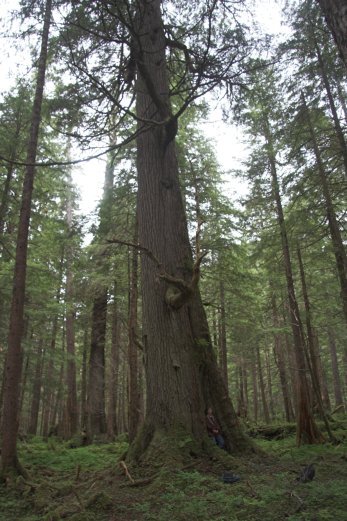
On the way up to the big tree, Ian kept pointing out relatively small trees as the potential big tree, guess I’ve neglected to take Ian into productive forests. Both kids seemed impressed with the tree; Ian climbed into the cavity (mostly because I said that I had climbed in, of course I neglected to tell him until afterwards that I had a bit of help).
We also went up to the falls (very little ice) where we spent most of our time picking through the rocks in the creek bed. Found metamorphosed greywacke (pelite?), some suspicious looking potential serpentine and lots of regular greywacke.
I didn’t get too far getting Deirdre to write up something on the rocks she found in the valley (too many applications to write), but she did come up with a synopsis on the basic rock of our area.
Sitka Greywacke is an extensive unit found predominately on Baranof, Chichagof, Kruzof, and Yakobi islands. The name 'greywacke' is slightly misleading, as the group is formed of both greywacke, a rock made up of poorly sorted quartz and feldspar fragments in a clay matrix, and argillite, fine-grained lithified mud. Particles present in the greywacke are derived from a region containing sedimentary and low-grade metamorphic rocks, as well as volcanics, which were lithified on the ocean floor during the Jurassic and Cretaceous periods, dated by fossils found in limestone-rich portions of the unit. Parts of the unit have been regionally metamorphosed to a low grade, and complexly folded, as well as contact metamorphosed by nearby plutonic intrusions.

Monday, December 21, 2009


Sunrise from Galankin Island (upstairs deck). The sun came up over the mountains east of the Pyramids around 9:35am.

Wednesday, December 16, 2009

November 13, 2009
I got ambitious this evening. Maybe it was the snow that fueled the domestic fires or perhaps it was just another way to avoid work. At any rate, I managed to bake a pumpkin for Thanksgiving pies, started soda culture and at long last I started a batch of wine.
My most recent attempt at beverage fermentation did not go well. The late September batch of soda didn’t ferment at all. Not sure what happened, it seemed like the culture was fizzy and there was sugar in the berries, but the bottled soda was tasty, but without fizz. My best guess at the most likely cause is inadequate cooling of the berry mix before adding the bacterial culture. In other words, I killed the bacteria with very hot juice. Guess I can’t carry on a conversation while brewing, so much for multi-tasking.
Back to the wine; I used 4 lbs of frozen red huckleberries (Vaccinium parvifolium) and blueberries (V. ovalifolium [honest, it was a single species]). I didn’t keep track of the ratio of berry types, but it was mostly red hucks. I loosely followed the amounts called for in a recipe that Michelle Putz and Perry Edwards gave us at the wine workshop. Loosely, in that I used the called for amount of sugar, berries, yeast and water, but left out the yeast nutrient, Campden tablet and acid blend included in the recipe. The recipe was for a completely different huckleberry (Gaylussacia baccata), but maybe it will work well enough. I’m using yeast that Perry gave me; I don’t remember what sort of yeast it is. I mostly followed his guidelines for the yeast “mix in a coffee cup full of water with about ¼ cup sugar, let stand for about 5 hours, and then add to the berry mix. I didn’t quite let it sit that long, more like 4 hours.
I had a plastic bucket with lid (washed and sterilized with boiling water). I added the berries, poured on the boiling water, then added the sugar. Apparently I was supposed to add the sugar later. Whoops. Not doing well following directions, these days. I suspect that adding boiling water to the berries is supposed to help kill the biota on the surface of the berries. I don’t think that the sugar is going to interfere with that process. I decided that the kitchen counter is the best place to leave the bucket, if there is any hope of stirring the juice every day. The counter is getting a bit crowded, in addition to the large vat of pre-wine, there is a jar of soda culture, another of sour dough and a batch of yogurt going. Long live yeast and bacteria!
On the 27th of November, the somewhat fermented juice should be transferred to a glass jug.
Part II
It took me until the 28th of November to assemble the gear I needed for step 2. I thought that buying a gallon glass jar would be easy; proceed to Lakeside or Seamart and buy a gallon of apple or cranberry juice and haul it home (this was supposed to be the hard part). Alas, plastic jugs seem to be the article of choice these days. There was a gallon jar of Gallo wine available at the liquor store, but I couldn’t bring myself to buy it. It seemed a bit weird to buy wine that I had no intention of drinking (okay I’m a snob) and worse to dump it out, so I went home empty handed and stewed for an evening. Fortunately the next day I found a 5 gallon glass demijohn at Rain Country and was able to lug that home. Straining the berries was a bit of slow chore. I sterilized the colander with boiling water, and then ladled the juice into the demijohn via an unsuitably small funnel. The juice was a rich purple red color and I was feeling rather pleased and contented when I discovered the next minor issue. I had found my airlock, but forgot to check for a stopper. No such item lived in the house, but I did find a bit of kids modeling clay in the pantry. So I put the airlock in the demijohn and sealed the edge with clay. This looked pretty good, but I decided it might be better to order a stopper and a new airlock (mine was missing the inner cap). I wasn’t confident that that clay would prevent air from entering the demijohn. The stopper and new airlock arrived a couple of days later and I replaced the cobbled together unit.
Fermentation seems to be proceeding what I hope is a reasonable rate. There are both small and very large bubbles covering most of the surface of the wine. Bubbles of gas (I presume CO2) are escaping the airlock.
The wine is supposed to stay in the demi-john for 3-6 months or the bubbles stop escaping the airlock. Good thing I have plenty of counter space.

Saturday, November 14, 2009


November 13, 2009

I got ambitious this evening. Maybe it was the first snow that fueled the domestic fires or perhaps it was just another way to avoid work. At any rate, I managed to bake a pumpkin for Thanksgiving pies, started soda culture and at long last I started a batch of wine.
The last batch of soda didn’t ferment at all. Not sure what happened, it seemed like the culture was fizzy and there was sugar in the berries. The most likely problem was inadequate cooling of the berry mix before adding the culture. Intense conversations while brewing may not be the best thing for me.
For the wine I used 4 lbs of red huckleberries and blueberries (mostly red hucks). I loosely followed the amounts called for in a recipe that Michelle Putz and Perry Edwards gave us at the wine workshop. I say loosely because I used the amount of sugar, berries, yeast and water, but left out the yeast nutrient , Campden tablet and acid blend included in the recipe. The recipe was for a completely different huckleberry (Gaylussacia baccata), but maybe it will work well enough. I’m using yeast that Perry gave me, I don’t remember what sort of yeast it is. I followed his guidelines for the yeast “mix in a coffee cup full of water with about ¼ cup sugar, let stand for about 5 hours, then add to the berry mix.
I had a plastic bucket with lid (washed and sterilized with boiling water). I added the berries, poured on the boiling water, then added the sugar. Apparently I was supposed to add the sugar later. Whoops. On the 27th of November , I’ll proceed to step 2. One piece of advice that I'll try to remember to follow is to keep a calendar of when to proceed to the next step.