Sunday, January 31, 2010


I got lucky this evening. I brought the camera with me to town this evening, I had given up chasing the owl with a camera for at least a week. I didn't see the owl for 14 days, then saw it again on the 29th closer to the buildings near the dock. On the 29th, it flew across my path (I thought from the ground, but wasn't sure) from near Vern's building to a sitka alder near an abandoned shed.

Tonight the owl was perched about 8-10ft off the ground in a branch of a Red alder. Not a brillant photo, but I was happy enough.

Monday, January 18, 2010

January 14

Walking home through the commons about 9pm I saw a Western Screech owl perched on a short willow branch over the trail. I'd seen an owl in the same spot on the 9th of January and the 8th of December. The branch is about 6 ft off the ground and must afford a pretty good view of where the owl likes to hunt. The owls on this perch seem to be pretty tolerant of traffic, one time I walked slowly right under it without causing it to fly off. This time the owl flew off after a minute or so and landed in a large Red alder near the lake outlet stream. Before it flew off, it was making very soft whistle-like calls, they were quiet enough I wasn't entirely sure it was this bird. As I was approaching the owl, I heard loud, but distant "bouncing ball" sort of call, followed by the softer calls of the near by bird. This call trading went back and forth for a couple of minutes before it stopped and I moved on.


This was the first time I've heard the island owls, typically I see them, often getting pretty close to the birds.


I haven't found any sign of what this or these birds have been eating on or near the trail, but I haven't looked too far. The Western screech owl that lived in the commons a few years back managed to catch a Varied thrush and a Hairy Woodpecker near the trail and left some nice piles of feathers.

I've been carrying the camera back and forth to town in the hope of getting a photo of one of the birds. No luck yet, but I did get some photos of their habitat. The lower photo is of the area to the south of the willow perch.

The vegetation is the commons is pretty similar to a fairly recently disturbed riparian site; Red Alder, Sitka alder, Sitka willow, Elderberry and Salmonberry. There large patches of trailing buttercup and horsetail as well. The commons has a some human detritus and several buildings. Besides birds and insects, I"m not sure what there is for the owls to eat on the island. I don't know of any rodents on the island. I don't think I've heard of anyone catching any in their house or seeing one in the woods. I suppose I could set live traps to see who is out there. There aren't any squirrels, so perhaps the smaller rodents didn't make it over. What we do have are newts. We did have one owl succumb to newt poison.

Thursday, January 07, 2010

December 29th

I decided that it was past time to take Deirdre and Ian up to the west valley of Indian River. The weather was sunny, calm and cool. What better way to spend a sunny day than in the forest? We didn’t exactly get an early start; all of us have shifted to the late to bed, late to rise schedule. We started on the trail around noon. I briefly thought about taking them up through the muskegs and down along the river, but neither kid had rubber boots and I am a bit less confident with the route between the muskeg and the big tree forest. There was very little snow; we saw a few scattered small clumps. The lack of snow made travel pretty easy particularly in the brushy bit just beyond the first bridge. It was pretty quiet bird wise (we were kind of chatty though) except for a dipper singing near the cascades and either kinglets or creepers in a couple of spots.
One of the most striking things we saw was a small bright orange streamlet flowing into the main bluish/clear main channel. There were masses of stringy colonies of what I assume are iron oxidizing bacteria or at least iron accumulating bacteria (I don’t know if the colonies I saw were responsible for the oxidation or just hoarding the precipitated iron). I’m kicking myself for not bringing a small jar with me; it would have been interesting to take a closer look at the critters.
I’m assuming that the iron comes from leaching of soils (spodosols typically leach iron and aluminum) and from weathering of rock (checked with Dave D’Amore on this one who concurred). The Fe2+ is mobile in the soil, Fe3+ not so much. The iron cations interact with negatively charged particles (colloids) and are somehow responsible for colloid movement and soil development around here. I’m hopeful that Dave will supply a bit more information about that point.
Whether the iron is oxidized by the bacteria or the oxygen in the water/atmosphere isn’t clear. Fe2+ →Fe3+ happens pretty readily in aerated solutions when the pH is above 5. The pH of Indian river in a USGS report ranged from 6.5-8.1. So, it could be that most of the oxidation of iron happens at the junction of the low oxygen hyporheic zone and the above ground river or stream?
There definitely are iron associated bacteria present in the stream. One species of freshwater bacteria that oxidizes iron, Gallionella ferruginea, uses Fe2+ as an electron donor (cellular respiration/electron transport . I’m guessing that the oxidation of Fe2+ is coupled with the reduction of NAD+→NADH?
Other iron associated bacteria bind already oxidized iron: sheathed bacteria; Leptothrix, Clonothrix, and Sphaerotilus basically iron oxide (rust ) sticks to the sheaths at their cell surfaces. Hence the orange or brown color of the colonies. Other bacteria and fungi produce siderophores to capture the Fe3+ (haven’t found names yet). Once chelated, the iron can be transported into the fungal or bacterial cells by active transport mechanisms.
One website I found talked about the growth of the mat (if it is the oxidizing bacteria) to the supply of Fe2+ and dissolved organic carbon. Given our soils, I suspect that supply is pretty constant if there is precipitation. Another supply of reduced iron is bacterial reduction of iron in anoxic zones below the river.
Most of my fascination with the iron bacteria manifested itself after the hike as we wanted to get up to the big trees and the falls and back before dark. The following links are some sites I found useful.
General Microbiology
Haw River Assembly

So back to the hike; like I said previously, the lack of snow made travel pretty easy compared to some winter trips I’ve taken, it also made it easy to see the extent of the deer browse on the Blueberry browse. A lot of the plants were around 1ft tall.
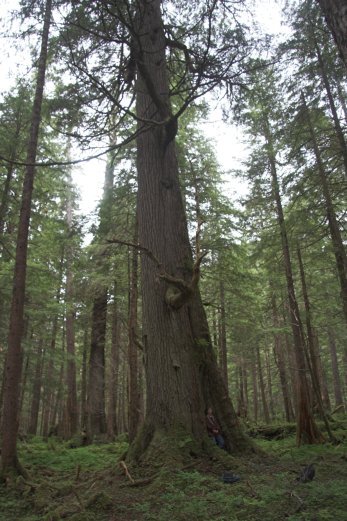
On the way up to the big tree, Ian kept pointing out relatively small trees as the potential big tree, guess I’ve neglected to take Ian into productive forests. Both kids seemed impressed with the tree; Ian climbed into the cavity (mostly because I said that I had climbed in, of course I neglected to tell him until afterwards that I had a bit of help).
We also went up to the falls (very little ice) where we spent most of our time picking through the rocks in the creek bed. Found metamorphosed greywacke (pelite?), some suspicious looking potential serpentine and lots of regular greywacke.
I didn’t get too far getting Deirdre to write up something on the rocks she found in the valley (too many applications to write), but she did come up with a synopsis on the basic rock of our area.
Sitka Greywacke is an extensive unit found predominately on Baranof, Chichagof, Kruzof, and Yakobi islands. The name 'greywacke' is slightly misleading, as the group is formed of both greywacke, a rock made up of poorly sorted quartz and feldspar fragments in a clay matrix, and argillite, fine-grained lithified mud. Particles present in the greywacke are derived from a region containing sedimentary and low-grade metamorphic rocks, as well as volcanics, which were lithified on the ocean floor during the Jurassic and Cretaceous periods, dated by fossils found in limestone-rich portions of the unit. Parts of the unit have been regionally metamorphosed to a low grade, and complexly folded, as well as contact metamorphosed by nearby plutonic intrusions.

Monday, December 21, 2009


Sunrise from Galankin Island (upstairs deck). The sun came up over the mountains east of the Pyramids around 9:35am.

Wednesday, December 16, 2009

November 13, 2009
I got ambitious this evening. Maybe it was the snow that fueled the domestic fires or perhaps it was just another way to avoid work. At any rate, I managed to bake a pumpkin for Thanksgiving pies, started soda culture and at long last I started a batch of wine.
My most recent attempt at beverage fermentation did not go well. The late September batch of soda didn’t ferment at all. Not sure what happened, it seemed like the culture was fizzy and there was sugar in the berries, but the bottled soda was tasty, but without fizz. My best guess at the most likely cause is inadequate cooling of the berry mix before adding the bacterial culture. In other words, I killed the bacteria with very hot juice. Guess I can’t carry on a conversation while brewing, so much for multi-tasking.
Back to the wine; I used 4 lbs of frozen red huckleberries (Vaccinium parvifolium) and blueberries (V. ovalifolium [honest, it was a single species]). I didn’t keep track of the ratio of berry types, but it was mostly red hucks. I loosely followed the amounts called for in a recipe that Michelle Putz and Perry Edwards gave us at the wine workshop. Loosely, in that I used the called for amount of sugar, berries, yeast and water, but left out the yeast nutrient, Campden tablet and acid blend included in the recipe. The recipe was for a completely different huckleberry (Gaylussacia baccata), but maybe it will work well enough. I’m using yeast that Perry gave me; I don’t remember what sort of yeast it is. I mostly followed his guidelines for the yeast “mix in a coffee cup full of water with about ¼ cup sugar, let stand for about 5 hours, and then add to the berry mix. I didn’t quite let it sit that long, more like 4 hours.
I had a plastic bucket with lid (washed and sterilized with boiling water). I added the berries, poured on the boiling water, then added the sugar. Apparently I was supposed to add the sugar later. Whoops. Not doing well following directions, these days. I suspect that adding boiling water to the berries is supposed to help kill the biota on the surface of the berries. I don’t think that the sugar is going to interfere with that process. I decided that the kitchen counter is the best place to leave the bucket, if there is any hope of stirring the juice every day. The counter is getting a bit crowded, in addition to the large vat of pre-wine, there is a jar of soda culture, another of sour dough and a batch of yogurt going. Long live yeast and bacteria!
On the 27th of November, the somewhat fermented juice should be transferred to a glass jug.
Part II
It took me until the 28th of November to assemble the gear I needed for step 2. I thought that buying a gallon glass jar would be easy; proceed to Lakeside or Seamart and buy a gallon of apple or cranberry juice and haul it home (this was supposed to be the hard part). Alas, plastic jugs seem to be the article of choice these days. There was a gallon jar of Gallo wine available at the liquor store, but I couldn’t bring myself to buy it. It seemed a bit weird to buy wine that I had no intention of drinking (okay I’m a snob) and worse to dump it out, so I went home empty handed and stewed for an evening. Fortunately the next day I found a 5 gallon glass demijohn at Rain Country and was able to lug that home. Straining the berries was a bit of slow chore. I sterilized the colander with boiling water, and then ladled the juice into the demijohn via an unsuitably small funnel. The juice was a rich purple red color and I was feeling rather pleased and contented when I discovered the next minor issue. I had found my airlock, but forgot to check for a stopper. No such item lived in the house, but I did find a bit of kids modeling clay in the pantry. So I put the airlock in the demijohn and sealed the edge with clay. This looked pretty good, but I decided it might be better to order a stopper and a new airlock (mine was missing the inner cap). I wasn’t confident that that clay would prevent air from entering the demijohn. The stopper and new airlock arrived a couple of days later and I replaced the cobbled together unit.
Fermentation seems to be proceeding what I hope is a reasonable rate. There are both small and very large bubbles covering most of the surface of the wine. Bubbles of gas (I presume CO2) are escaping the airlock.
The wine is supposed to stay in the demi-john for 3-6 months or the bubbles stop escaping the airlock. Good thing I have plenty of counter space.

Saturday, November 14, 2009


November 13, 2009

I got ambitious this evening. Maybe it was the first snow that fueled the domestic fires or perhaps it was just another way to avoid work. At any rate, I managed to bake a pumpkin for Thanksgiving pies, started soda culture and at long last I started a batch of wine.
The last batch of soda didn’t ferment at all. Not sure what happened, it seemed like the culture was fizzy and there was sugar in the berries. The most likely problem was inadequate cooling of the berry mix before adding the culture. Intense conversations while brewing may not be the best thing for me.
For the wine I used 4 lbs of red huckleberries and blueberries (mostly red hucks). I loosely followed the amounts called for in a recipe that Michelle Putz and Perry Edwards gave us at the wine workshop. I say loosely because I used the amount of sugar, berries, yeast and water, but left out the yeast nutrient , Campden tablet and acid blend included in the recipe. The recipe was for a completely different huckleberry (Gaylussacia baccata), but maybe it will work well enough. I’m using yeast that Perry gave me, I don’t remember what sort of yeast it is. I followed his guidelines for the yeast “mix in a coffee cup full of water with about ¼ cup sugar, let stand for about 5 hours, then add to the berry mix.
I had a plastic bucket with lid (washed and sterilized with boiling water). I added the berries, poured on the boiling water, then added the sugar. Apparently I was supposed to add the sugar later. Whoops. On the 27th of November , I’ll proceed to step 2. One piece of advice that I'll try to remember to follow is to keep a calendar of when to proceed to the next step.

Thursday, November 12, 2009


Visited Totem Park this week during the dry weather to collect lichens for air quality sampling. The target species were Platismatia glauca and Alectoria sarmentosa. Not exactly rare species, but they seemed less abundant when I had limited time to collect the 25 g required.
The first session I collected Platismatia mostly from the westward side of the park. I mostly found it on fallen branches, but some came from the spruce branches overhanging the beach. The protocol allows for collecting Platismatia from branches on the ground as long as the material isn't discolored. There was abundant Usnea on the west side, but not much Alectoria at least not within reach. On one foray into the woods looking for branches, I found a few more Goodyera oblongifolia plants. The plants were in the same general area as the plant I found last year, just a bit further back in the woods. They seemed to be about the same stage of development (no sign of a flowering stalk) and size as the first plant. Goodyera has tiny wind or ground insect dispersed seeds that require fungal infection for growth in the wild. Greenhouse studies say that it takes up to a year between germination and production of the first leaves. I've also gleaned from other sources that it might take up to 3 years before a plant is mature (flowering) . Each rosette only produces one flowering stalk, after the seeds ripen, that rosette dies. Apparently production of new rosettes from the parent rhizome accompanies flowering. Interesting mixture of reproductive strategies. There was a good discussion of Goodyera biology/taxonomy and ecology at this website. It might be interesting to identify the symbionts of these orchids and compare them with what we have found in the local Platanthera species. I'm not confident that I found the first plant in its first year of leafy growth, but if I did and assuming that it needs to be at least 3 years old before flowering, 2011 might be the summer I might find a flower stalk?
I had to return to the park a second time to collect Alectoria. That lichen is more abundant on the east side of the park. Apparently this species deteriorates quickly, so the collections can't be from the ground. There wasn't much Alectoria available and off the ground. Fortunately it is bigger than Platismatia, so I have plenty to send in for analysis.
There were still fungi fruiting in the park; Pholiota alnicola (?), Clavaria (Clavariadelphus) purpurea, Craterellus infundibulformis, Hygrophorus olivaceoalbus, Lactarius alpinus, Panellus serotinus and Pleurocybella porrigens.

Monday, November 09, 2009


November 8
I was fortunate enough to go out to the island Saturday at 4:30 and stay there until 1:30 the next day. It was a rewarding bit of home time both from the stand point of regaining some energy, accomplishing a few things and being treated to some enjoyable sights and sounds.
On one break from writing I went outside to plant some tulips (the latest ever!) and heard the distinct sound of a flock of shorebirds below the house. So decided to venture down the cliff to see if I could be quiet enough to watch them for awhile. Now, I'm not sure if I was actually quiet or if the birds weren't too worried about a large creature above them on the beach. At any rate, I sat and listened for awhile. There were about 120 mixed Surfbirds and Black Turnstones on the rocks; working the Fucus. They would scatter when the occasional big wave covered the rocks. I didn't do so well capturing their periodic flights, but I enjoyed them never the less.
While down there, a flock of about 20-30 Swans flew over headed in the direction of Aleutikina.


Monday, September 14, 2009

It seems like every year I see several fungi that I either haven't seen or haven't noticed previously. This year has not been an exception.

One surprise was finding this salmon colored Laetiporus or Chicken of the Woods near Otter Lake (Goulding Lakes) on Chichagof Island. It was growing on half buried wood on the ground in an alluvial fan with mixed Western Hemlock and Sitka Spruce overstory and a shrub understory dominated by Early Blueberry. There were open areas on the fan with a few Red alder (many senescent) and relatively unvegetated gravel

The salmon color of this fungus was striking, almost glowing on the green background. From a distance I thought this was a Laetiporus, but was a bit more dubious after I saw the white under side. The abundant version of Laetiporus has a bright yellow under surface.
The piece I collected gradually faded to an orange color on the upper surface, but the lower surface remains white.
Arora in Mushrooms Demystified talks about a rare variety of sulphureus, semialbinus, with features that match this fungus. I'm not sure about the fate of this variety as sulphureus is no longer used for North American species.

Michael Kuo (Mushrooom Expert) has a page on a similar featured Laetiporus, cincinnatus, that occurs east of the Rockies and prefers hardwoods. I haven't found a western counterpart as yet, so I might just refer to this one as a variety of conifericola. I'm not sure that the fungus from Otter Lake wasn't growing on buried Red Alder, there were a few in the area
I did find a resource on the web; The Genus Laetiporus in North America by H. Burdsall and Mark Banik that was somewhat helpful.
The only two taxa that I saw listed with a white pore surface was Laetiporus, cincinnatus and L. gilbertsonii var. pallida. Both occur on hardwoods and southeastern Alaska seems far out of range.
I might have to post this one on Mushroom Observer to get a few more leads.


Saturday, August 22, 2009

The road to Fairbanks is rather convoluted for a Sitkan. We started on the MV Fairweather on Thursday; spent the night in Juneau at the Mendenhall Campground (outwash is hard); took the Malaspina to Haines and spent last night at a campground we had visited years ago while taking in the Southeast State Fair.
I haven't spent much time looking around me; the heavy rains and general distraction of keeping things going in the right direction have been a bit of a deterrant.
We did stop at Mendenhall Glacier for a quick photo of Deirdre and to let her look at the rocks from her new perspective. She gets pretty excited by striations and weird textures.
We noticed alot of people hanging out in front of the restrooms; now this isn't unusual in a busy tourist area, but they had cameras and were busily snapping photos. Finally saw a group of fledgling Barn swallows on the ledge just above the Restroom sign. There were 4 when I took the photos; later there was a 5th bird. A parent visited twice while I was watching.
So far this is a three tarp camping trip; one under the tent, one over the tent and one over the eating area.

Sunday, August 09, 2009


Picked a sandwich container of Arnica lanceolata ssp prima at the shore of Lake Rezanof near the old cabin and our camp site. My intention was to do a bit of experimentation with the plant. I was pretty sure that only the flowers were used for medicinal purposes, but didn't want to collect too many in case I was incorrect about that assumption. I also dug up a small clump for the garden.
I had hoped that Janice Schofield's book "Discovering Wild plants" would have a recipe for preparing a cream for aches and pains. No such luck. A bit of research turned up a few articles on preparation of tinctures which can be used to treat bruises (I bruise very easily), bug bites (I was covered) and aches (not usually an issue).
The flowers filled an 8oz spagetti jar a bit more than 3/4 full, then I covered then with cheap vodka, and put the jar in the dark. The Doctor quoted in the Herb Companion article (http://www.herbcompanion.com/Health/Natural-healing-Arnica-montana-Natural-Magic.aspx) gave the following recipe: " 1 part arnica flowers and 10 parts 96 percent alcohol should be put together in a bottle and left for a week, during which the bottle should be shaken. Then the flowers can be removed. It is important that this alcoholic solution must be diluted with water from three to ten fold..."
Seems like my mixture will probablly be on the strong side, so I'll go with the 1 to 10 dilution (or maybe a bit more).
In the same article another person said to leave the steeping tincture in a sunny place for 3 weeks. At this point, I'm going to leave the jar in the pantry while I do a bit more research.
The species most often used medicinally, Arnica montana, is native to Europe and I'm not sure if North American species have been tested in any way for effectiveness.
The Doctor in the Herb Companion article said that the active ingredient in Arnica are Sesquiterpene lactones which seem to inhibit the release of inflammatory mediators e.g. transcription factor NF-kB, which seems to be involved in a number of basic cellular processes besides inflammation.
Sesquiterpene lactones aren't entirely benign; doesn't sound like Arnica should be ingested internally in anything but extremely small doses (homoeopathic sort of doses seem to be okay). Seems like I should be a bit cautious trying this tincture as it could cause contact dermititis.

Thursday, July 16, 2009

"Two little feet to get me 'cross the mountain
two little feet to carry me away into the woods
two little feet, big mountain and a
cloud comin down, cloud comin down, cloud comin down
I hear the voice of the ancient ones
chanting magic words from a different time
Well there is no time there is only this rain
there is no time, that's why I missed my plane"
Decided to refer back to my journal and a Greg Brown song for the third part of "Waste Not Want Not"
This is what I wrote (with some editing)
On day two of of waiting a day for a pickup, Jonathan and I decided to abandon the richness of our shelter for the less than certain chance of a floatplane pick up at sea level. We were motivated by travel plans (me to Glacier bay, Jonathan to Washington and Idaho) and by losing our only way to communicate with the outside world (Barth and Mary made it out in the morning). They left us food and a tent cached at Sisters lake, our job was to get there and hopefully meet a Ward Air plane at 5pm. There is a trail from Rust to Sisters lake, so this didn't sound all that bad and in fact it was quite doable. What is so bad about carrying alot of stuff downhill?
We left the tarp structure standing, the tent up and the less desirable food, garbage and traps up a tree. I somehow managed to fit all of my belongings into the large pack andstrapped the day pack to the outside of it. Jonathan carried the press and the few of his belongings that would fit in a large dry bag/pack, his camera bag and sleeping bag. Then there was the food bag with radio and water bottle; rather heavy, but it needed to come with us.
Paddling across the lake was a bit easier this time; serenaded by Jonathan and at the beginning a loon. The beginning of the trail wasn't terribly obvious,but we did find it. The trail itself was rather tricky, appearing and disappearing at rather inconvenient times. Alas I sent us off on a very wrong turn which added some distance and some totally unnecessary elevation gain. The trip down took much longer than the 1.5-2hours Barth thought it would. The wrong turn and the ridiculously heavy load didn't help. Happily we made it down in plenty of time, found the stashed gear and food, relaxed for a few minutes and then the Cessna arrived.
The float plane was wonderfully warm and dry after that sloppy wet walk.
The ceiling was just barely above 500 ft, we traveled along the outside coast of Khaz then down the outside of Kruzof as Salisbury was full of clouds. Great aerial tour of sandy beaches and survey of trollers on the eve of opening day. We finally made it across Kruzof just north of Mt Edgecumbe.
Mary met us at the Forest Service dock and saw Barth cheering from the fuel dock. It was nice to make it back in time for a cheeseburger, shower, deal with the plant press, laundry and repack for Glacier bay.
Left the house at 4:45, flew to Juneau, had breakfast at the Silverbow, did some grocery shopping and left Juneau for Glacier bay at 11am on board the Iyoukeen.

It turned out to be 10 days of sun
Wednesday, July 15, 2009


Must be time to get up to the Harbor Gavan trail. Ian returned home this morning with these flowers tucked in his pack strap.

Tuesday, July 14, 2009


" Waste not, Want not" part II

There were two reasons to go to Rust Lake, one was simply logistics, Mary and Barth were planning a trip there to look at options for restoring the lake and the other was the band of marble/limestone that occured nearby.

The second morning we set up off up the valley toward one of the carbonate outcrops. Fortunately it was a relatively obvious path, as I had managed to leave the aerial photos and topo behind in my hurry.

We crossed the creek at the second or third gravel bar, found several (14) poppies (not blooming) and further off towards the cut bank, several bones of a long dead bear. Long enough time had passed that there was moss growing on the bones (not fruiting though). Didn't see any knawing on the bones which seemed a bit odd. Thought that a large source of nutrients would have been pretty attractive.

Carried on up the river; through open meadows, another gravel bar with poppies, then dove into the scrubby forest. Not too far along, I tripped over something (very unusual) and saw about 4ft in front of me a very small, spotted fawn tucked under a blueberry bush. . It held very still for a time (I'm not here,really), then scampered off. Felt rather badly about disturbing it, I'm hoping that mom found it again.
Not too much further on, found more of the green appressed Nephroma on another Mountain hemlock and a smallish Sorbus sitchensis.
As we climbed (pretty gentle incline), the vegetation shifted from moderately productive mountain hemlock to mixed conifer interspersed with more typical muskeg/bog areas. The feeling was still of upper elevations; there was plenty of Cassiope mertensiana, Elliotia, and Nephrophyllidium crista-galli.
Like I hinted at in the last post, I had forgotten my aerial photos (I studied them, but how much was I going to remember?) at home and forgot that there was a small lake below the limestone area. Fortunately, we ended up on the open muskeg side of the lake (still had ice) and it was pretty easy getting around. We had a bit of a sun break here (may have been the only one of the day). Once around the lake, we went a bit further along the pass to Patterson Bay, before heading up the much steeper slope to get to the open rock. The rock on the west side of the pass was not carbonate.

Found Polystichum lonchitis and Asplenium trichomanes -ramosum at the base of the mountain. I haven't really decided what to call the place; is it a moutain? it goes above tree line, it seems more like a nunatak, but I'm sure that term should only be used to describe mountains above the icefields. Might stick with nunatak for now.
Going up the slope was interesting (code for slightly scary); I hadn't any prior experience with karst topography, but had read enough to be aware of sinkholes, but not how sharp some of the rock formations were. There was smooth rock, areas that were deeply vertically incised into channels by water (solifluction rills? Grikes?), sinkholes, column-like areas within sinkholes and really sharp mini mountains. Gloves would have been handy as would tougher rain pants. I managed to rip a few holes in my raingear clinging to the rock (I missed the sticky rock of Red Bluff).

From a brief conversation with Deirdre, it seems that the difference in weathering might be caused by differences in mineralization or metamorphism?

The P. lonchitis was abundant; and some of it was as large as sword ferns I'd seen down south. It was interesting that this fern was growing from the lower slopes to the top of the nunatak (in crevices only on top).

There was still alot of snow in large patches, most of which we didn't walk on; it was kind of difficult to tell if there was ground below the snow or if it was a "Snow field of death".

There were alot of interesting plants on the hike, including Anemone parvifolia, Saxifraga oppositfolia, Erigeron humilis, Silene acaulis and a few species of willows (including reticulata).
On top found Geum rossii on a few outcrops; abundant Pedicularis oederi and Oxytropis campestris (or some segregate). There were two species that I hadn't seen around here; Lloydia serotina ( a rather small lily-looking flower) and Thalictricum alpinum (not blooming). Both were growing in very shallow soil over rock. I was anxious to find the latter, earlier in the hike I was conjuring it out of weird looking columbine foliage. This species of Thalictrum is substantially smaller than the columbines, but the foliage pattern is pretty similar.

There were patches of meadow-like alpine plants; Arnia, Geranium, lupine, Columbine and Pink Paintbrush.

The going got much more certain on the top, it seemed that there was a mixture of rock types on the top. Despite the cloudy and frequently rainy weather, the view was pretty spectacular.
Saw a Rock Ptarmigan (?) still in winter plummage, RC thought that the males remain in winter plummage longer than females and kind of act as a distraction for predators.

I was rather relieved when we found an easier way down than the way we came up. I wasn't looking forward to clinging to the sharp rock while finding footing. As it was, I was grateful to accept a hand a couple of times over gaping holes.
"waste not, want not" (Part I)

Rust lake experience turned out to have rather convoluted logistics, marginal weather, but very interesting natural history.

Things started out a bit crazy; Richard and I got to the float dock a tiny bit late and Mary Emerick looking a bit frantic with a phone in her hand. It turned out that RC's partner's father had passed away and he couldn't go on the trip. This left me a bit frantic, it was the second trip in a week that would have been cancelled for some reason or other and I was beginning to feel like I wouldn't get anything done on the Wilderness survey project. After some frantic phone calls looking for a last minute substitute (on another phone, I couldn't find mine), I gave up and went to yoga and ate some pizza. At about 2pm, I found my phone and a field partner, Jonathan Goff. Called dispatch, arranged a flight and off we went. I should have taken the time to get a sat phone and perhaps checked my backpack for the aerial photos and topo map...

We did have half the food, some gear and a boat with oars (no life jackets, no outboard) and landed at the lake without much of an issue. The only question was; when were Barth and Mary going to join us?

The rest of the day, we set up camp; fortunately Jonathan found a large tarp in the trees (not since grad school had I felt so materially wealthy) and two 8ft (?) treated 2x4's and two 2x2's and we built a pretty skookum shelter. My earlier attempts at building a shelter from alder was fairly pathetic, but it kept me entertained.


Rust lake was dammed in 19?? as a reservoir for a power supply for a Sister's lake mining operation. They put a valve that seems to have malfunctioned at some point and Rust lake has a lower water level than it had in the past; there is a noticable band of rock or gravel (bathtub ring) around the lake.

The beach near the campsite had a cover of Racomitrioideae and Stereocaulon (brown apothecia) with scattered small spruce, mountain hemlock and sitka alder. There were deer and goose tracks along the shoreline below camp and a somewhat pesky pair of nesting mew gulls on a large rock in the lake near shore. They didn't seem to appreciate dish washing.

The next morning we decided to try to paddle across the lake to see if Barth and Mary were in sight. Paddling proved rather difficult in the wind, we made it about half way across the lake and decided to explore the south shore instead. Found a population of what seems to be Viola langsdorfii with an impressive amount of variation in size and color. I collected a range of the plants and plan on sending them off for a second opinion.

Adjacent to the lake was some shallow to bedrock muskegy like vegetation and outcrops. Found a Primula cunefolia, Dodecatheon jeffreyi, Elliotia and Pinquincula. Kind of an odd mix for 800ft.

On the far side of the outcrops and muskeg was a tall sedge meadow (we would see alot of tall sedge meadow in the area). Blooming Petasites and Caltha leptosepala, young Veratrum, Frittilaria and Athryrium made up the bulk of the non-graminoids. It turned out that most of the bear sign we saw was in this area. We started around the lake through the moutain hemlock/spruce forest thinking that it might be alot better to walk around than paddle, but decided that leaving the boat would cause alot more hassles than retrieving it. The highlight of the forest was finding large patches of Nephroma on the trunks of a few Mountain hemlocks. It was green; which reminded me of N. arcticum, but the habitat was wrong. I still haven't quite decided about the identity of this lichen. Also noted many Streptopus streptopoides blooming.
Collected blooming Sibbaldia procumbens from the lake shore.


Paddling back to our side of the lake was a real chore, the head wind was not merciful. We couldn't stop paddling or we traveled backwards, much vocalization and swithing of sides was required to make the trip.


Made our first foray up the creek to look at the gravel bar vegetation (poppies, cerastium, oxytropis, dandelions) and set out the snap traps in the meadow in the afternoon in hopes of catching a vole.

It turns out, I'm not much of a trapper, not surprising. Probably should have read up a bit on the habits of voles or brought more traps ( had 11). The next day we found a more heavily used (at least that we could see) vole site on the first gravel bar. We did catch and lose something in that area, at least the trap was knawed).


The lower reaches of the creek had pretty interesting cut banks which gave an indication of the role geomorphology had in determining the vegetation type. We could see a band of peat over what looked like till and in an adjacent rill, we found a nice outcrop of fine silty sediments. Not clay, at least it didn't roll into much of a stable worm.

The vegetation in the the valley along the river was fens (tall sedge) and small patches of Spruce-Mountain hemlock/ blueberry forest . The dominance of tall fens seems to be due to the layer of basal till and the preponderance of small minerotrophic water ways running through the area. It was rather spring-like up there, so I couldn't identify all of the sedges etc, but did see Carex lenticularis, I suspect that there are probably a few more species eg. C. aquatilis. Dodecatheon jeffreyi and Rubus stellatus were in bloom.


I was oddly enthralled with the slumping peat banks along the river. Right across from this bank we found our first and only poppy in bloom. The rest of the plants were on the opposite shore and not quite blooming.


Went to Blue Lake around noon to spend the night to be in position for a breeding bird survey on the 19th of June. After dropping the overnight gear at the gravel bar near the lichen rich alder/nettle avalanche track, we proceeded up the creek with the intention of at least getting around the barrier falls. We went a bit further.
Did stop to check on the lone poppy in the gravel bar and to "measure" the exceptionally large cedar along the trail. My reach is roughly 5ft 3", it seems like the tree must have a diameter of slightly less than 5ft.

The valley beyond was narrow U-shaped one with an interesting mixture (or maybe tangle) of different vegetation; alder thickets, youngish mature forest, boulder piles with subalpine like shrubs and a lovely patch of nettles. Seems like the driving force in succession in this valley is probably avalanches and mass wasting. Wind may have some role, but it seems secondary.

There was one slide not too far past the falls that seemed like it happened this last winter or spring, found some bones and a nice bit of hide of a mountain goat in the snow. Some of the hair is now in my freezer, hopefully, I'll get this spun this winter.

We made our way up the valley using the rather large remaining patches of snow allowed for easier going. Things were pretty springlike (plant wise) beyond the falls. Ranunculus coolyeae was blooming and many of the plants that would have made the walk more challenging were short or buried in snow. Did find an interesting Agrocybe in the alders.

Finally reached a point in the evening that it was time to turn back; it would be well worth a return. The valley felt like we were at the core of Baranof; steep valley walls, rugged topography and a raw kind of feeling. We could see muskegs much further up the valley and Mountain goats not really all that far above us.

Before we headed back I collected a bag or two of young nettles and fiddleheads. Many of the young nettles were purple.


Thursday, June 04, 2009

The warm temperatures and sun over the last 5 days has given things quite a boost. There are darners flying around the garden and a good variety of both domestic and wild flowers blooming in the garden. The crab apples (Malus fusca) are in full bloom on this end of the island.

I haven't spent much time in the garden this year. I've been too busy hiking on the weekends and going in an absurd number of directions. Fortunately the flowers are mostly perennials and seem to be still mostly outcompeting the rhizomatous grasses, chickweed and arabis. I franticly planted most of the vegetable garden before I went to Fairbanks on the 31st and added a few more seeds this evening. Now, there's garlic, horseradish, rhubarb, 3 kinds of onions, french sorrel, potatoes, carrots, cauliflower, lettuce, joi choi, brocoli, basil, zucchini, and a variety of herbs growing or hopefully growing.


The blue and purle columbines (I think that the one in the photo is a flabellata cross) are beginning to hit there peak. I need to stop culling the hybrids that didn't work out. By "work out" I mean have flowers that are pleasing in appearance. There are a few that are down right ugly.


Still catching up.

May 8, 2009 May 9 May 10 May 11 May 12 May 13
Pelagic
cormorant
3 1 2 2 1
Glaucous-winged
gull
2 1 5
Marbled
murrelet
1 4 3 3
Rhinoceros
auklet
2 2 2 2
Belted
Kingfisher
1
Bald Eagle 1 1
Raven 1 1
Crow 3
Weather calm calm, overcast sunny, calm
cruise ships 2 1


May 14 May 15 May 16 May 18 May 19 May 20
Pelagic
cormorant
3
Common
Merganser
3
Mew gull 1
Glaucous-winged
gull
9 5 8 10 1
Marbled
murrelet
5 8 2 2
Rhinoceros
auklet
2
Bald Eagle 3
Raven 2
Crow 4 1
Weather overcast choppy sunny
cruise ships 1 1 3 1

Friday, May 29, 2009

May 1 May 2 May 3 May 4 May 5 May 6 May 7
Common Loon 1
Barrow's
Goldeneye
2 2
Common
Merganser
2
Glaucous-winged
gull
8 9 18 8 2
Gull spp 2 8
Marbled
murrelet
2
Rhinoceros
auklet
6
Bald Eagle 2
Crow 1 1 1 1
weather sunny,
calm
calm,
sunny
calm,
light rain
cruise ships 1


Note that on the 4th, I didn't see any birds on the water portion of the commute. In the evening of the 4th, I saw 3 Rhinoceros auklets, 5 Marbled murrelets, 1 Pacific loon and a Mew gull.

The trail to the dock was pretty bird rich during this week. There were Golden and White crowned, Fox and Song sparrows; scads of Rufous hummingbirds, Nuthatches, Pine siskins, Winter wrens, Robins, Varied and Hermit thrushes.
Orange crowned warblers were singing in the garden on the 4th of May.

A first for the garden (at least that I observed) was an Olive sided Flycatcher. I was sitng on the boardwalk in the sun, talking on the phone when I noticed an odd looking bird in my peripheral vision in a nearby hemlock. Fortunately, it stuck around for several minutes and I could see the dark vest-like pattern on the chest.
The Menziesia and Red alder leafed out on the island during this period.
I seem to have gotten rather behind in the posts again...

April 20 April 21 April 22 April 23 April 24 April 29 April 30
Common Loon 1
Pelagic Cormorant 1 3
Mallards 2 4 2
Barrow's
goldeneye
2 4 4 2 2 4 2
Bufflehead 2 2
Common merganser 2 4 2 4 1 8
Mew gull 2 1
Herring Gull 1
Thayer's gull 1
Glaucous-winged
gull
2 4 4 3 2
Gull spp 30 1 1 1 50
Bald Eagle 1
Raven 1
Shorebirds 60
weather/time 8am low chop
8am
sunny
8am
sunny
8am


I went to Juneau for a few days so there is a gap in the data collection. The flock of shorebirds on the 30th were on a rock near Morne island. Unfortunatelly I didn't have my binoculars along, so I didn't get a good look at them. My best guess is a mixed flock of Turnstones and Surfbirds, but I'm not convinced.
On the 30th (it was sunny and warm) found Pippets, Townsends warblers, Robins, White-fronted geese, 4 semi-palmated plovers, and Sandhill at Totem Park. The crane did a fly over before it landed by the stream side for a short time then flew off toward Jamestown Bay. Fortunately it flew back, but then overflew the beach and headed toward town. It flew over a couple of other times, but didn't land. The call is pretty distinctive, hard to find words to describe the sound exactly. Patience was helpful in this case as the crane eventually returned and landed in the tide flats, so I got a good look.
Also in this period (based on my notebook) I seem to have collected alot of herring eggs for the garden and