Thursday, March 08, 2012


On Saturday the 25th of February, we (Deirdre, I and a temp.park employee, Ami) went for hike up the west valley of Indian river. I wasn't sure when we started up the trail that our destination was going to be in that direction, I had considered the falls, but the off trail experience seemed more compelling. We did not get off to an early start. On sunny Saturday mornings, I'm pretty interested in sipping my coffee while staring out the window at the bird feeder, so we hit the trail close to noon.
I decided to be bold and head up through the muskeg, then cross the river and to the big tree. This was bold because I hadn't gone that way when I was leading, but thought that it would be pretty easy to find my way. Fortunately, I was right.
The muskeg was snow covered, but it wasn't deep and the surface was quite firm. No post holing for us. There were lots of deer tracks in the muskeg and later in the forest. Didn't notice any other tracks though. Where we stopped for lunch was particularly thick with tracks and browsed Vaccinium.
The forest in the valley (like the forest along the lower trail) showed impact from the fall and winter wind storms. There were a number of both snapped trees and tipped trees in the forest, maybe more tipped trees, but I didn't keep careful count. Did notice that both types showed some nice growth of mycelium and/or wood that was chunky and orange-brown presumably due to the action of cellulose degrading fungi.

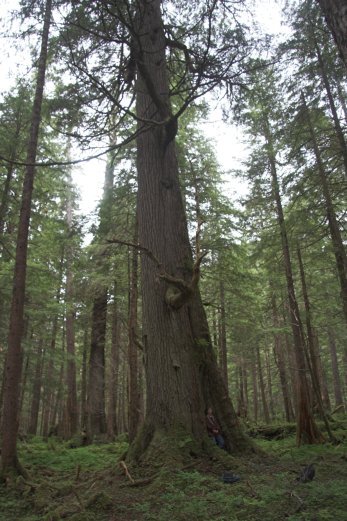
One of the casualties of the storm was the big tree. I found it in the typical way (for me) by thinking I had missed it, then seeing the distinctive large lower branches in the distance. Once we got closer, we could see that there was much tree debris on the ground nearby . It turned out to be the top of the tree. I must admit, I was a bit dismayed, okay bummed. It wasn't a surprise that it was damaged, after all there was a cavity in the center of the tree large enough for two people to stand in, but still, I didn't like to see this sentimental landmark change.

I'm not sure when the top blew out. I haven't found anyone that has been up in that part of the forest recently to help me pinpoint the timing. Haven't given up yet though.
On the way back down the west side of the river, we passed many more downed trees, most of which tipped over. Maybe there will be more Schistostega up there in the future? I wish that I had counted or even better mapped the tipped versus snapped trees as I'm curious which occurs more often in that valley. Guess now I have an excuse to return once again.

Thursday, January 19, 2012

Not exactly breaking news, but it has been cold this week, extremely cold for Sitka. The temperatures started working their way down last Friday, sunny with a temperature range a fairly wintery 24-29). Saturday and Sunday saw a slow downward trend (19-30) and (14-24), with pretty mild winds and sunny skies. Monday and Tuesday were even colder with lows of 8 and 6 respectively. So far, the house seems to have survived the cold spell, the skirting on the east side of the house and having Deirdre at home tending the fire probably makes a huge difference in these conditions. The skiff has not been so happy; the telltale isn't showing water even after a long warm up and slow idle across the bay, fortunately it does not go into automatic slow down due to overheating, but does sound an awful alarm. I tend to associate pretty intense winds with these clear, cold periods, but this time we have been relatively fortunate. Sunday’s weather map showed a fairly minimal difference between the high over the Yukon and the low to our west, todays shows a slightly deeper low. Seems like the winds could be on the increase.

I was curious about previous episodes of single digit weather; apparently I've been in Sitka for at least two pretty cold events; one November 25th and 26th 1985 (lows of 3 and 2) and the other January 30,31 and February 1 1989 (lows of 4,4, and 8).
During the 1985 event, Jim, Dave, Paula and I were on a long Thanksgiving break hunting trip on the Romance. The boat log/journal speaks to the feast (wild Canada goose, pies, sweet potatoes), a sapsucker, deer and sunny, windy cold weather. I didn’t write anything about especially cold weather. By this time we had a small wood stove in the wheel house in addition to the oil stove in the galley, so it was a bit easier to keep the boat toasty in the evenings, but the heat didn’t hold at all once the fire went out. I remember being cold. The overall lack of notes about the extreme cold could be due to cold (19) weather during a hunting trip 2 weeks before. I wrote "clear and cold! NE winds at 50 knots, with higher gusts". I think that an adventure wading into the water up to my thighs at Brent's beach to retrieve a drifting inflatable might have colored my view of the temperatures. The other big difference in my perception might have been the amount of time I spent outside in those years; pretty much every other weekend was a hunting trip during the season, so I probably was a lot more acclimated to the cold than I am these days.
My main recollection of the 1989 event was lack of water. I was very new at water management in those days and a house with four adults (my parents, sister and I) and a baby went through the water supply at a pretty good rate. We were on a catchment system only at the time, so if it was dry, it didn’t take too long before things were marginal. If I remember right we were melting snow in buckets to flush the toilet and had to switch to disposable diapers until we could get more water. Happily, this year we have a half a tank (1200 gallons) of water and only two of us to use it.

Mostly Pine siskins at the feeder during the cold; they seem to be camped out by the feeder. The chickadees and juncos are feeding below the feeder under the tangle of wild apple and salmonberry. I suspect that the energy expended tussling with the siskins for feeder space is not worth the energy cost given that there is plenty of seeds on the ground below.

Deirdre found a dead murre (presumably a Common Murre) on the trail on Monday. Its head and a goodly portion of its breast and belly were missing. When I saw it on Tuesday, one wing was in a nearby shrubby hemlock, but the bulk of the corpse was still on the trail. I’m assuming an eagle killed it and subsequently dropped it on the trail. Not sure if an eagle or raven did the later damage. I’ll probably leave it on the trail to see how long it takes the scavengers to clean it up.

P.S. This morning the murre was gone, it seems that either a bird or a mink found the murre overnight. The wing was still in the tree

Monday, January 02, 2012


This years Sitka Christmas bird count fell on New Year's day which turned out to be a bit unfortunate for a couple of reasons; first it put a bit of a damper on the late night revels and the weather was on the hideous side.
I had planned on counting on Galankin Island and doing as much counting on the water as possible. Last year's trip around the south sound was pretty productive and I was looking forward to seeing lots of birds (and getting really cold) out on the water. Alas it was not to be; the forecast was for a gale with gusts to 40-60 knots with rain and snow turning to all rain. A double alas that the wind actually came to pass, but we were a bit fortunate in the rain (not too bad).
The wind could have been worse, as it was I didn't feel too stupid wandering around in the forest; the reported high gust was 43mph (weather underground) with steady winds between 22 and 29mph. I'm happy to say that there were no trees or large branches down.
I spent the day doing slow laps around Galankin island with one brief foray to the fuel dock to pick up Deirdre who had stayed in town. The trip to town was a bit intense, fairly bouncy around Breast Island and going with it wasn't too bad, but coming back out from the bridge was a bit worse, so ducked behind aleutski and Turning islands to avoid bucking directly into the rather steep and sharp seas. I did get a Rhinoceros auklet, 2 murrelets, surf scoters and longtails on the short trip.
All in all it wasn't a bad day in terms of species seen; 29 (couldn't bring myself to count the kinglets which I heard, what if it was a creeper?) which seems to be pretty similar to most years (last year was 37). Highlights for this year for me was finally finding a Varied Thrush on the island after months of not seeing any on the island, Red polls and seeing the Western Screech owl in the evening. I was also grateful that Pine siskins had found the deck feeder on Saturday.
  1. Pacific Loon
  2. Common Loon
  3. Horned Grebe
  4. Double crested cormorant
  5. Pelagic cormorant
  6. Great Blue heron
  7. Mallard
  8. Harlequin Duck
  9. Surf Scoter
  10. Long-tailed duck
  11. Barrow’s Goldeneye
  12. Common Merganser
  13. Bald Eagle
  14. Mew Gull
  15. Thayer’s gull
  16. Glaucous-winged gull
  17. Marbled murrelet
  18. Rhinoceros auklet
  19. Belted Kingfisher
  20. Common Raven
  21. Chestnut-backed Chickadee
  22. Pacific Wren
  23. Varied Thrush
  24. Fox Sparrow
  25. Song Sparrow
  26. Dark-eyed Junco
  27. Common Redpoll
  28. Pine Siskin
  29. Western screech owl
One thing that struck me this year was that I almost always see everything I'm going to see on the island by 1pm, yet I am still compelled to go out until dark. At least this year, going out after dark was pretty productive.

Sunday, December 04, 2011


Fall happenings on the trail

On the morning walk to the dock I've found two headless Varied thrushes on the trail in the last month. One was pretty close to the Litman's house, the other on the trail between the path to the lake and the creek outlet. The first disappeared during the day, the second remained undisturbed for two days then was covered by snow for a week or so. It was still on the trail after the snow melted (a week or so) until one of the neighborhood dogs found it.

I was fairly convinced that the hunter was a raptor of some sort, since the only thing initially missing was the head. In my experience with local owls, they don't leave much behind besides a small pile of feathers, so I thought it might have been a Sharp-shinned hawk or something similar. Given that the first bird disappeared the first day, I guess it could have been an owl that was interrupted by traffic (the neighbors take their dogs for a walk pretty early) and returned later after we had passed. The area has a mix of Sitka and Red alder with a pretty open feel to it. I've seen several owls in this habitat over the years and last night walking home saw one perched in a branch over hanging the trail where I've seen one before, so maybe this is the thrush eater.
The second bird, I'm not so sure about what killed it. I haven't seen owls in that area, which doesn't mean that they aren't using that habitat. There are bigger conifers and relatively dense understory of blueberry and Rusty Menziesia, so it might just be more difficult to spot them. I certainly could have been an owl that wasn't so comfortable with the narrow trail or a raptor winging through.
Not too far from the second kill site after a particularly heavy wet snow, a hemlock (roughly 10-12ft tall) perched on a nurse log was pulled off its log, presumably by its heavy ice covered branches and the decayed state of the log. The tree is still alive, so it might form a new leader and carry one, but not so sure how long folks will be willing to walk around it.

Thursday, October 13, 2011

A new Suillus (for me)

Received a mushroom identification request this week for a fungus growing on the ground under a "spruce" by Harrigan Centennial Hall. The fungus in the photo I was sent was pretty clearly a Suilllus because it had a veil that was cream colored, lacked glandular dots on the stem and wasn't associated with Larch. The character that jumped out the most from the photo was the brown bruising of the pores, definitely not something I had seen around here.

I tried to run through the key to Suilllus on the Pacific Northwest Key Council site, but the photo lacked information about several key features used in the key (viscidness was the first).

Once I had it in hand the following were the characters that I used to help me identify ( or misidentify) it:
Cinnamon brown cap with very fine fibrous sort of look, it was not viscid, but had a few needles stuck to the cap
Cap turning dark with KOH
Pores yellow, bruising red brown
Veil didn't form a distinctive ring, more of a zone on the stem, there were a few fragments on the cap rim
Stem solid, slowly and indistinctly turning blue-green
Associated with Douglas Fir

I used Mushroom Matchmaker: Mushrooms of the Pacific Northwest (handy synoptic key) as my texts were at home and I was anxious to try the program out again. It pretty quickly took me to Suillus lakei (Yeah, a name!), reading the description, it seemed to fit pretty well and there was enough variation in the photos available on Mushroom expert that I decided that it was a positive identification.
I looked at a few similar species (in my mind) e. g. Suillus caerulescens and dismissed it because of the lack of a distinctive color reaction in the stem of the fungus in question.
I started feeling a bit less certain when I looked at the descriptions and photos in Mushrooms Demystified (Arora) and Mushrooms of the Pacific Northwest (Trudell and Ammirati). For one the lakei were all pretty red and/or fibrillose looking and what reinforced the sense of disquiet was the lack of discussion in the descriptions of species that I thought were similar. Why didn't neither book's discussion of lakei talk about how to distinguish it from caerulescens? What was I missing?

It seems like I was perhaps not paying enough attention to the overall color the cap of lakei (reddish) vs cinnamon brown (caerulescens) that is distinctive enough to rarely cause confusion and the more extensive fibrils found on lakei .

This is a brief synopsis of the small group of Suillus species included in Arora and Boletes in the PNW) that have ring zones, yellow pores that stain brown that are found with Douglas Fir.

S. ponderosa: has a viscid, bright yellow veil and a smooth cap

S. lakei: fibrillose with reddish brown to brick red or pinkish fibrils (occasionally tawny). Viscid when wet, stalk weakly turning blue or green when cut

S. caerulescens: dry, whitish veil, cap smooth or fibrillose, viscid when wet, stalk turning blue or green when cut, sometimes slowly.

I found myself leaning back toward S. caerulescens at this point, the lack of fibrils is starting to seem like a problem. Still a bit uncomfortable with the identification, I turned to another book (A. H. Smiths and H. Thiers monograph on North American Suillus) and was relieved to finally see the difference between these two species addressed.

" It (caerulescens) differs from S. lakei in having a distinct change to blue in the stipe and in having numberous large latifciferous ducts in the context of the cap. ..."

Well, now I have to make a judgment call; are the fibrils more important than the blue reaction? I did pick another sample today and cut it open fairly quickly after picking. It did turn blue, not abundantly, but more so than previously. No real joy yet.
Guess I'll have to look for lactciferous ducts next.

Monday, September 05, 2011

DYCs!

Because there aren’t really that many native yellow composites in SEAK, I don’t often have to use DYC too often anymore. Then one day, I decided it was time to get better acquainted with the weedy species around town.

The two plants that caught my attention were growing in the gravel at the edge of the road to the work float near the island side of the O’Connell Bridge. The yellow ray flowers, milky juice and clasping leaf bases made the genus identification fairly straight forward for both plants; Sonchus or Sow thistle. I wasn’t so sure about the species identification of either plant.

At this point, I should confess that I tend to use keys to identify plants, then look at the descriptions and photos/drawings, so the following paragraphs mostly talk about comparing the keys in various books.

I first consulted Invasive Plants of Alaska which includes a description of perennial sow thistle (S. arvensis ssp. uliginosus) and a paragraph about differentiating one species of annual Sonchus (oleraceus) from the perennial one. This text focused on the long horizontal root systems found in the perennials. There was a photo of the leaf base of the perennial (rounded) and the annual (had longish pointy auricles).

Neither plant had a well developed root system, but they might not if they were first year plants. So I looked for additional references.

To sum up this book focused on the root system and auricle shape. S. arvenis has a large root system and rounded auricles.

The key in Hitchcock and Cronquist also referred to differences in the root systems, but added size of flower heads; perennial are 3-5cm and annuals species 1.5-2.5 cm. Lastly, H & C included gland tipped hairs as a characteristic of S. arvensis (this character turned out to be a bit of a red herring). One of the plants had this character, so despite the flowers being a bit on the small size, I was pretty certain that one of the species was arvensis.

To sum up H& C use root system, flower head size with a mention of glandular hairs.

Because the line drawings didn’t really fit what I had in hand, I decided to consult another reference. FNA treatment

This key begins with leaf base auricle shape, number of ribs on the cypsela (fruits) and introduces the idea that one of the species treated as an annual in the last two references, could be a biennial.

Second decision in this key involved life history as well as stem hardness (…”stem bases soft to hard, herbaceous, often hollow” vs. “stem bases hard, sometimes more or less woody”. I think I’ll emphasize the woodiness issue.

Once a direction is chosen, the leaf blade shape is important in differentiating S. oleraceus from S. ternerrimus (leaf blades more or less deltate to lanceolate with the terminal lobe larger vs rhombic to lanceolate and equal sized.

Between arvensis and palustris; geography helps (Ontario vs. widespread) and the leaf base. S. arvensis is rounded and palustris acute auricles

To sum up the FNA (widespread spp only, this removes ternerrimus and palustris from consideration)

S. asper has recurved auricles and fruit with 3 ribs on each face annual or biennial

S. oleraceous: has straight auricles, and lobed leaves with a larger terminal segment and often hollow stems.

S. arvensis: straight auricles, hard stem base, rounded auricles and dark brown cypsela at maturity.

Although I already had a bit more information than I wanted, I decided to consult another favorite reference; Anderson’s Flora of Alaska

Although there was common ground between this and other treatments, another new character came into play; involucres bract length. Also, this key indicated that the annual species could have stipitate glands.

S. arvensis: perennial, involucre bracts more than 14mm long in fruit, pubescent with stipitate glands

S. asper:annual, involucres less than 14mm, leaves with sharp and narrow pointed teeth, cypsela not wrinkled, but longitudinally nerved

S. oleraceus: annual, involucres bracts less than 14mm, leaves sharply and broadly toothed, lyrate pinnatifid (handy character), cypselae transversely wrinkled and longitudinally nerved

I had one last reference at my disposal; the Illustrated Flora of British Columbia . Fortunately the descriptions fit in pretty well with those found in H &C and Anderson.

S. arvensis: perennial, heads 3-5cm

S. oleraceus: annual or biennial: flower heads 1.5-2.5, cypselae several nerved and wrinkled

S. asper: annual or biennial, flower heads 1.5-2.5 cm, cypselae several ribbed, not wrinkled.

The handy thing about these taxa is that there doesn’t seem to be any noticeable disagreement in the taxonomy, just a bit of variation on which characters might be useful and a bit of haziness about how variable the presence/absence of certain character (glandular hairs).

So the synopsis of all keys

S. arvensis: perennial, straight auricles with rounded bases, may have woody stems, they may also be hollow, heads 3-5cm stipitate hairs present on the flower stems, and dark brown cypselae at maturity

S. asper: annual or biennial, stems not woody, may be hollow, leaves with sharp and narrow pointed teeth recurved auricles. Flower heads 1.5-2.5 cm and involucres bracts less than 14mm, fruit with 3 ribs on each face, not wrinkled

S. oleraceous:, annual or biennial, stems not woody, may be hollow. Leaves sharply and broadly toothed, lyrate pinnatifid, auricles straight, cypselae transversely wrinkled and longitudinally nerved

At this point, I’ve decided that for unambiguous identification (at least the first time around) I need mature seeds.

Back to the actual plants in hand; both have flowers less than 3cm (but neither are really fully open). Neither root system is obviously forming horizontal branches. The fruit aren’t fully mature, I can see ribs, but it isn’t clear if they are or will be wrinkled

One has rounded auricles, some stipitate hairs and very pointy large teeth on the leaf margins, the leaves are also darker and thicker. (I’m going with S. asper)

The second has straightish auricles with pointed bases, no hairs and less menacing teeth, the leaves are lyrate pinnatifid (like a dandelion) with a larger terminal segment. (going with S. oleraceus)

Saturday, May 14, 2011

About every ten years a bear makes its way to Galankin island. This year a 3 or 4 year old (200 lb+) bear wandered to Bamdoroshni, then swam across the channel to visit us. A neighbor saw it come ashore near the cable landing on the west side of the island.
It was next seen in the lawn at a house on the south end of the commons. From there it worked its way south along the shore past Litman's then went up the cliff from the transformer for my lot. There wasn't any sign of it sticking around the house though.
From Phil Mooney we heard that the bear had swam to Morne then to Kutkan Island. Fish and Game attempted to capture it so they could collar and move the bear, but couldn't get a safe shot. Deirdre and I saw the bear later in the day swimming near Kutkan island, then it climbed ashore.
We kind of relaxed out here for a day, but last night the bear reappeared at the Pendell's house (the beach near the deck), they scared it off, then it went to the Goffs (on the porch at the front door) and was shooed away. This morning we had a call from the Litman's reporting the bear was in their garden, then it wandered to the cabin and disappeared. It sounds like it also visited the Rush's island. At some point, it wandered up here and tore into the rhubarb, riffled through the compost and moved the mink trap (no bait). We searched the rest of the garden (banging our pot lid) but didn't find any other sign or tracks.


Tuesday, May 10, 2011

Douglas Maple (Acer glabrum var. douglasii) is a deciduous tree that I mostly associate with Peril Strait and Shaman Island in Juneau. Arctos has a few records (Thatcher Point on Catherine island, Sitkoh Bay on Chichagof, Chaik Bay, Pybus Bay and Young bay on Admiralty island and Port Protection and Dry Pass on POW.

I first encountered maples in Alaska in 1981 near Neka Mtn on a limestone outcrop (other plants from the site include Polystichum lonchitis, Polemonium pulcherrium, and Asplenium trichomanes ramosum (viride) on a trip to the Eva islands on the Romance. That lone maple had a large canopy overhanging the beach. Over the years I’ve noticed a few trees along the Peril Strait shore (Lindenberg head, near Todd) in the fall when the leaves had turned bright yellow, but it encounters with native maple are rare for me.

On a trip to False Island this last weekend, I was lucky enough to find another one. Searching for plants wasn’t the goal of the trip, we were there to set up 4 deer exclosures to try to get at the effect of deer on vegetation in treated clear-cuts (thinned or gapped). At the end of the first day we were close to a beach and decided to spend a few moments on a sunny beach (young growth tends to be a bit dark). Fortunately, I can’t seem to resist walking down a beach and so found the maple. What drew me in was the luxurious growth of Lobaria pulmonaria on the trunks. It was only later that I noticed the opposite twigs (no leaves yet). Besides the Lobaria, the trunk had healthy growth of Metzgeria, Porella, and a bit of Ramalina (sp).

This small maple tree (to 5 m in Anderson and 10m in Pojar) is easy to recognize as such, it has pretty typical looking lobed leaves and samaras that most people associate with the genus. Characteristics that separate this variety of maple from the species include; red stems and shallowly lobed leaves with lobes > 6cm across. The flowers are yellow-green (not that I’ve seen them) as are the young v-shaped samaras.

Douglas maple is reported to be dioecious (separate staminate and pistillate flowers on the same plant), it seems like the ratio of male to female flowers on a given plant might be variable. The seeds are wind dispersed and reportedly have limited viability (?) and require a stratification period.

E-Flora BC has a nice photo and write up for this species.

Chris is about 6'4"

Thursday, April 28, 2011


I found the first Early blueberry (Vaccinium ovalifolium) blooming on the island on March 11. There are still early blues blooming (top photo), but many are on their way to being fruit. The now synonymized Alaska blueberry (Vaccinium alaskense) has been blooming for about a week. I haven't done a survey of flower color on the island, but the red ones do seem to be more abundant.
I've started tagging the blooming plants with labeled flagging so I can track the plants through to fruiting. I've never been convinced that the berry color is consistently darker in the Alaska blueberry, but that could be because I not sure which plant is which by the time they have fruit. I'm also hoping to collect a few leaves from each plant for DNA extraction/analysis to see if there is a consistent molecular difference. The work from last fall is a bit inconclusive as yet.
Golden crowned sparrows and a Hermit thrush have been on the island the last few days.

Sunday, April 24, 2011


I've had a few posts planned this spring about trips and what is blooming when, but they don't seem to be materializing just from thinking about writing them. Strange.

I did have the opportunity to go to Three Entrance Bay on Friday with Scott Harris and Sandra Lindstrom (visiting phycologist). We had a couple of short hours on the island so that Sandra could collect taxa of interest to her and I could soak up as much information as possible. I need a seaweed refresher a bit more often than once every 4 or 5 years.
My eyes were pretty focused on the algae and my ears on the sounds of a Common loon, winter wren and a Varied thrush or two. I'm almost embarrassed to to say that I hardly noticed any invertebrates, yes there were black turbans, a gumboot chiton, green anemones, ochre & sunflower stars and a black katy, but I'm pretty sure that another person would have noticed many more. My eyes were feasting on the chlorophyll rich kingdom. The seaweeds look so lush this early in the year, that it was hard to see anything else. There wasn't herring spawn in that bay or outer coast, so it was easy to see all the features of the blades.
A few algal highlights for me was tasting the Alaria marginata (excellent), it seems like it would be a nice complement to the black seaweed. Alaria has the added feature that each blade is larger and may not be in as high of demand. Another was the Tokidadendron bullatum, a delicate little red alga which tends to get beat up a bit over the season, so early is best. One deeper tide pool had the sides covered with Monostroma grevillei (Sea cellophane) and the center with large tufts of Palmeria mollis and coral seaweeds.
The photo on the right is a bit odd, but shows the iridescence of Mazzaella phyllocarpa, a red alga. It is probably relatively common, but isn't so easy to notice except when the light/angle is right.
Crowberry (Empetrum nigrum) was blooming on the rocks.

Monday, March 14, 2011


The below freezing temperatures were behind us for a couple days last week. It might have been Monday that it was sunny and I managed to get to town early enough to walk to work. Rewarded with the sight of some early blooming crocuses. These were benefiting from a large heat sink (building and pavement) and a southern exposure. The latter doesn't seem to be enough to bring the crocuses in my garden out of the ground.

Saturday, March 05, 2011


The return of warm weather over the last couple of days brought out a couple of birds that I haven't seen for several weeks. I flushed a snipe was in the small creek in the commons (the camera was safely tucked in the back pack) this morning on the way to town. This evening was lucky enough to spot a Western screech owl on a very short branch of a Red alder in the commons. It was near the two larger shops where I saw I've seen the last few birds.

Thursday, February 17, 2011


I've been counting birds on my commute between island and Crescent harbor again this fall and winter. It took awhile for me to get motivated this fall as there just weren't that many birds to count in September. I've been fairly faithful about counting since early October, keeping the data in a daily calendar instead of a spread sheet. The data entry will no doubt be great fun.

For at least a month now, I've been seeing birds that I couldn't quite make up my mind about. They were definitely alcids of some sort, just hadn't a good enough look at to decide which one. At first they reminded me of guillemots, just lacking the white wing patch. Some sort of murre made the most sense based on the features I could see. Given that winter Common murres have a distinctive black line on their cheek and winter Thick billed murres have a mostly black head, I decided that the mystery birds were most likely winter Thick-billed murres. I saw or thought I saw white on the chest so decided that these birds weren't in breeding plummage.
This last week, I've managed to get close enough to get a few photographs. I'm not sure about all of the birds I've seen the last month, but the birds in the photo seem to be Common murres in breeding plumage. The bill is thick, but doesn't seem to be the quite the right shape, the flanks are streaked and I'd be hard pressed to describe this bird as blockier than the rest of the Common murres that I've seen.
About half the birds I'm currently seeing on the commute are clearly winter plumage Common murres and the other half the same species in breeding plumage or possibly Thick-billed in some cases. Given that the birds reminded me of guillemots (all black chest) it might be safe to assume that most of the birds were breeding Common murres. Hard to say for certain though.
Now I'm pretty curious about the timing of plumage change in murres. Does it start this early most years or is it pretty variable? Guess I should add notes about plumage in the future.

Tuesday, February 15, 2011


Finally managed to get up to the Upper Cross trail sampling site to change out the ibutton early in the afternoon. The trail was crunchy with ice and as I walked up the trail through the woods, Varied thrushes (at least 20) flew up and away from me. I was a walking illustration of a bird plow. Also saw several juncos and Pacific wrens, 2 Hairy woodpeckers and a Song sparrow. Heard Pine siskins, Crossbills, Chickadees and Kinglets.
I hadn't been in the Gavan site since I put out the ibuttons out on October 28th, so I assumed that it might take awhile to locate them. I was correct, in fact I was getting worried that I wouldn't find it in the time I had available. So in the interest of finding the tree again, I took a few photos.


Monday, January 03, 2011


The main commons on Galankin island looks like a place recovering from intense industrial activity. In fact the land is more the equivalent of newly deglaciated as most of the area is fill related to the quarrying of rock for runway expansion in the 1960s. I'm not positive if the fill changed the shoreline of the island significantly or if the fill was just to even out the access to the quarry.
The vegetation is mixture of native and non-native pioneer species: Alnus rubra, A. viride var sinuata, Salix sitchensis, Rubus spectabilis and a few very sad looking Picea sitchensis and Tsuga heterophylla. The herbs include: Ranunuculus repens, Veronica americana, Aruncus diocus, Equisetum varigatum, Heracleum maximum and several species of Carex.

There is a pretty wide footpath through the commons that is part of the trail system connecting the common dock to most of the island lots. There are also 2 large, functional but ramshackle sort of buildings, and a couple of sheds filled with semi-abandoned long-line gear and outboards.

There is a small creeklet from the lake that enters the ocean via the lot on the south end of the commons.

Besides being an interesting place to look at plant succession, the commons has been a great place to see a good variety of birds. The mixture of vegetation, open ground, puddles and the small creek draining the lake seem to provide a variety of food sources and cover. Last fall I stalked Western Screech owl(s) in the commons, but this year I'm seeking Common snipe.
This isn't the first year I've seen snipe in the commons, the creek and brush seem to be to their liking. Typically I see a single bird that disappears mid fall, but this year I've seen multiple birds and they seem to be sticking around (or surviving?) longer. The high count was 4 birds on the 5th of November. The last time I saw a single snipe was the 30th of December.

I found the snipe in the typical fashion, that is getting very close without seeing them, snipe exploding into the air, and me jumping out of my socks. I have tried walking slowly and quietly while watching/looking carefully while I walked through the commons to see if I could manage to get a bit closer before they flushed. These efforts have met with a variable amount of success. Snipe are really hard to see for those of us that rely on a bit of movement to see well camouflaged birds. They also are really good at holding still until the last second. The best I've done is when a flock of juncos were working the ground. The juncos weren't spooked or were at least more tolerant of my walking. This time the snipe walked out of view behind the brush. Trying to get closer was not so successful.
I was kind of hoping to get a photo of a snipe, so I've taken to walking with my camera ready through the commons. No photos of snipe yet, but some great blurry "art" photos of shrubs.

Monday, November 08, 2010


Armillarias seem to be one of the mushrooms that are found toward the end of the fall mushroom season. Not that they don't fruit earlier in the year, but that they seem to keep fruiting when most other species have given it up for the year. Although they fruit abundantly and don't get as gushy as say a Russula would with the heavy rains of October, individually they don't seem to hold up as long as other species, e.g. Golden chanterelles. The Armillarias seem to get mushy in a couple of weeks or less, while the Golden chanterelles seem to last for upwards of two months (it was very hard not picking the one near the trail to the house. I'm happy to report that the neighbors also resisted in the interest of learning just how long one of these fungi would hold up.


The mushrooms in the photos were fruiting in the lawn of the Crescent harbor green strip. The yellower ones were part of a large group fruiting under a couple of large Red alders and near a spruce tree near the basketball court. The darker red brown one was near the green sign between Lincoln St. and the basketball court.
The green sign individuals were growing in fairly tight groups, but not truly caespitose (not fused). They are darker, not striate at the cap margin and have fairly cobwebby veils that leave a ring zone on the stem. The caps had small dark fibrils or what might be called very minute scales. The stem base seems a bit bulbous, not not extreme. I cut cross sections of the gills and searched in vain for clamps at the base of the basidia.

The yellow-brown ones are both lighter in color and a bit different hue. The cap margin is noticeably striate. The veil didn't seem as cobwebby, but I didn't find many that still had intact partial veils. The other important feature is the fusion of the stem base. There were several groups of two or three in the lawn with stems fused at the base. There were minute dark fibrils, but nothing terribly noticeable without a dissecting scope.

In Trudell and Ammirati's Mushrooms of the Pacific Northwest there is a fairly accessible discussion of the species that are known to occur in the PNW which I'll summarize:

A. nabsnona: smooth reddish-brown cap, pale upper & dark lower stipe, not cespitose, hardwoods
A. ostoyae: dark scales on cap, strong brownish ring, stipes often fused in clusters or bases enlarged, conifers and hardwoods
A. sinapina: slightly smaller cap than ostoyae, more of a cobwebby veil, cespitose in smaller clusters than ostoyae, usually with conifers
A. gallica: pinkish brown color, white cobwebby veil, bulbous based stipe, not cespitose, hardwoods
Based on this book, I'm leaning toward A. sinapina despite it being fond of conifers. How far do away can the conifer be? Does buried conifer debris work? Trudell and Ammirati note in the text that ostoyae and sinapina can be difficult to distinguish from one another, so I'm not betting my savings on this identification.

Then there is the key to North American Armillarias posted by Tom Volk. There are a few differences in species options; no ostoyae, add in solidipes and NABS XI.

We can eliminate nabsnona (no clamps seen), NABS XI (lacks double ring), and solidipes (ring isn't thick, no scales). The character used to distinguish between gallica and sinapina, is the size of the annulus cells. I did find some that looked larger, but haven't managed to get the micormeter and slide in the same location as yet. A. gallica is rare in the west, so it is probably less likely to be in the green.
The treatment in Mushrooms Demystified groups all of the species in Armillaria mellea group so wasn't of much help in this case.

Thursday, November 04, 2010


Hygrophorus pacificus

Fruiting near the entrance road to UAS and Mt. Edgecumbe hish school for at least the last month is a species of Hygrophorus that seems to fit H. pacificus. The mushrooms form a rather large group (about 70 individuals at one time) on the grass under a row of Sitka spruce. The are gregarious, and often quite close together, but I didn't see any stem fusion.
Characterisitcs:

Caps to 7cm across, slightly to moderately visicid and pale orange yellow to very pale yellow orange at the margins and strong yellow brown at the center ((ISCC-NBS color names).
The caps are convex when young, then upturned and a bit wavy when mature. The cap tissue doesn't react with KOH.
When dry the entire cap turns a medium brown (58)

The gills are pale cream, waxy and widely spaced and slightly decurrent. The gill trama is divergent (managed to get a decent cross section).
The stems are not viscid, cream in color without any noticeable surface features. The longest are close to 5cm tall.

The mushroom was somewhat aromatic, not almond-like though.
It keys out fairly easily to H. pacificus in both Arora and in the Pacific Northwest Key council site and the characteristics agree with the descriptions I found in the Hesler and Smith monograph.

Friday, October 08, 2010


These two photos of Bear Mtn were taken from just east of the Galankin Island dock. The first on the 6th, the second this morning. The weather is cooler at sea level as well, I've been building fires in the wood stove for about two weeks now. This year I'm trying to primarily use wood instead of electricity, not because of the cost, but because I'm finding the ritual of building a fire when I get home to be rather enjoyable. Good thing Ian chopped a lot of wood when he was home otherwise, this ritual might not be so easy to maintain.

Saturday, May 29, 2010


On the third day of the trip we left Suloia bay to try yet again to venture up the outside coast of Khaz peninsula. We quickly figured out that was not happening. I had already lobbied to walk to Sea Lion cove if we had to wait another day (we had already visited the bad weather acessible parts of the wilderness). I had two excuses; it was a good way to spend a day waiting for the weather and I hadn't been there since I carried my then 9 month old daughter (now 22 ) on my back. It had clearly been way too long since I had been there.

The trail is in pretty good shape, I probably didn't need my boots except to get in and out of the skiff in the bay. We did notice that a bear had been digging under and taking bites (?) out of the boardwalk in a few places in the muskeg closest to the trailhead.

There was an impressive pile of obviously collected plastic garbage near the junction of the trail and the beach. Perhaps it is destined to get picked up?


There were a number of flowers blooming on the beach: Fragaria chiloensis, Arabis hirsuta, Carex macrocephala and Dodecatheon pulchellum and my favorite grass, Hierochloe odorata (by whatever name it goes by these days).
Calypso bulbosa was blooming under the spruce trees (near the surf board cache). It was interesting that we didn't see this orchid on the other uplift beaches we visited.


I spent some time with my nose in the uplift beach meadow looking for Botrychium, where I actually found it was right beside the trail.
There were several plants, B. spathulatum, all under 5 inches tall on both sides of the trail.

I suspect there is more of it growing further down the beach, but our time was limited, so didn't get to look on this visit. Given how quick the walk is to this beach, I really need to visit a bit more often.


We saw a large group of what was probably Sanderlings, one Dunlin and a Black bellied plover on the beach.


Day two of the West Chichagof trip: We woke up to much calmer conditions, so we made another attempt to head up the coast to Khaz Head. Once again we decided it was prudent to turn around not too far outside Fortuna Strait.

At the beginning of Fortuna strait (from Leo's) there is an intriguing looking beach on the northwest shore. Since we couldn't proceed north, we opted to stop and check it out. The bight has a large kelp patch and the swell can make its way in, but it was okay for the c-dory.

The beach landing was alot less bumpy for the kayaks than it was at Leo's anchorage and it looks like the site is used regularly by kayakers making their way north. Scott pointed out that kayakers could see the ocean conditions from the camp making it an ideal spot.

There were holes about a foot wide and 6-8 inches deep in the gravel just above the log line. In some of the holes it was evident that a bear (or more) had has been digging Heracleum maximum. Some plants were mostly dug out others just eaten to the base of the leaves. We found scat with alot of gravel in it, not something I've noticed before.
Draba hyperborea was blooming on the rocks, no Calypsos lurking under the trees here., but there were a few new shoots of Coral root.
We motored on to Suloia and hiked up the 1 mile of trail to the lake. I had assumed that the trail followed the creek, but not so. Lots of plants were blooming in the muskeg including Andromeda polifolia and Coptis trifolia. Saw one Pergrine falcon and many swallows over the lake.
The inner anchorage was suitable for the C-dory, seems like a spot to check out in the future with a larger boat. Nice show of Dodecatheon pulchellum and Ranunuculus occidentalis flowers in the estuary meadow. We had a much more restful night at anchor.