I decided that it was past time to take Deirdre and Ian up to the west valley of Indian River. The weather was sunny, calm and cool. What better way to spend a sunny day than in the forest? We d
 idn’t exactly get an early start; all of us have shifted to the late to bed, late to rise schedule. We started on the trail around noon. I briefly thought about taking them up through the muskegs and down along the river, but neither kid had rubber boots and I am a bit less confident with the route between the muskeg and the big tree forest. There was very little snow; we saw a few scattered small clumps. The lack of snow made travel pretty easy particularly in the brushy bit just beyond the first bridge. It was pretty quiet bird wise (we were kind of chatty though) except for a dipper singing near the cascades and either kinglets or creepers in a couple of spots.
One of the most striking things we saw was a small bright orange streamlet flowing into the main bluish/clear main channel. There were masses of stringy colonies of what I assume are iron oxidizing bacteria or at least iron accumulating bacteria (I don’t know if the colonies I saw were responsible for the oxidation or just hoarding the precipitated iron). I’m kicking myself for not bringing a small jar with me; it would have been interesting to take a closer look at the critters.
I’m assuming that the iron comes from leaching of soils (spodosols typically leach iron and aluminum) and from weathering of rock (checked with Dave D’Amore on this one who concurred). The Fe2+ is mobile in the soil, Fe3+ not so much. The iron cations interact with
 negatively charged particles (colloids) and are somehow responsible for colloid movement and soil development around here. I’m hopeful that Dave will supply a bit more information about that point.
Whether the iron is oxidized by the bacteria or the oxygen in the water/atmosphere isn’t clear. Fe2+ →Fe3+ happens pretty readily in aerated solutions when the pH is above 5. The pH of Indian river in a USGS report ranged from 6.5-8.1. So, it could be that most of the oxidation of iron happens at the junction of the low oxygen hyporheic zone and the above ground river or stream?
There definitely are iron associated bacteria present in the stream. One species of freshwater bacteria that oxidizes iron, Gallionella ferruginea, uses Fe2+ as an electron donor (cellular respiration/electron transport . I’m guessing that the oxidation of Fe2+ is coupled with the reduction of NAD+→NADH?
Other iron associated bacteria bind already oxidized iron: sheathed bacteria; Leptothrix, Clonothrix, and Sphaerotilus basically iron oxide (rust ) sticks to the sheaths at their cell surfaces. Hence the orange or brown color of the colonies. Other bacteria and fungi produce siderophores to capture the Fe3+ (haven’t found names yet). Once chelated, the iron can be transported into the fungal or bacterial cells by active transport mechanisms.
One website I found talked about the growth of the mat (if it is the oxidizing bacteria) to the supply of Fe2+ and dissolved organic carbon. Given our soils, I suspect that supply is pretty constant if there is precipitation. Another supply of reduced iron is bacterial reduction of iron in anoxic zones below the river.
Most of my fascination with the iron bacteria manifested itself after the hike as we wanted to get up to the big trees and the falls and back before dark. The following links are some sites I found useful.
General Microbiology
Haw River Assembly
So back to the hike; like I said previously, the lack of snow made travel pretty easy compared to some winter trips I’ve taken, it also made it easy to see the extent of the deer browse on the Blueberry browse. A lot of the plants were around 1ft tall.
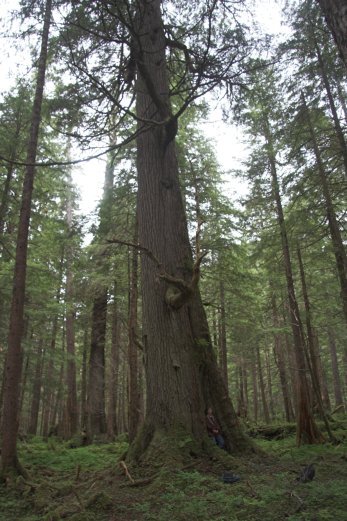
On the way up to the big tree, Ian kept pointing out relatively small trees as the potential big tree, guess I’ve neglected to take Ian into productive forests. Both kids seemed impressed wi th the tree; Ian climbed into the cavity (mostly because I said that I had climbed in, of course I neglected to tell him until afterwards that I had a bit of help).
We also went up to the falls (very little ice) where we spent most of our time picking through the rocks in the creek bed. Found metamorphosed greywacke (pelite?), some suspicious looking potential serpentine and lots of regular greywacke.
I didn’t get too far getting Deirdre to write up something on the rocks she found in the valley (too many applications to write), but she did come up with a synopsis on the basic rock of our area.
Sitka Greywacke is an extensive unit found predominately on Baranof, Chichagof, Kruzof, and Yakobi islands. The name 'greywacke' is slightly misleading, as the group is formed of both greywacke, a rock made up of poorly sorted quartz and feldspar fragments in a clay matrix, and argillite, fine-grained lithified mud. Particles present in the greywacke are derived from a region containing sedimentary and low-grade metamorphic rocks, as well as volcanics, which were lithified on the ocean floor during the Jurassic and Cretaceous periods, dated by fossils found in limestone-rich portions of the unit. Parts of the unit have been regionally metamorphosed to a low grade, and complexly folded, as well as contact metamorphosed by nearby plutonic intrusions.
On the way up to the big tree, Ian kept pointing out relatively small trees as the potential big tree, guess I’ve neglected to take Ian into productive forests. Both kids seemed impressed wi
 th the tree; Ian climbed into the cavity (mostly because I said that I had climbed in, of course I neglected to tell him until afterwards that I had a bit of help).
We also went up to the falls (very little ice) where we spent most of our time picking through the rocks in the creek bed. Found metamorphosed greywacke (pelite?), some suspicious looking potential serpentine and lots of regular greywacke.
I didn’t get too far getting Deirdre to write up something on the rocks she found in the valley (too many applications to write), but she did come up with a synopsis on the basic rock of our area.
Sitka Greywacke is an extensive unit found predominately on Baranof, Chichagof, Kruzof, and Yakobi islands. The name 'greywacke' is slightly misleading, as the group is formed of both greywacke, a rock made up of poorly sorted quartz and feldspar fragments in a clay matrix, and argillite, fine-grained lithified mud. Particles present in the greywacke are derived from a region containing sedimentary and low-grade metamorphic rocks, as well as volcanics, which were lithified on the ocean floor during the Jurassic and Cretaceous periods, dated by fossils found in limestone-rich portions of the unit. Parts of the unit have been regionally metamorphosed to a low grade, and complexly folded, as well as contact metamorphosed by nearby plutonic intrusions.

