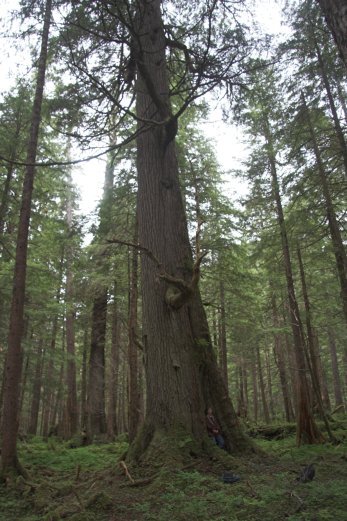
Indian River Falls
Jeanne Stolberg and I went on our annual hike to Indian River falls. Typically we go during spring break, but weren't able to do so this year. I may opt to permanently move the traditional hike to June as today was especially nice.
We started out around 9:30 in somewhat cloudy, but warm weather. Made reasonable time to the first bridge, then started ambling a bit after that. We didn't see anyone else on the trail until 3/4 of the way to the falls.
The slide area about 5 minutes from the falls has had some recent activity. The relatively unvegetated area of the slide is about 60ft wide, full of snow and covered with dirt and some plant debris. Haven't been able to determine when the most recent slide occured, not that I've asked too many people.
There are more Polystichum andersonii along the trail than I remembered, but it has been awhile since I've been to the falls in the summer. Maybe I've only been to the falls once in the summer? Anyway, several of the P. andersonii had growing buds at the end of last year's fronds. Most of the bud fronds were less than an inch tall, did see one about 4 inches tall. Not sure if more than one bud will grow from each frond or if the first to grow excretes some sort of chemical to inhibit growth of the other buds. Could easily envision a population of P. andersonii colonizing an unoccupied space, each old frond producing a few new plants around itself. It would be interesting to see if one could start a colony from one or two plants. According to FNA, P. andersonii is an allotetraploid resulting from P. munitum and P. kwakuilti. There seems to be a certain amount of variation in the division of the pinnules of the fronds, but I haven't been able to conjure any of the local ferns into P. kwakuilti.
The Polystichum (at least braunii and andersonii) have an interesting way of developing. Like Lady ferns, they start as a fiddlehead, but go through a bit of a backbend phase before they become totally erect. That is the base of the fronds is erect and the tips are reflexed away from center and the tips are curled up in a fiddlehead.
The falls, like the river had alot of water. Where we have eaten lunch the last few years was under water. There was a debris dam across the river below the falls. Thought that a dipper was using the dam as a nest site, but didn't watch long enough to be certain. Also saw a winter wren and a Hermit thrush on the dam. The snow was gone around the falls, the Ribes bracteosum was blooming on the slopes around the debris dam.
Only looked briefly at the mosses near the gravel bar; lots of Hypnum dieckii, Codriphorus aciculare, C. ryszardii and Oligotrichum aligerum on the shady side of a rock.
Did find Nephroma bellum on an elderberry growing in the gravel bar where we ate lunch.
After lunch, we decided to explore the forest between the slide and the falls. This stand has escaped recent slides (at least a couple of hundred years?). There are blueberries (well chewed) and a variety of herbs in the understory. Memorable was the abundant blooming Streptopus streptopoides and Listera cordata. I haven't seen S. streptopoides blooming for a number of years. Probably just haven't bothered to turn over a leaf at the right time of year.
Collected Amphidium lapponicum from a boulder on the falls side of the slide on the way back. It is a small clump forming moss with capsules somewhat similar in form to the more familiar Orthotrichums and Ulotas. At maturity, this moss has a ribbed capsule that is flared at the mouth and lacks a peristome.
On the way down stopped at a small muskeg uphill from the trail. It was kind of an odd looking place. There were areas that looked like Trichophorum/Carex dominated muskeg and others had more grass (Calamagrostis), Viola, Chocolate lily and Shooting Star. There were a few alders and some Cow parsnip as well. The muskeg wasn't quite divided in half between meadow and muskeg, however there was a clear division between the areas. THe meadow areas had exposed ash in a few spots. Makes me wonder if depth to ash is controlling the water table. Yes, ash can be used (inapppropriately) to explain everything. Anyway, why on a similar slope is one area typical muskeg and the other areas more meadow like? Need to take the shovel next time and look at depths of organic matter.
The Shooting stars were blooming and the fragrance was rather pleasant. Okay, I couldn' t keep myself from sticking my nose in many flowers. It is one of my favorite fragrances, intense, but not cloying. Also was treated to bumblebees pollinating the flowers. Buzz pollen removal is kind of an interesting thing. Vibrating the pollen loose from the anthers makes a kind of a buzzier buzz sound than the usual bee noises.
The Violets are making me a little crazy. There are four species of blue violets included in Hall; langsdorfii, palustris, adunca and selkirkii. V. palustris has stolons, V. adunca has more oval-elongate leaves, V. selkirkii has hairy leaves and lacks hairs on the petals. Doesn't seem like V. selkirkii is an option for our area, so stolons and leaf shape seem to be the important characters to notice. Admittedly I could be missing the stolons, but the violets in the meadow look like V. langsdorfii or Alaska violet.
Also abundant and blooming in the meadow was Coptis trifoliata, Trichophorum caespitosum and a few Vaccinium caespitosum. There were Equisetum arvense fruiting as well.
There was a small rill running through the muskeg with Skunk Cabbage. In a few of the old leaf bases was a small ascomycete, Mitrula (elegans or borealis) or bog beacon. It is a very small (1.5-2 inch tall) stalked fungus. I'll discuss this one further in another entry on spring fungi.
Collected a few aquatic mosses from the small waterways near the trail; Chiloscyphus polyanthos and Jungermannia (still haven't decided which one), and Hygrohypnum ochraceum. There may have been a bit of Campylium stellatum (very squarrose) in the mix, but I haven't relocated the strand to verify.
We did see/hear several Sapsuckers, Varied and Hermit Thrushes, Robins, Dippers, Winter wrens, and chickadees along the trail.
Saturday, May 31, 2008


Monday, May 26, 2008

Found several of these beetles under the 3 5-gallon buckets of rotting herring eggs left at the head of the dock. The eggs were collected in the aftermath of the Crow Island adventure, so they have been decomposing for a few weeks. I'm sure that the neighbors enjoyed the smell.
When the buckets were moved, several of these distinctive beetles scurried away. I grabbed one and tossed it in a bucket for the trip home.
Relocating a dark beetle in a bucket of gooey eggs was kind of iffy, but I got lucky and found the beetle. It took several rounds of cooling off in the refrigerator to manage even this quality of photo. Let's say this guy was active.
Found a name for the beetle in " Bugs of Alberta";Creophilus maxillosus or Hairy Rove beetle. BugGuide, http://bugguide.net/node/view/15625 has a synopsis of its characteristics and distribution.
The yellow bands on its abdomen, short wing covers and visibly segmented abdomen seem like useful recognition characteristics.
I shouldn't be surprised to find interesting and unfamiliar places very close to trails that I have walked on many times. Surprised may not be the best verb to describe my reaction to this place, surprise kind of implies somthing completely unexpected. As I expect to find almost any place here interesting, it is more like having a curtain opened to a room that you had no idea was there.
Anyway, the toeslopes (between the Cross trail and the muskegs) of Gavan hill are rather interesting for a couple of reasons, one is the mixture of conifers that occur and the second is the density of the stand. There are Yellow cedar (X. nootkatensis), Western Hemlock (T.heterophylla), some Sitka Spruce (P.sitchensis) and most unusual, there are relatively large (40ft +?), straight trunked Shore pine (Pinus contorta var. contorta). I can't remember if there are any Mountain hemlock (T. mertensiana) in the stand. The sites I typically associate with such mixtures of species are poorly drained areas on flat terrain. Not so in this site. This stand seems to more the result of disturbance (logging, fire ?) and perhaps other site limitations (soil depth ?). This stand is dense and the trees are relatively small, but drainage doesn't seem to be the driving factor in stand characteristics. I need to take a shovel and a tree corer to get a better sense of this place.
It was the mosses in this site that attracted my attention most recently. Or maybe the combination of mosses found on the cedars. Present were what seem to be the regular epiphytes; Isothecium cardotti, Metzgeria conjugata (and perhaps some M. temperata), Radula bolanderi, and Frullania nisquallensis.
What seemed a bit different was the occurence of Hookeria lucens at the base of most or at least many of the cedars. I tend to think of Hookeria as occuring in wet, shady sites, sometimes on mineral soil, never on rock. I hadn't previously seen it at the base of trees.
Apometzgeria pubescens was another species I hadn't previously noticed on cedar. It was apparently different even without my glasses. The distinctive characteristic of this liverwort is the hairs on the upper surface of the thallus. The hairs give it a dull green color and a fuzzy appearance. In Jean Paton's "Liverwort Flora of The British Isles", Apometzgeria pubescens is a calcicole which rarely spreads to the bases of trees. Yellow cedar seems to be habitat for a number of calcicole bryophytes, eg Tortella tortuosa.
Claopodium crispifolium was found on the same cedar (?). I may have overlooked this one as it looks kind of like a dull sort of Hypnum. However at first glance, it looked more like a Thuidium or Helodium to me. This species does like a bit different, even to a far-sighted woman, it seems a bit duller or fuzzier. Good characteristics are the strong costa (midrib) which is hyaline, serrate leaf margins and the papillose leaf cells. The plants are somewhat regularly pinnate, yellow green like many Hypnums and have leaves with long slender points. On a good day, I can see the hyaline costa and serrate margins with my hand lens. Schofield lists the habitat as epiphytic on maple, yew and cedars as well as on rock.
Hypnum callichroum was retrieved from a few cedars in the stand. Hypnums are so much fun...H. circinale is pretty straight forward to recognize, but some of the others stretch my feeble brain or at least my ability to be certain about an identification in the field.
The following is a synopsis produced in hope of keeping the species of Hypnum straight, no doubt I'll need to adjust this first try:
H. callichroum: leaves circinate, leaf margins entire, long slender tips, irregularly pinnate, hyaloderm, stems yellow or green, capsule not ribbed, arcuate
H. dieckii: leaves circinate, leaves with tiny teeth at the apex, regularly pinnate, hyaloderm, capsule not ribbed, inclined to horizontal or nodding, near streams
H. subimponens: plants large, regularly pinnate, leaves falcate, few distinctive inflated alar cells, hyaloderm, capsules erect to suberect, typically epiphytic on trees or rocks
H. lindbergii: leaves falcate, alar cells inflated, leaves not rounded to insertion, hyaloderm, stems red, capsule ribbed when dry
H. revolutum: leaves without acuminate points, leaf margins rolled under, irregularly pinnate, no hyaloderm, capsule erect
H. circinale: small plants, leaves strongly circinate, tips toothed, alar cells differentiated, often colored, no hyaloderm, small capsule horizontal, epiphytes on trees, logs
Neckera douglasii: found in the same stand. I'm starting to wonder how many times I've ignored this species. (Kind of makes me feel like I should admit that being an idiot is kind of like being high all of the time) Previously I've found it at the Experimental station and at the Baranof cemetary on decdiuous trees. I'll have to pay more attention to this one.
A minor thrill was had in the discovery of fruiting Tetrodontium brownianum on a moist vertical rock surface in a small creeklet or rill. They kind of looked like sparse hairs on the rock. I scraped off a few of the capsules, and happily didn't lose them in transport. Managed to obtain both capsules and the tiny leaves at the base. In the collection was four toothed older capsules and younger ones covered by the calyptra.
Still not satisfied with the identification of a small liverwort from the rill. I'll have to add that one in later.
Anyway, the toeslopes (between the Cross trail and the muskegs) of Gavan hill are rather interesting for a couple of reasons, one is the mixture of conifers that occur and the second is the density of the stand. There are Yellow cedar (X. nootkatensis), Western Hemlock (T.heterophylla), some Sitka Spruce (P.sitchensis) and most unusual, there are relatively large (40ft +?), straight trunked Shore pine (Pinus contorta var. contorta). I can't remember if there are any Mountain hemlock (T. mertensiana) in the stand. The sites I typically associate with such mixtures of species are poorly drained areas on flat terrain. Not so in this site. This stand seems to more the result of disturbance (logging, fire ?) and perhaps other site limitations (soil depth ?). This stand is dense and the trees are relatively small, but drainage doesn't seem to be the driving factor in stand characteristics. I need to take a shovel and a tree corer to get a better sense of this place.
It was the mosses in this site that attracted my attention most recently. Or maybe the combination of mosses found on the cedars. Present were what seem to be the regular epiphytes; Isothecium cardotti, Metzgeria conjugata (and perhaps some M. temperata), Radula bolanderi, and Frullania nisquallensis.
What seemed a bit different was the occurence of Hookeria lucens at the base of most or at least many of the cedars. I tend to think of Hookeria as occuring in wet, shady sites, sometimes on mineral soil, never on rock. I hadn't previously seen it at the base of trees.
Apometzgeria pubescens was another species I hadn't previously noticed on cedar. It was apparently different even without my glasses. The distinctive characteristic of this liverwort is the hairs on the upper surface of the thallus. The hairs give it a dull green color and a fuzzy appearance. In Jean Paton's "Liverwort Flora of The British Isles", Apometzgeria pubescens is a calcicole which rarely spreads to the bases of trees. Yellow cedar seems to be habitat for a number of calcicole bryophytes, eg Tortella tortuosa.
Claopodium crispifolium was found on the same cedar (?). I may have overlooked this one as it looks kind of like a dull sort of Hypnum. However at first glance, it looked more like a Thuidium or Helodium to me. This species does like a bit different, even to a far-sighted woman, it seems a bit duller or fuzzier. Good characteristics are the strong costa (midrib) which is hyaline, serrate leaf margins and the papillose leaf cells. The plants are somewhat regularly pinnate, yellow green like many Hypnums and have leaves with long slender points. On a good day, I can see the hyaline costa and serrate margins with my hand lens. Schofield lists the habitat as epiphytic on maple, yew and cedars as well as on rock.
Hypnum callichroum was retrieved from a few cedars in the stand. Hypnums are so much fun...H. circinale is pretty straight forward to recognize, but some of the others stretch my feeble brain or at least my ability to be certain about an identification in the field.
The following is a synopsis produced in hope of keeping the species of Hypnum straight, no doubt I'll need to adjust this first try:
H. callichroum: leaves circinate, leaf margins entire, long slender tips, irregularly pinnate, hyaloderm, stems yellow or green, capsule not ribbed, arcuate
H. dieckii: leaves circinate, leaves with tiny teeth at the apex, regularly pinnate, hyaloderm, capsule not ribbed, inclined to horizontal or nodding, near streams
H. subimponens: plants large, regularly pinnate, leaves falcate, few distinctive inflated alar cells, hyaloderm, capsules erect to suberect, typically epiphytic on trees or rocks
H. lindbergii: leaves falcate, alar cells inflated, leaves not rounded to insertion, hyaloderm, stems red, capsule ribbed when dry
H. revolutum: leaves without acuminate points, leaf margins rolled under, irregularly pinnate, no hyaloderm, capsule erect
H. circinale: small plants, leaves strongly circinate, tips toothed, alar cells differentiated, often colored, no hyaloderm, small capsule horizontal, epiphytes on trees, logs
Neckera douglasii: found in the same stand. I'm starting to wonder how many times I've ignored this species. (Kind of makes me feel like I should admit that being an idiot is kind of like being high all of the time) Previously I've found it at the Experimental station and at the Baranof cemetary on decdiuous trees. I'll have to pay more attention to this one.
A minor thrill was had in the discovery of fruiting Tetrodontium brownianum on a moist vertical rock surface in a small creeklet or rill. They kind of looked like sparse hairs on the rock. I scraped off a few of the capsules, and happily didn't lose them in transport. Managed to obtain both capsules and the tiny leaves at the base. In the collection was four toothed older capsules and younger ones covered by the calyptra.
Still not satisfied with the identification of a small liverwort from the rill. I'll have to add that one in later.
Sunday, May 25, 2008

The last few days have been sunny and warm. 
I've managed to get a few more things planted in the garden.

I've managed to get a few more things planted in the garden.
Planted one long row (about 20ft) of snap peas in the middle bed on the lower slope. In front of the peas, put in carrots. This year the varieties included: Red samurai, Purple haze, Mokum hybrid, Nantaise, and Nelson Hybrid. I've grown all but the first and last in the list with good results. Hopefully, the carrots will be good again this year.
Started a bit of lettuce at the end of one bed: couldn't resist the mixture of Merlot, Drunken Woman Frizzy Headed and Buttercrunch. Tossed in a few Easter egg variety of radish seeds for a good salad.
Planted out celery and onions and transplanted the tomatoes. The Brussels are coming along slowly. There are a couple of asparagus shoots growing in the upper bed, maybe if I moved the pine tree they might do a bit better.
The Erythroniums are in full glory, it took several attempts, but perhaps the included photo does them some justice. The newts are hiding under most of the boards around the garden beds. The one in the photo was on its own in the lower garden. Most of the other newts I found were in groups of 3 to 7.
New bloomers include the early columbines, dwarf and one flabellata, Claytonia (both pink and white forms) and the vine maple. A few of the Streptopus roseus are blooming in the garden. The Viola glabella is a bit past its prime.
There is one elderberry with flowers opening near the dock as well as one Ribes bracteosum.
Enjoying the songs of Orange-crowned and Townsends warblers, Hermit and Varied thrushes, Robins and pine siskins in the garden. The hummers are quite busy, I'm fairly certain that there is a nest in the bushes/trees between the wood shed and the burn pile, but I haven't searched for it yet. The winter wrens and chickadees are still around, but seem to have moved back into the forested parts of the lot.
Kayaked around the park Friday evening (5/23). It was a beautiful evening on the water or probably anywhere around Sitka Sound. Drifting past several whimbrels (7-8 ?) and a pretty flashy Caspian Tern near the point of the park was an added treat.
The commute has been relatively quiet lately. A few marbled murrelets, a pigeon guillemot, and mew and glaucous-winged gulls and many sea lions. The sea lion population in the channel increases with the charter fleet activity, lots of fish cleaning going on outside of the harbor.
Sunday, May 18, 2008

Sunny with light, but determined northwest winds. In other words inspirational weather after the rain of the previous week.
Decided it was about time to take the skin on frame kayak out for a paddle. It was breezy enough that I decided against going around the airport, and instead headed for the rocks off the north shore of the Twins and Ball Islets (I hadn't previously noticed the name on the chart). I was curious if any of the shorebirds were using the rocks as they had been the last time I kayaked. No luck, so headed toward the park. It was convenient to travel southeast of the anchored cruise ship in order to avoid most of the shore boat traffic. I wasn't interested in negotiating their relatively large wake.
Paddled up the river just to the flats, then back around the battleground beach. I'm not sure I would have seen the 7-9 whimbrels if it wasn't for a couple of people walking down the beach. The birds flew up, around in a small circle then landed again. It was a bit difficult staying still in the wind and looking through the binoculars was problematic, but I was close enough to get a nice look.
Spent the afternoon and part of the evening working in the garden. Cleared out a few beds (didn't cook any of the weeds this time, I was mostly pulling up Mainanthemum). Dug up the bearded iris and divided them in some what more manageable chunks. They were crowded enough that they didn't flower last year. Also started Cauliflower (Panther and Cheddar) and Rubine Brussel Sprouts. The snap peas are soaking overnight, I'll plant them tomorrow.
The Erythroniums and Drumstick Primroses are at peak bloom. The Daffodils are pretty nice as well.
Gardening was much more interesting because of the birds; saw Golden crowned (2), Fox, Song, and Savannah Sparrow, Townsends and Orange-crowned warblers, Robins, Varied Thrush, and Hermit thrushes. The Rufous hummers were chasing each other around the garden, there was an almost constant hummer chatter/noise. One was investigating last year's Fireweed capsules, I couldn't see if the bird collected any of the remaining white fibers.
Also checked 3 of the red Ceratodons in the garden with KOH, on the off chance that I had overlooked a Bryoerythronphylllum. None turned red, so I'm sticking with Ceratodon.
Sunday, May 04, 2008
I've been home for 15 + days, spent a reasonable amount of time looking at birds and plants, but haven't done quite so well at recording my observations. The week I was gone, and the warmer, sunny weather, made a noticable change in the birds observed and in the state of the vegetation.
The birds on the following list were mostly observed in Totem park and in the alders on Galankin Island from May 4 through May 17. There were other birds around that I didn't see (Whimbrels, Ruddy Turnstone, Eurasian Widgeon, Snow Goose, Semi-palmated plover, Townsend's and Orange Crowned warblers). The list of birds (in no particular order) I saw in the last couple of weeks includes:
Golden crowned sparrows
Fox sparrows
Song sparrows (including one without a tail, nor any trace of ever having one)
Savannah sparrows (mostly at the beach at Totem Park)
Varied Thrushes
Robins
Hermit Thrush (first singer in the garden on the 4th)
American Pipit (finally) several on the beach at Totem park
Pine siskins
Northern Flicker
Sapsucker
Hairy Woodpecker
Bald Eagle
Northern Harrier (at the park, May?, the white patch just above the tail was helpful)
Rufous Hummingbird
Winter wren
Golden Crowned Kinglets
Ruby Crowned Kinglets
Great Blue Heron
Kingfisher
Rock Dove
Oystercatchers (? at the park afternoon May 7th, 2 on the 17th)
Dunlin
Western Sandppiper
Rock Sandpiper
Spotted Sandpiper (5/17)
Greater Yellowlegs
Pacific Golden Plovers
Black bellied Plover
Dowitchers
Black Turnstones (hundreds at Totem park at low tide May 7th)
Surfbirds
Brant (park)
Canada Geese (park)
Swans (Swan Lake)
Common merganser
Buffleheads
Barrow's Goldeneye
Northern Shovelers (at the park, about 50 or so 5/ and for a week or so after this)
Pintails ( at the park)
American Widgeon
Green -winged teal
Mallards
Ring-necked duck (swan lake)
scaup
White-winged scoter
Pacific loon
Common loon
Red-necked Grebe (near Galankin dock)
Marbled murrelets
Pelagic cormorants
Mew gull
Glaucous winged gull
Thayers gulls
Herring gulls
Heard Western Screech owls
Earlier this spring I had thoughts of doing a 1-3 day count of birds, similar to the Backyard Bird count. I didn't quite work out that way. Might have had something to do with it being the end of the semester.
The birds on the following list were mostly observed in Totem park and in the alders on Galankin Island from May 4 through May 17. There were other birds around that I didn't see (Whimbrels, Ruddy Turnstone, Eurasian Widgeon, Snow Goose, Semi-palmated plover, Townsend's and Orange Crowned warblers). The list of birds (in no particular order) I saw in the last couple of weeks includes:
Golden crowned sparrows
Fox sparrows
Song sparrows (including one without a tail, nor any trace of ever having one)
Savannah sparrows (mostly at the beach at Totem Park)
Varied Thrushes
Robins
Hermit Thrush (first singer in the garden on the 4th)
American Pipit (finally) several on the beach at Totem park
Pine siskins
Northern Flicker
Sapsucker
Hairy Woodpecker
Bald Eagle
Northern Harrier (at the park, May?, the white patch just above the tail was helpful)
Rufous Hummingbird
Winter wren
Golden Crowned Kinglets
Ruby Crowned Kinglets
Great Blue Heron
Kingfisher
Rock Dove
Oystercatchers (? at the park afternoon May 7th, 2 on the 17th)
Dunlin
Western Sandppiper
Rock Sandpiper
Spotted Sandpiper (5/17)
Greater Yellowlegs
Pacific Golden Plovers
Black bellied Plover
Dowitchers
Black Turnstones (hundreds at Totem park at low tide May 7th)
Surfbirds
Brant (park)
Canada Geese (park)
Swans (Swan Lake)
Common merganser
Buffleheads
Barrow's Goldeneye
Northern Shovelers (at the park, about 50 or so 5/ and for a week or so after this)
Pintails ( at the park)
American Widgeon
Green -winged teal
Mallards
Ring-necked duck (swan lake)
scaup
White-winged scoter
Pacific loon
Common loon
Red-necked Grebe (near Galankin dock)
Marbled murrelets
Pelagic cormorants
Mew gull
Glaucous winged gull
Thayers gulls
Herring gulls
Heard Western Screech owls
Decided to try a hummingbird feeder again. Found a window stick-on variety and decided to put it in the window next to the table. Haven't seen any activity as yet. One hummingbird ignored it and hit the window with some speed. I found it between the deck boards, clinging to the side of the board, beak down. I tried to pick it up (one finger on each side), but my attempt failed. It fell then flew off before it hit the ground below. Guess I should stick with botany.
In bloom: salmonberries, Ribes laxiflorum, Osmorhiza purpurea, Viola glabella, Coptis asplenifolia, Salix sitchensis, both species of alder are shedding pollen.
Had a meal of ladyfern fiddleheads, Chamerion angustifolium (from the garden), and Violets. I'm not as fond of the fireweed as I am of either of other plants. The fireweed had a bit of a lemony flavor that was good, but the lasting taste wasn't as good as the others.
Captured 2 mink and transported them to town. I decided to spray paint the back side of one of the two. I doubt if they make the trip back to the island, and one mink won't really answer the question, but might as well try.
resolving to do much better posting...
April 24-26
The other unofficial piece of the Bryophyte workshop was birds. In both of bryophyte workshops that I've indulged in, there has been at least one avid birder. In this class, it was Tim Rodenkirk of Coos Bay that was supplying the local expertise.
On the field trip to the West Fir area: White crowned sparrows, Hermit Thrush, dippers, Townsend's Solitaire (first for me), Turkey Vultures, Red-tailed hawk, and a Rufous hummingbird or two.
Friday and Saturday, Tim and I met at 6:20am and drove to Skinner's Butte which is just the other side of downtown Eugene. We parked below the gate and walked up, most of the crowd showed up just after 7:30 when the gate opened.
Friday: 6:30-7:50am
Nashville, Black-throated grey, Orange-crowned, Wilson's, Townsends, Myrtle and Audubon Warblers
Robin, Hermit Thrush, Bushtits, Brown Creeper, Pine Siskins, Spotted Towhee, Nuthatch, Golden crowned, and Song sparrows, Bewick's Wren, Lesser Goldfinch, Downy Woodpecker, Steller's and Scrub Jays and an Osprey
Saturday: many of the same birds with a few additions:
Merlin, Osprey (with nesting material), Acorn Woodpecker, Turkey Vulture
Vaux's swift, Violet green swallow, House finches, and an alleged cross between an Anna's and a Rufous hummingbird.
I couldn't really grasp the nuances of the potential hybrid myself. It sure didn't display or look like any rufous that I had seen around here, but I'll defer to the local experts.
The Black throated grey was another new species for me. It was a very striking bird, Sibley almost does it justice.
Cierra and I stopped by Minto Park before I went down to Eugene. It was nice to spend a little time with her, and hopefully infect her with some enthusiasm for natural history. Fat chance, but might as well try.
Enjoyed listening to the Red-wing blackbirds. We also found Wood ducks and I'm pretty sure observed a very brief mating of two Northern Flickers.
The other unofficial piece of the Bryophyte workshop was birds. In both of bryophyte workshops that I've indulged in, there has been at least one avid birder. In this class, it was Tim Rodenkirk of Coos Bay that was supplying the local expertise.
On the field trip to the West Fir area: White crowned sparrows, Hermit Thrush, dippers, Townsend's Solitaire (first for me), Turkey Vultures, Red-tailed hawk, and a Rufous hummingbird or two.
Friday and Saturday, Tim and I met at 6:20am and drove to Skinner's Butte which is just the other side of downtown Eugene. We parked below the gate and walked up, most of the crowd showed up just after 7:30 when the gate opened.
Friday: 6:30-7:50am
Nashville, Black-throated grey, Orange-crowned, Wilson's, Townsends, Myrtle and Audubon Warblers
Robin, Hermit Thrush, Bushtits, Brown Creeper, Pine Siskins, Spotted Towhee, Nuthatch, Golden crowned, and Song sparrows, Bewick's Wren, Lesser Goldfinch, Downy Woodpecker, Steller's and Scrub Jays and an Osprey
Saturday: many of the same birds with a few additions:
Merlin, Osprey (with nesting material), Acorn Woodpecker, Turkey Vulture
Vaux's swift, Violet green swallow, House finches, and an alleged cross between an Anna's and a Rufous hummingbird.
I couldn't really grasp the nuances of the potential hybrid myself. It sure didn't display or look like any rufous that I had seen around here, but I'll defer to the local experts.
The Black throated grey was another new species for me. It was a very striking bird, Sibley almost does it justice.
Cierra and I stopped by Minto Park before I went down to Eugene. It was nice to spend a little time with her, and hopefully infect her with some enthusiasm for natural history. Fat chance, but might as well try.
Enjoyed listening to the Red-wing blackbirds. We also found Wood ducks and I'm pretty sure observed a very brief mating of two Northern Flickers.
 April 23-26
This year for the annual or perhaps semi-annual nerd vacation, I was able to attend Dave Wagner's Bryophyte II workshop at University of Oregon.
The class met at the University, but was not associated with it, except that they supply the space at some unknown cost. There were 10 students attending, most of whom were federal employees, there was also a graduate student from Northern Arizona, a private consultant, a retired lawyer and myself. 4 of the BLM employees had taken the class at least once, but three of the students were taking this class because the level I class had been cancelled.
Dr. Wagner has focused his attention on knowing the flora of Oregon with a lesser emphasis on the surrounding Pacific Northwest. The most helpful shove for me was the emphasis on use of microscopic characters to initially identify the species, then developing a set of field characters from that base. This is definately a goal of mine, not sure how long it will take to be as confident as he is. I might have to focus a bit more to achieve it in the nearer future. The class was also quite useful for checking my interpretation of characterisitcs and getting some species verified.
The first day we focused on hornworts and liverworts which was very helpful. I hadn't looked at hornworts since Dr. Lawton's class and not much then, so it was useful to get a good look at both Anthoceros and Phaeoceros. I'm fairly convinced that I haven't seen either genus here, but now I'll have a better search image to work with. The two genera are pretty easily seperated; Anthoceros has lamellae on the thallus and Phaeoceros does not. The latter genus also has interesting dumbell shaped chloroplasts. We found both genera on our field trip growing on banks of exposed mineral soil (clay texture). I'll have to find the right habitat before I get too worried about finding hornworts around here.
We did a nice survey of the less familiar (to me) genera of thalloid liverworts, Asterella, Sphaerocarpos, Targionia, Riella, etc. Learned that epidermal peels was the best way to see the pore structures and how to easily find the scales & associated appendages on the underside.
Moved on the the leafy liverworts, focused a bit on the importance of oil bodies. Guess I'll have to look at things when fresh to get accurate counts of them in the future. In most liverworts, the oil bodies break down rather fast.
I have some useful drawings of the interpretation of decurrent leaves of Scapania, but no way as yet to transfer those to the computer. The attachment was easier to see by peeling back the leaves on one side of the stem.
We also spent some time on Porella species. P. roelli tastes very peppery (we tried it on the field trip), whereas P. cordeana and navicularis don't. P. navicularis can also be recognized by the wide lobules that diverge from the stem and the revolute margins. P. cordeana has round tips and is somewhat bluish. Bulging trigones is not a good character in this genus.
The second day was spent up Goodman Creek and near West Fir. We parked at the covered bridge picnic area and walked up the trail a ways. What struck me was that the forest floor was dominated by Rhytidiadelphus triquetrus, we saw very little Hylocomium splendens, no R. loreus or Mniaceae. We did see Leucolepis along a forested road, and a few Rhizomnium glabrescens on a log. The big thrill for me was finding Buxbaumia piperi. I said something aobut never seeing before and Tim, Kurt and Jennie started searching. In about 5 minutes Jennie found one right beside the trail. It was growing in a small crevice on a rotten stump without any other mosses. I wonder if it grows up here, given how densely most wood is covered with other mosses, it may not have a chance.
Learned a field character to try on H. dieckii and H. subimponens. The latter is yellow green and away from streams and the former is slightly reddish brown and streamside. Not feeling too certain about this working here, but will have to try.
The other field character that I want to try is for Radula bolanderi vs. R. complanata. The former has leaves that are somewhat seperate and with imagination looks like drops of rain. R. complanata has overlapping leaves.
One of the two Frullania species that I learned to field identify, doesn't seem to grow here, alas. F. bolanderi can be recognized by the small branches that arise from the plants. They are easiest to see from the side. This species also prefers hardwoods.
Plagiochila satoi= P. porelloides according to Dave.
We found a large patch of Climacium dendroides growing beside a lake among the grasses. The plants were so closely packed together that the dendroid habit was not apparent. I'm a little worried that I've ignored it or just looked in the wrong places. Sounds like lakes is one place I should be looking around here. It is reported to be rare except in the northern part of the region, one site is in Sitka Sound. Something to look into or search for.
It was nice to see some old friends blooming: Asarum caudatum, Dicentra formosa, Calypso bulbosa, Viola sempervirens, Petatisties frigidus, Ribes sanguineum, Valeriana sitchensis and Trillium ovatum. I don't remember Valerian growing in the forest, I must have replaced that memory with my local map. The Calypso was larger (about 3 inches or so) than I've seen around here. Saw elk along the Willamette river on the drive back.
Spent the next day focusing on the former genus Racomitrium and its segregates. I think I might have a better handle on the genera or at least the species of the genera.
Section in upper part of leaf!
* = locally found
Bucklandiella
*B. heterosticha: 2 rows of cells in costa, some bulging cells, usually without pseudopapilla
S-twist seta, leaves pointing upwards
*B. sudetica: 1 row of bistratose cells on margins, dentate hair point
*B. brevipes: dentate hair point, strong pseudo-papillae (bumps over cross wall not lumen)
B. affine: 3+ stratose costa, hair point flat, not as long decurrent as lawtoniae
B. lawtoniae: z-twist seta, decurrent hair points
Codriophorus leaf sections have cells that look like the bumpy surface of a molar, Ron called them saddle-backed, but I'll stick with molars.
C. ryszardii: boulders, leaves irregularly bluntly erose-dentate at tips. The Indian river valley samples had pointier leaf tips than typical.
Niphotrichum: identified the sample from the beach at Pt. Brown as canescens ssp canescens. The papillose cells and weakly serrate hair points were useful characters
Racomitrium lanuginosum: papillose and branched dentate hair points are diagnostic. Had a sample from the muskeg at Kruzof.
Wagner confirmed my identification of the pesky Pohlia from the rock banks of Indian River. The red stems and metallic luster help identify it as P. cruda.
Managed to work through a variety of Alaska collections, but unfortunately didn't get anywhere with the mosses from the cliff/rocks on Kruzof. Mostly eliminated taxa.
To sum up, the class was excellent. It was very nice to spend time learning from someone who has spent years focusing both on the bryoflora and the natural history of western Oregon.
Friday, May 02, 2008


 Although it isn't the usual natural history that I usually record, consider this a special topic in this blog; human grooming behavior.
I met up with two friends that were a significant part of my life from age 11 through 17 (graduation for me) last week in Portland. Maureen and Gail decided that we should do something on the silly side of fun before we went to eat Indian food (my request).
Pedicures seem a little on the bizarre side to me, but sound like they are a relatively regular thing for my friends. The other threesome in the place seemed to agree with my assessment of the practice, but were quite willing to be indulge themselves. Three guys from Kentucky, fortified with alcohol had decided to see what was so good about pedicures that women would pay for the service on a regular basis.
Gail, Maureeen and I were enjoying the incongruity of at the sight of the guys in what is generally thought of as a woman's activity. We were laughing enough that we thought it appropriate to tell the guys that only real men would get pedicures.
Gail, Maureeen and I were enjoying the incongruity of at the sight of the guys in what is generally thought of as a woman's activity. We were laughing enough that we thought it appropriate to tell the guys that only real men would get pedicures.
This was the second pedicure in my life and they both happened within a month of each other. Not sure what brought about this change in behavior, but I can't imagine that it will become a regular thing. Although I have to admit that soaking my feet in a hot bath, followed by a massage and the most strange of all, dipping my feet in hot wax could be somewhat relaxing. Don't think that I need to have bright red toenails to feel well groomed. I don't think it made me feel particularly girly either, just a bit silly. The sandals Gail provided were some how quite appropriate.
Friday, April 25, 2008
April 19th
Annual AK naturalist trip to Pt. Brown, Kruzof island
24 people met at 5:45am at Crescent Harbor, miraculously everyone made it there on time. It was cold, sunny with light northwest winds. The winds were much less intense than they were on Friday. For me, the temperature meant wearing long underwear. Optimistic person that I am, I also brought my shorts. I probably could have exchanged the long pants for short ones in the afternoon, but I wouldn’t have been quite as comfortable.
Unfortunately, I was in charge of the field trip. I’d much rather be the person who periodically during the day leads the exploration instead of feeling like I needed to constantly encourage people to notice what is around them. For the most part, it was okay, but I was a little surprised that people grew tired of sitting, basking and minor independent exploratory forays in the muskeg.
The herring spawn continued to cover the intertidal algae, so the search for intertidal creatures was a bit tougher than during years without spawn. Probably because we lacked a dedicated intertidal person, people were much less interested in exploring the intertidal.
We did the usual walk from the drop off point to the caves then back around and up to the muskeg.
Around 50 Greater Yellowlegs and 4 Black-bellied plovers were on the beach when we arrived. Also saw mallards, Buffleheads, Barrow’s Goldeneyes, Northern Shovelers, and Green winged teal right off shore. Many Brant and 2 Canada geese flew over when we were on the beach and in the muskeg.
Found a variety of tracks this year, probably because I was paying more attention (thanks to Jonathan being around for the class). There were bear tracks along the tide line, as well as otter, mink, deer and mouse. The mouse tracks were found in the sand, under the Sitka alder by the forest. The tracking group found a dead Sea otter on the beach south of Pt. Kamenoi. Niphotrichum canescens var canescens was collected from the sand just below the alders on the beach.
A very simplified synopsis of what Cathy Connor shared with us was that the greywacke is a mixture of volcanic sandstone and mud from an older sea that has lithified. The next oldest rock that she mentioned is the flow of volcanic rock about 600, 000 years ago. The rock on the beach that is brown, white, black freckled (best I can do) is from this oldest volcanic flow. The cave material is from underwater volcanic eruptions that covered the greywacke. The softer material was weathered away by water etc and left the arch formation. The diorite that we find on the beach is probably from the Magoun island area. I asked about the possibility of small rocks being explosively moved with the ash eruptions to other areas (eg. Crow island). She said unlikely, but that the entire basin around Kruzof was probably "leaky" in terms of igneous rock and that small cracks were a more likely source of stray volcanic rocks. Some day perhaps I'll get a clue about geological processes that is more than superficial.
The muskeg vegetation was still mostly in winter mode, most of the sedges were still brown and dry. There were Carex livida starting up and some Empetrum nigrum blooming. I only remember seeing male flowers.
It took awhile, but we found Caddis flies in the reed-like tubes and dragonfly larvae in the ponds. We didn’t find Caddis flies in the ponds with Dragon fly larvae, but it wasn’t an exhaustive search.
Collected a few bryophytes in the muskeg including a small liverwort that on brief inspection looks like a tiny Mylia, but I haven’t confirmed the identification yet.
Racomitrium languinosum from a snag in the muskeg. Collected Riccardia latifrons from the undercut bank of a muskeg pond.
Also collected what seems to be Nitella from a pond. It is smaller and smooth to the touch which distinguished it from Chara. It also lacked the bad smell that stonewort is supposed to have. I haven't found a species key as yet to identify it further.
Annual AK naturalist trip to Pt. Brown, Kruzof island
24 people met at 5:45am at Crescent Harbor, miraculously everyone made it there on time. It was cold, sunny with light northwest winds. The winds were much less intense than they were on Friday. For me, the temperature meant wearing long underwear. Optimistic person that I am, I also brought my shorts. I probably could have exchanged the long pants for short ones in the afternoon, but I wouldn’t have been quite as comfortable.
Unfortunately, I was in charge of the field trip. I’d much rather be the person who periodically during the day leads the exploration instead of feeling like I needed to constantly encourage people to notice what is around them. For the most part, it was okay, but I was a little surprised that people grew tired of sitting, basking and minor independent exploratory forays in the muskeg.
The herring spawn continued to cover the intertidal algae, so the search for intertidal creatures was a bit tougher than during years without spawn. Probably because we lacked a dedicated intertidal person, people were much less interested in exploring the intertidal.
We did the usual walk from the drop off point to the caves then back around and up to the muskeg.
Around 50 Greater Yellowlegs and 4 Black-bellied plovers were on the beach when we arrived. Also saw mallards, Buffleheads, Barrow’s Goldeneyes, Northern Shovelers, and Green winged teal right off shore. Many Brant and 2 Canada geese flew over when we were on the beach and in the muskeg.
Found a variety of tracks this year, probably because I was paying more attention (thanks to Jonathan being around for the class). There were bear tracks along the tide line, as well as otter, mink, deer and mouse. The mouse tracks were found in the sand, under the Sitka alder by the forest. The tracking group found a dead Sea otter on the beach south of Pt. Kamenoi. Niphotrichum canescens var canescens was collected from the sand just below the alders on the beach.
A very simplified synopsis of what Cathy Connor shared with us was that the greywacke is a mixture of volcanic sandstone and mud from an older sea that has lithified. The next oldest rock that she mentioned is the flow of volcanic rock about 600, 000 years ago. The rock on the beach that is brown, white, black freckled (best I can do) is from this oldest volcanic flow. The cave material is from underwater volcanic eruptions that covered the greywacke. The softer material was weathered away by water etc and left the arch formation. The diorite that we find on the beach is probably from the Magoun island area. I asked about the possibility of small rocks being explosively moved with the ash eruptions to other areas (eg. Crow island). She said unlikely, but that the entire basin around Kruzof was probably "leaky" in terms of igneous rock and that small cracks were a more likely source of stray volcanic rocks. Some day perhaps I'll get a clue about geological processes that is more than superficial.
The muskeg vegetation was still mostly in winter mode, most of the sedges were still brown and dry. There were Carex livida starting up and some Empetrum nigrum blooming. I only remember seeing male flowers.
It took awhile, but we found Caddis flies in the reed-like tubes and dragonfly larvae in the ponds. We didn’t find Caddis flies in the ponds with Dragon fly larvae, but it wasn’t an exhaustive search.
Collected a few bryophytes in the muskeg including a small liverwort that on brief inspection looks like a tiny Mylia, but I haven’t confirmed the identification yet.
Racomitrium languinosum from a snag in the muskeg. Collected Riccardia latifrons from the undercut bank of a muskeg pond.
Also collected what seems to be Nitella from a pond. It is smaller and smooth to the touch which distinguished it from Chara. It also lacked the bad smell that stonewort is supposed to have. I haven't found a species key as yet to identify it further.
Sunday, April 20, 2008
April 18th
I had promised to take Jonathan Goff out to the Pt. Brown area before the Saturday field trip so we set out Friday morning around 10am. It was sunny, cold and rather windy out of the northeast. In fact the wind was up enough that I had serious doubts about making it all the way to Kruzof, but thought it was worth trying. I've been getting a bit nervier about zipping through the Apple, Chaichei island route, so we went out that route. Actually it was the way to go in a north wind. Kasiana and Middle island blocked the worst of the waves. Now that I've gone that way a few times, it is alot less nerve wracking. Started out through the passage between Gagarin and Crow island, but saw that the path between us and Kruzof was looking gnarlier than I was interested in. Thought about going through the passage between Crow and Middle island, and around, but I didn't see any advantage to that approach in terms of avoiding the wind.
We decided to go to a beach on Crow island northwest from the Middle island Goodyera beach access. It was relatively steep, but accessible landing that was protected from the wind. The beach was mostly mid sized rocks, so it didn't look to problematic. Sucker beach. It was sunny, calm and covered with herring eggs, in other words quite inviting. Many ravens, eagles and maybe a few crows were in agreement about the beach.
Had a nice wander across the island to the windy, cold northwest side. The center of the island had more cedar than I'm used to seeing on small islands. The yellow cedar had the braided bark that I associate with older trees (of course I don't have any real basis for this impression). Gorgeous trees with lots of typical looking cedar epiphytes. Jonathan found a squirrel tracks and scat in a hummock with devoured spruce cones, I found a tarp shelter. I had a difficult time looking at the ground with the plethora of cedar, but managed to refocus a little bit. Both early and alaska blueberry were in bloom, didn't notice any salmonberry, but there wasn't really much habitat for that shrub.
Went back to the beach, shoved the boat around a little and ate. The beach seemed a little less steep at this point, but still okay. Slight error in judgement. Thought about using the kayak to anchor the skiff out deeper, but didn't think in necessary since we were leaving for Middle island after a short walk to pick up a tote we had seen on a neighboring beach. I wanted to collect some of the herring eggs for the garden, so the tote was a great find.
Shoved the skiff again and wandered off down the beach. Was totally distracted by the lichens in the alder along the way, not to mention the piles of unidentifiable seedlings, young dock leaves and impressive beach combing (batman t-shirt, broken lawn chair). In the back of my mind, I kept thinking I should go check the skiff, as we were beach combing during the beginning of the falling of the tide, but why listen to such voices when the sun is out and there is beach to explore?
The dock leaves were pretty tasty, nice and lemony. I might have to go back to determine which species we were eating. The seedlings weren't identifiable by their growth (cotyledons or taste), so who knows what we had tasted. Should have noticed that I was still on the dense side of my recent cold or perhaps blind without my glasses, when it had to be pointed out that the leaves were still cotyledons. I thought the one I ate had a bit of a mustardy flavor, but Jonathan didn't notice any.
The alders had alot of Ramalina, looked like R. farinacea and R. roesleri, but I haven't looked carefully at the collections. Also found abundant Tuckermanniopsis chlorophylla and Ulota phyllantha and crispa.
Ultimately decided that I couldn't ignore the tide any longer, but alas I had ignored it a bit too long. When we returned to the skiff with our plastic treasures, the skiff wasn't moving quite so freely in the water. There was still water all on all sides, just not quite enough. The water on the deep side was still over our boots, but the stern part of the keel was resting on a rock somewhat larger than the rest of the rocks on the beach. Despite alot of sweat inducing use of levers and implementation of roller logs and removal of cargo, the skiff wasn't moving.
We made the necessary phone calls (needed a bit of ridicule to go with the and proceeded to gather fire wood. Despite being a bit on the dense side, I had at least brought my fire kit. I guess that it was quite useful to get stranded with a fire builder as well. Jonathan had a pretty nice fire going in pretty short order and we had quite a pile of wood in reserve, alot of it drying behind the fire. I was too busy saving lichens from the fire. Found Coptis asplenifolia blooming in the Spruce/Calamagrostis zone just above the beach on one wood gathering foray.
It didn't seem like particularly tough duty, sun, nice fire, pizza, cookies, a nainamo bar, lots of water and a few cokes (salvaged from the skiff) and good company. It was nice getting stranded with someone who wasn't visibly ticked off by my error. I can imagine that many people wouldn't have been so easy going about the situation.
The only bad part of the adventure was going to be getting up at 5am after moving the skiff in the middle of the night. As it turned out, we didn't spend the evening on the beach. Jeff couldn't quite hear me well enough on the phone, so was a bit worried. Jonathan and I were just settling into the log by the fire and a skiff approached. Actually, it was headed to another beach, but soon came our way. I have to admit that I was a little disappointed at being rescued, both from the standpoint that I thought that it would have been kind of interesting and because Jeff was going to end up cleaning up my mess. The good part was that Jonathan made his dinner appointment and we both got some needed sleep.
We broke up the fire, packed up and went back to town. Saw a few Tufted puffins on the west side of Kasiana.
I was planning on heading back out with Jeff to retrieve the skiff, but didn't end up doing that either. I wanted Steve Langhorst to come with us (strength seemed good), he did, but Joanne decided to go along as well, so I stayed home. Steve and Joanne enjoyed the evening boat trip and the opportunity for teasing me about getting stranded with a younger guy. They suggested using an inflatable rock next time and bringing alcohol.
Jeff got home around 2am from the island. The heartless wretch at home was sound asleep at the time, but I guess that was the point of being resuced. Fortuntately, he could sleep in on Saturday. He was treated to multiple Great Horned owls calling. Happily, he enjoyed the evening on the island and didn't have much trouble getting the skiff off the rock. It still took a bit to get it off the rock that had us trapped earlier.
Nice blood red sun setting in the evening. Looking forward to visiting Crow island again, but perhaps will use the kayak to anchor the skiff. Or maybe not.
I had promised to take Jonathan Goff out to the Pt. Brown area before the Saturday field trip so we set out Friday morning around 10am. It was sunny, cold and rather windy out of the northeast. In fact the wind was up enough that I had serious doubts about making it all the way to Kruzof, but thought it was worth trying. I've been getting a bit nervier about zipping through the Apple, Chaichei island route, so we went out that route. Actually it was the way to go in a north wind. Kasiana and Middle island blocked the worst of the waves. Now that I've gone that way a few times, it is alot less nerve wracking. Started out through the passage between Gagarin and Crow island, but saw that the path between us and Kruzof was looking gnarlier than I was interested in. Thought about going through the passage between Crow and Middle island, and around, but I didn't see any advantage to that approach in terms of avoiding the wind.
We decided to go to a beach on Crow island northwest from the Middle island Goodyera beach access. It was relatively steep, but accessible landing that was protected from the wind. The beach was mostly mid sized rocks, so it didn't look to problematic. Sucker beach. It was sunny, calm and covered with herring eggs, in other words quite inviting. Many ravens, eagles and maybe a few crows were in agreement about the beach.
Had a nice wander across the island to the windy, cold northwest side. The center of the island had more cedar than I'm used to seeing on small islands. The yellow cedar had the braided bark that I associate with older trees (of course I don't have any real basis for this impression). Gorgeous trees with lots of typical looking cedar epiphytes. Jonathan found a squirrel tracks and scat in a hummock with devoured spruce cones, I found a tarp shelter. I had a difficult time looking at the ground with the plethora of cedar, but managed to refocus a little bit. Both early and alaska blueberry were in bloom, didn't notice any salmonberry, but there wasn't really much habitat for that shrub.
Went back to the beach, shoved the boat around a little and ate. The beach seemed a little less steep at this point, but still okay. Slight error in judgement. Thought about using the kayak to anchor the skiff out deeper, but didn't think in necessary since we were leaving for Middle island after a short walk to pick up a tote we had seen on a neighboring beach. I wanted to collect some of the herring eggs for the garden, so the tote was a great find.
Shoved the skiff again and wandered off down the beach. Was totally distracted by the lichens in the alder along the way, not to mention the piles of unidentifiable seedlings, young dock leaves and impressive beach combing (batman t-shirt, broken lawn chair). In the back of my mind, I kept thinking I should go check the skiff, as we were beach combing during the beginning of the falling of the tide, but why listen to such voices when the sun is out and there is beach to explore?
The dock leaves were pretty tasty, nice and lemony. I might have to go back to determine which species we were eating. The seedlings weren't identifiable by their growth (cotyledons or taste), so who knows what we had tasted. Should have noticed that I was still on the dense side of my recent cold or perhaps blind without my glasses, when it had to be pointed out that the leaves were still cotyledons. I thought the one I ate had a bit of a mustardy flavor, but Jonathan didn't notice any.
The alders had alot of Ramalina, looked like R. farinacea and R. roesleri, but I haven't looked carefully at the collections. Also found abundant Tuckermanniopsis chlorophylla and Ulota phyllantha and crispa.
Ultimately decided that I couldn't ignore the tide any longer, but alas I had ignored it a bit too long. When we returned to the skiff with our plastic treasures, the skiff wasn't moving quite so freely in the water. There was still water all on all sides, just not quite enough. The water on the deep side was still over our boots, but the stern part of the keel was resting on a rock somewhat larger than the rest of the rocks on the beach. Despite alot of sweat inducing use of levers and implementation of roller logs and removal of cargo, the skiff wasn't moving.
We made the necessary phone calls (needed a bit of ridicule to go with the and proceeded to gather fire wood. Despite being a bit on the dense side, I had at least brought my fire kit. I guess that it was quite useful to get stranded with a fire builder as well. Jonathan had a pretty nice fire going in pretty short order and we had quite a pile of wood in reserve, alot of it drying behind the fire. I was too busy saving lichens from the fire. Found Coptis asplenifolia blooming in the Spruce/Calamagrostis zone just above the beach on one wood gathering foray.
It didn't seem like particularly tough duty, sun, nice fire, pizza, cookies, a nainamo bar, lots of water and a few cokes (salvaged from the skiff) and good company. It was nice getting stranded with someone who wasn't visibly ticked off by my error. I can imagine that many people wouldn't have been so easy going about the situation.
The only bad part of the adventure was going to be getting up at 5am after moving the skiff in the middle of the night. As it turned out, we didn't spend the evening on the beach. Jeff couldn't quite hear me well enough on the phone, so was a bit worried. Jonathan and I were just settling into the log by the fire and a skiff approached. Actually, it was headed to another beach, but soon came our way. I have to admit that I was a little disappointed at being rescued, both from the standpoint that I thought that it would have been kind of interesting and because Jeff was going to end up cleaning up my mess. The good part was that Jonathan made his dinner appointment and we both got some needed sleep.
We broke up the fire, packed up and went back to town. Saw a few Tufted puffins on the west side of Kasiana.
I was planning on heading back out with Jeff to retrieve the skiff, but didn't end up doing that either. I wanted Steve Langhorst to come with us (strength seemed good), he did, but Joanne decided to go along as well, so I stayed home. Steve and Joanne enjoyed the evening boat trip and the opportunity for teasing me about getting stranded with a younger guy. They suggested using an inflatable rock next time and bringing alcohol.
Jeff got home around 2am from the island. The heartless wretch at home was sound asleep at the time, but I guess that was the point of being resuced. Fortuntately, he could sleep in on Saturday. He was treated to multiple Great Horned owls calling. Happily, he enjoyed the evening on the island and didn't have much trouble getting the skiff off the rock. It still took a bit to get it off the rock that had us trapped earlier.
Nice blood red sun setting in the evening. Looking forward to visiting Crow island again, but perhaps will use the kayak to anchor the skiff. Or maybe not.
Sunday, April 13, 2008
April 8th
Had a different sort of experience in a familiar place. Marty Johnson asked me to help transport his Marine Biology class over to the Port Krestof to Pt. Brown beach. There were 3 skiffs , 18 kids and three adults on this adventure. Josh Arnold was the other driver. We met around 7:45am at the work float, at least that was when I arrived, the rest slowly trickled in. The forecast didn't sound that great, but the morning was sunny, calm and rather cool. I took 5 students, two of whom fit in the cabin, the other three sat outside.
Because it was calm, we went the short way through the Apple Islands to Chaichei to Gagarin and on to Kruzof. It was nice just following along instead of thinking, but looking at the chart the path through seems pretty straight forward. Stopped to watch a large group of sea lions, two humpbacks, mixed scoters and Harlequins between Chaichei and Middle island. There were roughly 30 Harlequins which seems like more than I usually see in one spot.
Tried following Marty in closer to the middle of the beach, but decided against it. It was obvious that a larger boat was going to ground out before the water depth was comfortable for boot height. Did see a large number of frosted nudibranches and herring eggs on the eel grass on the way back out. Both Josh and I anchored near where the Allen Marine boats usually drop us off. The steep beach is alot more comfortable for a larger skiff or boat.
The sunny weather didn't last too long, it started snowing mid morning and didn't stop for too long the rest of the day.
The water was murky with eggs and the spawn was thick on the seaweed and rocks. There weren't windrows of herring eggs on the beach, but I suspect that there will be on my next visit. I've been visiting this beach every spring for the last 8 years and this is the second time that I've seen heavy spawn. The eggs were pretty fresh tasting off the rocks. The best to my mind were on the green algae, the brown kelps were a bit too chewy.
It was a more structured visit than I'm accustomed to at this beach. We had several specific tasks to complete, mostly looking at specific habitats and the creatures living in them. I'd rather just wander, but I can see the utility in being more organized.
Noticed several juncos, 2 Varied thrush and a Savannah sparrow while helping the splash zone crew with their survey. They were feeling a bit cheated because of the lack of diverse invertebrates in their zone. Found the Hermit thrush nest in the Aruncus on the cliff. It looked pretty tidy which makes me wonder if it is maintained year to year. The sparrow nests that I've found never look quite that smooth and neat.
Pretty much followed the same ritual as most trips, that is we eventually worked our way around to the caves. One of the large rocks near the cave had a bread crumb sponge about 2-3 ft across. Not sure why I hadn't noticed it on other trips.
Found most of the usual invertebrates including moon snail egg cases and a good variety of sea stars. We did find a creature in the sand that I don't remember finding on this beach previously, a sand lance. Alas, for the sand lance, the shovel that found it, also accidently murdered it.
The herring that we found in the intertidal were some of the largest that I've seen. I didn't measure them, but it seemed that they were approaching 9 -12 inches long. One of the giant herring was being eaten by a sunstar.
Other birds along the beach: one oyster catcher, 20-25 Buffleheads, around 40+ Barrow's goldeneyes, Golden-crowned kinglets (in the spruces) and song sparrows in the intertidal. There were large flocks of gulls by Brent's beach and in Hayward Straits, but it was too snowy and too far to get a good sense of which gulls were in the mixture.
The Cow parsnip was coming up and the Early blueberry blooming, but the rest of the flowering plant world was not visibly responding to spring.
It was snowy and cold enough that the kids lost alot of enthusiasm after lunch, so after they finished their last inventory, we packed up for home. We took the skiffs over to Port Krestof before heading back. Did see a couple of Canada geese, Common mergansers, Surf Scoters and the Buffleheads and Goldeneyes. There was one deer on the beach.
The wind had come with the snow, so the ride back was not as pleasant as the ride out. We went behind Guide Island and around Middle Island and had to slow down considerably. I was very happy not to be driving a lund, I have alot of memories of driving open skiffs in harsh weather that I'd just as soon not refresh. Marty's boat didn't catch up until we stopped on the lee side of Middle island. The weather just got worse for awhile, at one point the snow was heavy enough that I couldn't see where I was going. A compass is a nice thing to have. I did see a Pigeon guillemot near Kasiana in the midst of the snow squall. It was a cold ride back, my toes and fingers were on the numb side. Seemed like it took a couple of hours to completely stop shivering. It took roughly 12 gallons of fuel to make the trip.
Longtails at the north end of the channel both coming and going.
Had a different sort of experience in a familiar place. Marty Johnson asked me to help transport his Marine Biology class over to the Port Krestof to Pt. Brown beach. There were 3 skiffs , 18 kids and three adults on this adventure. Josh Arnold was the other driver. We met around 7:45am at the work float, at least that was when I arrived, the rest slowly trickled in. The forecast didn't sound that great, but the morning was sunny, calm and rather cool. I took 5 students, two of whom fit in the cabin, the other three sat outside.
Because it was calm, we went the short way through the Apple Islands to Chaichei to Gagarin and on to Kruzof. It was nice just following along instead of thinking, but looking at the chart the path through seems pretty straight forward. Stopped to watch a large group of sea lions, two humpbacks, mixed scoters and Harlequins between Chaichei and Middle island. There were roughly 30 Harlequins which seems like more than I usually see in one spot.
Tried following Marty in closer to the middle of the beach, but decided against it. It was obvious that a larger boat was going to ground out before the water depth was comfortable for boot height. Did see a large number of frosted nudibranches and herring eggs on the eel grass on the way back out. Both Josh and I anchored near where the Allen Marine boats usually drop us off. The steep beach is alot more comfortable for a larger skiff or boat.
The sunny weather didn't last too long, it started snowing mid morning and didn't stop for too long the rest of the day.
The water was murky with eggs and the spawn was thick on the seaweed and rocks. There weren't windrows of herring eggs on the beach, but I suspect that there will be on my next visit. I've been visiting this beach every spring for the last 8 years and this is the second time that I've seen heavy spawn. The eggs were pretty fresh tasting off the rocks. The best to my mind were on the green algae, the brown kelps were a bit too chewy.
It was a more structured visit than I'm accustomed to at this beach. We had several specific tasks to complete, mostly looking at specific habitats and the creatures living in them. I'd rather just wander, but I can see the utility in being more organized.
Noticed several juncos, 2 Varied thrush and a Savannah sparrow while helping the splash zone crew with their survey. They were feeling a bit cheated because of the lack of diverse invertebrates in their zone. Found the Hermit thrush nest in the Aruncus on the cliff. It looked pretty tidy which makes me wonder if it is maintained year to year. The sparrow nests that I've found never look quite that smooth and neat.
Pretty much followed the same ritual as most trips, that is we eventually worked our way around to the caves. One of the large rocks near the cave had a bread crumb sponge about 2-3 ft across. Not sure why I hadn't noticed it on other trips.
Found most of the usual invertebrates including moon snail egg cases and a good variety of sea stars. We did find a creature in the sand that I don't remember finding on this beach previously, a sand lance. Alas, for the sand lance, the shovel that found it, also accidently murdered it.
The herring that we found in the intertidal were some of the largest that I've seen. I didn't measure them, but it seemed that they were approaching 9 -12 inches long. One of the giant herring was being eaten by a sunstar.
Other birds along the beach: one oyster catcher, 20-25 Buffleheads, around 40+ Barrow's goldeneyes, Golden-crowned kinglets (in the spruces) and song sparrows in the intertidal. There were large flocks of gulls by Brent's beach and in Hayward Straits, but it was too snowy and too far to get a good sense of which gulls were in the mixture.
The Cow parsnip was coming up and the Early blueberry blooming, but the rest of the flowering plant world was not visibly responding to spring.
It was snowy and cold enough that the kids lost alot of enthusiasm after lunch, so after they finished their last inventory, we packed up for home. We took the skiffs over to Port Krestof before heading back. Did see a couple of Canada geese, Common mergansers, Surf Scoters and the Buffleheads and Goldeneyes. There was one deer on the beach.
The wind had come with the snow, so the ride back was not as pleasant as the ride out. We went behind Guide Island and around Middle Island and had to slow down considerably. I was very happy not to be driving a lund, I have alot of memories of driving open skiffs in harsh weather that I'd just as soon not refresh. Marty's boat didn't catch up until we stopped on the lee side of Middle island. The weather just got worse for awhile, at one point the snow was heavy enough that I couldn't see where I was going. A compass is a nice thing to have. I did see a Pigeon guillemot near Kasiana in the midst of the snow squall. It was a cold ride back, my toes and fingers were on the numb side. Seemed like it took a couple of hours to completely stop shivering. It took roughly 12 gallons of fuel to make the trip.
Longtails at the north end of the channel both coming and going.
Thursday, April 03, 2008
Decided that it was time to publish this somewhat half-baked entry from a week ago.
Happy to write that there are 367 plant descriptions completed as of Tuesday, April 1st. Started to work on the lichens which I expect to be challenging, mostly because of the restrictions on technical language. I haven't thought of an appropriate description of isidia yet, maybe columnar reproductive bodies?I'd probably get a few giggles out of that description, which wouldn't necessarily be a bad thing particularly since the text is somewhat dry. I've since moved on to trees and shrubs in the interest of making some forward progress.
Did get to visit Indian river a couple of times this week. There were several skunk cabbage flowers up, each about 6-8 inches tall, but not yet open. No salmonberrry flowers or Coptis asplenifolia blooming.
Collected several bryophytes and a pin lichen in my travels. Found a particularly large Bazzania which prompted reviewing the characteristics of the local species. This large Bazzania didn't have any deciduous leaves that would have immediately identified it as denudata, nor did it have the leaf characteristics of the other two common species, but wasn't large enough to be B. trilobata.
Laid out the Bazzania species side by side on a slide so that I could do some comparison.
Bazzania trilobata is much larger than the other species that I have available, but the difference wasn't as extreme as I expected. Particularly between the newly collected species and B. trilobata. What was apparent was that the leaves of trilobata overlap the stem more than those do of the unknown. There isn't as much overlap as in B. tricreanata or as what is described for pearsonii. The unknown Bazzania is much flatter than are the other species. Both trilobata and the unknown species have multiple slender stems from the underside and fairly regularly 3 toothed leaf tips.
At the moment I'll use the following characteristics to identify Bazzania species.
B. trilobata: size of stems (6mm wide), leaves somewhat overlapping, 3 toothed apex, ventral flagella present
B. denudata: stems to 2mm wide, 3 toothed truncate apex, ventral flagella, leaves deciduous
B. tricrenata: stems usually less than 2mm, leaves mostly overlapping on dorsal surface of stem, acute apex with 1-3 teeth, underleaves wider than long, with 3-4 lobes
B. personii: stems to 1.5 mm, leaves strongly overlapping on dorsal surface, leaf tips acute, underleaves longer than wide, less lobed than in B. tricrenata
I'm leaning toward calling the unknown Bazzania denudata despite the lack of naked stems.
The pin lichen seems to be Chaenotheca brunneola.
trimmed rugosa roses on 4/5
planted seeds of Thalictricum dekvayi var decorum, Aconitum sp. (climbing) and Cremanthodium that Les Brake sent from Wasilla on 4/6. I put the flats in the greenhouse, hopeful for some cool weather to chill the seeds.
4 marbled murrelets on Saturday. Humpback right in front of the house .
about 50 redpolls working the ground near UAS in the grass by the row of pine by the waterfront 4/4?.
Happy to write that there are 367 plant descriptions completed as of Tuesday, April 1st. Started to work on the lichens which I expect to be challenging, mostly because of the restrictions on technical language. I haven't thought of an appropriate description of isidia yet, maybe columnar reproductive bodies?I'd probably get a few giggles out of that description, which wouldn't necessarily be a bad thing particularly since the text is somewhat dry. I've since moved on to trees and shrubs in the interest of making some forward progress.
Did get to visit Indian river a couple of times this week. There were several skunk cabbage flowers up, each about 6-8 inches tall, but not yet open. No salmonberrry flowers or Coptis asplenifolia blooming.
Collected several bryophytes and a pin lichen in my travels. Found a particularly large Bazzania which prompted reviewing the characteristics of the local species. This large Bazzania didn't have any deciduous leaves that would have immediately identified it as denudata, nor did it have the leaf characteristics of the other two common species, but wasn't large enough to be B. trilobata.
Laid out the Bazzania species side by side on a slide so that I could do some comparison.
Bazzania trilobata is much larger than the other species that I have available, but the difference wasn't as extreme as I expected. Particularly between the newly collected species and B. trilobata. What was apparent was that the leaves of trilobata overlap the stem more than those do of the unknown. There isn't as much overlap as in B. tricreanata or as what is described for pearsonii. The unknown Bazzania is much flatter than are the other species. Both trilobata and the unknown species have multiple slender stems from the underside and fairly regularly 3 toothed leaf tips.
At the moment I'll use the following characteristics to identify Bazzania species.
B. trilobata: size of stems (6mm wide), leaves somewhat overlapping, 3 toothed apex, ventral flagella present
B. denudata: stems to 2mm wide, 3 toothed truncate apex, ventral flagella, leaves deciduous
B. tricrenata: stems usually less than 2mm, leaves mostly overlapping on dorsal surface of stem, acute apex with 1-3 teeth, underleaves wider than long, with 3-4 lobes
B. personii: stems to 1.5 mm, leaves strongly overlapping on dorsal surface, leaf tips acute, underleaves longer than wide, less lobed than in B. tricrenata
I'm leaning toward calling the unknown Bazzania denudata despite the lack of naked stems.
The pin lichen seems to be Chaenotheca brunneola.
One of the other liverwort questions that surfaced this week concerned Herbertus. There seems to be 2 species in our area, H. aduncus and H. dicranus. I have to admit that I hadn't much thought about there being 2 species, so I haven't been paying much attention to which is where or for that matter how to tell them apart. One key feature seems to be whether the leaves are falcate or not (H. aduncus is falcate, H. dicranus is not). The collections I have from the class I took from Schofield look very different in growth form. H. dicranus is much larger, it looks a bit more like twine. Unfortunately after reading the species descriptions, I'm not sure if size differences can be relied upon.
Misc. notes:
salmonberries blooming near Galankin dock.
One streptopus amplexifolius popping up on Sunday 4/6trimmed rugosa roses on 4/5
planted seeds of Thalictricum dekvayi var decorum, Aconitum sp. (climbing) and Cremanthodium that Les Brake sent from Wasilla on 4/6. I put the flats in the greenhouse, hopeful for some cool weather to chill the seeds.
4 marbled murrelets on Saturday. Humpback right in front of the house .
about 50 redpolls working the ground near UAS in the grass by the row of pine by the waterfront 4/4?.
Hummingbirds have arrived in town (Harris Island), not seen on Galankin yet.
Tuesday, April 01, 2008
I haven't done well recording my observations the last couple of weeks. Hopefully, I'll recall most of the highlights.
The end of spring break, just before Easter the red polls were abundant around town, I saw several large flocks up Indian River trail and in the commons on Galankin island. In both places the birds were both in the alders and on the ground near the alders. More than once, I stood or sat still and had the flock fly past and around me. It seemed that the birds kept coming back and around, but I'm assuming that the flock was large enough that it took a few minutes for them to pass.
The Pine siskins have been rather thick as well. For the first time this feeding season, siskins came to the feeder. There were also several in the garden on the east side of the house.
It snowed on Easter and several inches on the following Tuesday. Heard my the first Varied thrush on the 24th, they have been vocal ever since. The Song sparrows, Juncos and Winter wrens have also been singing/calling.
The first opening of the herring fishery was on Tuesday (3/25) near Big Gavanski Island. The second was on the eastern shore of Kruzof Island on 3/26. They fished in shallow water right off the shore and caught a tremendous amount of fish. The Infinite Glory caught 3 million pounds in one set which took 4 days to pump to the tenders. The last opening was on Monday the 31st.
I haven't seen any spawn around the south end of town. There have been a few pods of sea lions in the islands, but not much of a congregation.
Mary Willson came over from Juneau on Thursday to give a lecture. We walked up to the first bridge on the Indian River trail, I was hoping to show her the dippers that I've been watching this winter. It was a beautiful sunny day with about 6 inches of snow along the trail. The dippers behaved like I would expect, and weren't to be found on the way up. We did see one from the bridge. The bird was singing and in fact we heard it before we saw it. It was eating insects (?) from the snow on the small gravel bar in the river. It didn't venture much into the water, mostly staying on the snow on the gravel and from the top of a boulder on the bar.
Mary suggested looking on large rootwads or large boulders in or near the river for nests. She said that they sometimes build nests on the top of debris if there isn't suitably steep rock banks.
Found one bright yellow Skunk cabbage flower in a small snow free spot. The top was nipped off, but it was still bright yellow, not bruised looking.
Heard a Steller's jay on the way down near the boundary cut. Didn't see it, but it was rather distinct. Don't belive that I've seen or heard one this winter. I know that they are around, but I don't seem to hang out where they do and none have ventured to Galankin island.
Mary gave an overview of her studies on bird dispersal of fruit/seeds. She worked with red/orange salmonberries and red/yellow elderberries. The take home message for me was that birds are rather fickle and don't clearly prefer a certain color at least not in salmonberries or elderberries. They often prefer red fruit, but will choose orange/yellow fruit if it is easier to obtain. There doesn't seem to be much evidence that bird preference is much of a selection agent for fruit characteristics, at least not for salmonberries or elderberries. The birds are just too variable in their taste. There are more red salmonberries than orange in Southeast, which could account for the preference. However, in Oregon orange salmonberries are more abundant than red ones and the birds still prefer the red ones (at least in aviary experiments).
What was interesting to me was the 25% lipid content of elderberries and red osier dogwood berries. I'm curious to watch how quickly elderberries disappear when they are ripe. Those calories would seem to be quite attractive.
It seems that bears may disperse alot more blueberries than do birds. From what I remember the berries don't spend much time in the digestive track, just moving through in a rather rapid time. Germination was rapid, but there was alot of crowding of seedlings, so survival wasn't great. Not very surprising given the density of seedlings in a pile of bear scat. Seems like going through a smaller digestive tract might be a better deal for a seed. At least in terms of seed density.
I do wonder if the birds prefer red over blue berries. Most of the thrushes in the garden seem to be eating red huckleberries instead of blueberries.
Went to Juneau on Friday on the Fairweather. Beautiful sunny, flat calm day. Lots of scaups, mallards, goldeneyes, common mergansers, cormorants, scoters, 2 Canada geese and a couple of Humpback whales along the way.
Didn't get out much in Juneau, but did notice the willow catkins were out, didn't see any stamens or pistils, but they must be on the way. Briefly visited Mendenhall glacier (the lake was solid with lots of people skiing, walking on it) and the new NOAA lab out at Lena Pt. The labs were impressive, as were the magpies.
The ferry ride back was just as pleasant, but with low clouds instead of sun. Drove through the herring fleet on the way to the terminal. They weren't fishing, just wandering in search of fish. Large group of Common murres and several groups of sea lions were with the boats.
Today found several almost open salmonberry flowers by the Galankin island dock. Not quite open, but very pink.
The end of spring break, just before Easter the red polls were abundant around town, I saw several large flocks up Indian River trail and in the commons on Galankin island. In both places the birds were both in the alders and on the ground near the alders. More than once, I stood or sat still and had the flock fly past and around me. It seemed that the birds kept coming back and around, but I'm assuming that the flock was large enough that it took a few minutes for them to pass.
The Pine siskins have been rather thick as well. For the first time this feeding season, siskins came to the feeder. There were also several in the garden on the east side of the house.
It snowed on Easter and several inches on the following Tuesday. Heard my the first Varied thrush on the 24th, they have been vocal ever since. The Song sparrows, Juncos and Winter wrens have also been singing/calling.
The first opening of the herring fishery was on Tuesday (3/25) near Big Gavanski Island. The second was on the eastern shore of Kruzof Island on 3/26. They fished in shallow water right off the shore and caught a tremendous amount of fish. The Infinite Glory caught 3 million pounds in one set which took 4 days to pump to the tenders. The last opening was on Monday the 31st.
I haven't seen any spawn around the south end of town. There have been a few pods of sea lions in the islands, but not much of a congregation.
Mary Willson came over from Juneau on Thursday to give a lecture. We walked up to the first bridge on the Indian River trail, I was hoping to show her the dippers that I've been watching this winter. It was a beautiful sunny day with about 6 inches of snow along the trail. The dippers behaved like I would expect, and weren't to be found on the way up. We did see one from the bridge. The bird was singing and in fact we heard it before we saw it. It was eating insects (?) from the snow on the small gravel bar in the river. It didn't venture much into the water, mostly staying on the snow on the gravel and from the top of a boulder on the bar.
Mary suggested looking on large rootwads or large boulders in or near the river for nests. She said that they sometimes build nests on the top of debris if there isn't suitably steep rock banks.
Found one bright yellow Skunk cabbage flower in a small snow free spot. The top was nipped off, but it was still bright yellow, not bruised looking.
Heard a Steller's jay on the way down near the boundary cut. Didn't see it, but it was rather distinct. Don't belive that I've seen or heard one this winter. I know that they are around, but I don't seem to hang out where they do and none have ventured to Galankin island.
Mary gave an overview of her studies on bird dispersal of fruit/seeds. She worked with red/orange salmonberries and red/yellow elderberries. The take home message for me was that birds are rather fickle and don't clearly prefer a certain color at least not in salmonberries or elderberries. They often prefer red fruit, but will choose orange/yellow fruit if it is easier to obtain. There doesn't seem to be much evidence that bird preference is much of a selection agent for fruit characteristics, at least not for salmonberries or elderberries. The birds are just too variable in their taste. There are more red salmonberries than orange in Southeast, which could account for the preference. However, in Oregon orange salmonberries are more abundant than red ones and the birds still prefer the red ones (at least in aviary experiments).
What was interesting to me was the 25% lipid content of elderberries and red osier dogwood berries. I'm curious to watch how quickly elderberries disappear when they are ripe. Those calories would seem to be quite attractive.
It seems that bears may disperse alot more blueberries than do birds. From what I remember the berries don't spend much time in the digestive track, just moving through in a rather rapid time. Germination was rapid, but there was alot of crowding of seedlings, so survival wasn't great. Not very surprising given the density of seedlings in a pile of bear scat. Seems like going through a smaller digestive tract might be a better deal for a seed. At least in terms of seed density.
I do wonder if the birds prefer red over blue berries. Most of the thrushes in the garden seem to be eating red huckleberries instead of blueberries.
Went to Juneau on Friday on the Fairweather. Beautiful sunny, flat calm day. Lots of scaups, mallards, goldeneyes, common mergansers, cormorants, scoters, 2 Canada geese and a couple of Humpback whales along the way.
Didn't get out much in Juneau, but did notice the willow catkins were out, didn't see any stamens or pistils, but they must be on the way. Briefly visited Mendenhall glacier (the lake was solid with lots of people skiing, walking on it) and the new NOAA lab out at Lena Pt. The labs were impressive, as were the magpies.
The ferry ride back was just as pleasant, but with low clouds instead of sun. Drove through the herring fleet on the way to the terminal. They weren't fishing, just wandering in search of fish. Large group of Common murres and several groups of sea lions were with the boats.
Today found several almost open salmonberry flowers by the Galankin island dock. Not quite open, but very pink.
Tuesday, March 18, 2008
 Have to make do with a feeble attempt to photograph the blueberry flowers in the garden. These flowers are the first sign (promise?) of more flowers to follow. They don't imply any promise of when the next flowers will bloom, but do give some assurance that spring and summer are coming. The salmonberries buds are fat on the island, but not showing pink yet. The other sign of spring I notice this week was the breeding patches on the Pelagic cormorants. The weather is also rather spring-like, snow, hail, and sun usually within the same hour.
Seemed suitable to acknowledge the first full day of spring by wandering up Indian River trail to check in with the dippers. It also happened to be mostly sunny, with a few light intermittant snow showers. As usual went further than I had intended or perhaps further sideways. Found one dipper on the way up the trail at the gravel bar by the boundary line clearing(?). Found both birds on the way back, not sure if both were there all along or if one was foraging in another reach. Watched one eat a fish, no luck for the other.
Crossed the river a bit lower because the other side was beckoning. It looked a sunny and mossy, so how could I resist? Found a confluence of a small creeklet, so walked up it a little ways. Distracted by an upturned root wad. Even without my glasses, I could see the Schistostega. There wasn't much, what I could see was sporophytes. There was alot of uncolonized soil and several other species (didn't do a very complete inventory, but did notice Pogonatum contortum, Bartramiopsis lescurii). I could vaguely make out the cilia on the sheath of the Bartramiopsis with a hand lens, meant to check it with something more powerful, but my extremely small collection seems to have disappeared. I still wonder if alluvial soils favor establishment of Schistostega. Back near the main river found a pool (12 x 4) with alot of salmon (by the size of the fish (up to 3-4 inches), I'm guessing some were in their second year).
Also heard/watched several flocks of redpolls, working the trees along the river, but on the ground further back in the woods. To my ignorant ear, the redpolls sound alot like siskins and I've been wondering if some of the flocks that I've heard (not seen) in the past that I've assumed were siskins were in fact redpolls.
There seems to be alot of redpolls in the area. This morning in the commons on Galankin there were between 60 and 80 redpolls mostly foraging on the ground. They would fly up as we got close, but fairly quickly went back to ground. I didn't see any siskins in the flock.
Also saw/heard Chickadees, Golden crowned kinglets and winter wrens up the river.
Earlier in the day briefly stopped by Swan lake. I'm fairly certain that there were both Lesser and Greater Scaups around. Still a little hesitant on that one. The female Ring-necked duck, 2 swans, Cackling Goose, Buffleheads, Mallards and a few gulls were also present. I was kind of amazed to see any gulls on the lake, given the activity in the channel and between town and the island.
The rocks by Breast and Turning island were covered with gulls on the way home this evening. Herring?
Commute birds: 4 Pacific loons, Harlequins, Common murre (breeding plummage), Common mergansers, Surf Scoters, Barrow's Goldeneyes, Buffleheads, Mallards, and a Heron or two.
Sunday, March 16, 2008

On Tuesday I finally got around to looking at the roots of the wheat plants I had innoculated with a fungus isolated from Cornus suecica. None of the plants I had innoculated with commercial mycorrhizae had a sign of infection, so I wasn't in a hurry to be disappointed. I was very pleased to see a dark septate hyphae infecting the roots. The pattern of infection was similar to what I've seen in all of the muskeg plants I've looked at so far.
The next step is to attempt to identify the fungus. Extracted DNA or at least went through the process of extracting DNA on Thursday. Extracted from both the Cornus isolate and another from Kalmia which I haven't used for innoculum as yet. It was quite entertaining trying to get the hyphae out of the culture tubes and into the very tiny extraction tubes. Try stuffing spiderwebs into something half the size of a thimble, all the while making sure that everything stays nice and clean. Next time I'll grow the fungus in a petri plate, that would at least be easier to scrape. Next step is choosing the primers.
Wednesday went to Indian River and out to Starrigaven with Scott and a group from University of Portland. It was sunny and cool with fresh snow. Didn't have much time at either place, but it was a nice day to be out. They heard a winter wren or two and saw a Sapsucker and probably heard more about fungi and trees than they ever wanted. I suspect I start to sound a bit loopy when I start talking about how all the growing things in the forest are interconnected in life and death. Maybe that's why mycologists are often thought of as being a bit odd. The group as a whole was most interested in social issues around native land claims and social justice issues, but seemed to enjoy seeing the forest. It was fun watching Oregonians drive in the snow out at Starrigavan, I guess I've come along way (in confidence, not necessarily competence) in terms of snow driving since I moved here.
Longlining opened last Saturday and the channel is full of gulls. Took a few breaks from writing on Friday to look at the multitude. It was intermittantly sunny and cold with the northwest wind. On one of the trips to the ramp I counted the birds. It is alot easier to count that many gulls with a class, or maybe it was just easier to supervise the counting. I saw Herring, Thayers, Mew, Glaucous-winged and one Western Gull. There were also a number of eagles, and a few Common mergansers, Scaup and Barrow's Goldeneyes. On the second trip out, there was more of everything and a few Sea lions. There was one spot that looked like spawning Herring were around. The birds and Sea lions were certainly focusing on that area.
Saturday was sunny again so I walked through the park on my way back from dance class. It was low tide so I spent most of my time on the beach looking at another multitude of gulls. There were a few kittiwakes in the mix, one of which had very bright orange-red legs. I didn't get a good enough look at it to say anything terribly definitive about it except that it was most likely a kittiwake. Did see a Robin in the park as well.
Found a flock of Redpolls in the alders in the commons. Took me a bit to find them after I heard their chatter. They were foraging on the ground instead of the tree tops, perhaps all of the alder seeds have fallen by this point.
The elderberry buds are swollen and purple, the salmonberry buds are swollen, but no pink on the island. One branch of Early blueberry was in bloom on the east side of the house. It looked a little the worse for the cold, kind of dry and bit yellow. Today I found another shrub with healthier looking flowers toward the burn pile.
Sunday, March 09, 2008
Decided that it was time for a walk in the woods regardless of the weather. It was raining rather hard in the morning, but there were variable lengths of breaks in the afternoon. It wasn't an favorable start in terms of weather, as soon as I arrived in town, it started to hail, but didn't last long.
I had been warned at the opera that the Indian River trail was rather slippery, but found it to be fine. I was a bit cautious though after trying to crack my hard head open on the Cross trail. I had at least learned by that mistake to avoid the pools of water on top of ice .
The water was alot higher than it was on my last visit, but then alot of snow has been melting as well. Found a pair of dippers in the reach below the gravel bar on this trip. When I first saw them they were about 1ft or less apart working the center of the stream. One caught a small fish and got it down pretty fast while I watched. I'm assuming by their proximity that they were a pair. I couldn't see any noticable size difference between the two birds, so I'm not positive that they were a pair, but I seem to remember that dippers are rather territorial. Regardless of their relationship, they were working the same reach of the stream rather compatibly.
I didn't see a bird in the other reach that I've seen one on the way up the trail, but did find it on the way down. Not sure if the two birds I've been watching through out the winter are the pair I found today or not or for that matter how many total dippers are residents of this river. Good thing Mary is returning in a couple of weeks to remind me of everything I was supposed to have learned last winter, hopefully I'll have time to take her up the river.
Went as far as the second bridge, was thinking about going to the muskegs, but unfortunately answered my phone on the trail and was called to return to work on the grant. Before I turned around heard a flock of something over the noise of the river. Finally found a mixed flock of siskins and redpolls in the alders in the Polystichum andersonii spot (below the second bridge).
On the way back saw someone's fire through the woods toward the west valley. Curious creature that I am started to walk toward it to investigate, but decided it might not be one of my smarter moves and returned to the trail.
The water wasn't so high that I couldn't walk down the bank in a few spots. Found what I hope is a Mnium on the cut bank (it is probably an Oligotrichum) there are paired teeth, but I still need to make certain there aren't lamellae. With it was a Fissidens, of uncertain species at this point.
Surprised a mink when crossing the river near the owl spot. It scurried off, but lured me into the woods. Was amused by the pink flagging that said "escape route". Seemed like a good route to me. Collected a resupinate fungus from a very rotten snag, not sure that there is any hope of identifying it, but might as wel try.
Lots of Guepiniopsis alpina and a few smaller Panellus fruiting right now. No Coptis yet.
Stopped by Swan lake on the way home (not avoiding work, just waiting for Ian). Hoping to see the Hooded merganser, no luck, but did find two swans on the far side of the lake. The female ring-necked duck, lesser scaups, and the usual residents were around.
Was wrong about the flowers in the garden. Looked a bit closer and found a few snow drops blooming and the crocus leaves were starting to push up.
I had been warned at the opera that the Indian River trail was rather slippery, but found it to be fine. I was a bit cautious though after trying to crack my hard head open on the Cross trail. I had at least learned by that mistake to avoid the pools of water on top of ice .
The water was alot higher than it was on my last visit, but then alot of snow has been melting as well. Found a pair of dippers in the reach below the gravel bar on this trip. When I first saw them they were about 1ft or less apart working the center of the stream. One caught a small fish and got it down pretty fast while I watched. I'm assuming by their proximity that they were a pair. I couldn't see any noticable size difference between the two birds, so I'm not positive that they were a pair, but I seem to remember that dippers are rather territorial. Regardless of their relationship, they were working the same reach of the stream rather compatibly.
I didn't see a bird in the other reach that I've seen one on the way up the trail, but did find it on the way down. Not sure if the two birds I've been watching through out the winter are the pair I found today or not or for that matter how many total dippers are residents of this river. Good thing Mary is returning in a couple of weeks to remind me of everything I was supposed to have learned last winter, hopefully I'll have time to take her up the river.
Went as far as the second bridge, was thinking about going to the muskegs, but unfortunately answered my phone on the trail and was called to return to work on the grant. Before I turned around heard a flock of something over the noise of the river. Finally found a mixed flock of siskins and redpolls in the alders in the Polystichum andersonii spot (below the second bridge).
On the way back saw someone's fire through the woods toward the west valley. Curious creature that I am started to walk toward it to investigate, but decided it might not be one of my smarter moves and returned to the trail.
The water wasn't so high that I couldn't walk down the bank in a few spots. Found what I hope is a Mnium on the cut bank (it is probably an Oligotrichum) there are paired teeth, but I still need to make certain there aren't lamellae. With it was a Fissidens, of uncertain species at this point.
Surprised a mink when crossing the river near the owl spot. It scurried off, but lured me into the woods. Was amused by the pink flagging that said "escape route". Seemed like a good route to me. Collected a resupinate fungus from a very rotten snag, not sure that there is any hope of identifying it, but might as wel try.
Lots of Guepiniopsis alpina and a few smaller Panellus fruiting right now. No Coptis yet.
Stopped by Swan lake on the way home (not avoiding work, just waiting for Ian). Hoping to see the Hooded merganser, no luck, but did find two swans on the far side of the lake. The female ring-necked duck, lesser scaups, and the usual residents were around.
Was wrong about the flowers in the garden. Looked a bit closer and found a few snow drops blooming and the crocus leaves were starting to push up.
Saturday, March 08, 2008

Managed to get sucked into working on a grant application, so didn't get out much this week, in fact I was distracted enough to forget to do the channel count.
I did hear another winter wren singing near the house on Thursday morning. It could have been the same bird I heard earlier in the week, but this one's song was much more assured sounding. At least it sounded more like what I expect from a winter wren song.
The earliest bulbs have started blooming in town at least in the warmer spots. The crocus along the east side of the Franklin building are blooming as are the snow drops by the Pioneer home. No sign of bulbs in my garden, it is usually a couple of weeks later than those in town. The Witch hazel flowers are completely open.
Did get to see the Juneau based Opera to Go production of Henry Purcell's Dido and Aeneas at the Nakahidi. Opera from the 17th century is alot different from the later more familiar (to me) operas. The musical clues are not quite as helpful for the unfamiliar. You always know when the opera is over in a show like Carmen, not so with this one. In fact there weren't any great Bugs Bunny opera moments at all. Bugs should have worked on a Baroque opera or two so that I could familiarize myself with the structure. People don't die quite as dramatically (none of the choke on your own blood stuff with this show) nor did the music really let me or anyone else know that it was done. Reading the libretto would have helped, and since it is quite short it wouldn't have taken much time. The director should have given the audience a few more clues, because without a few ringers in the audience we wouldn't have really known when to clap. I tried to watch the viola players husband for clues, but he wasn't much help.
The company made good use of the space, they didn't use the stage, instead they used the benches below the central exit and the center floor as the stage. They didn't confine themselves to the stage, but used all of the aisles, space in front of the audience on the actual stage and the central exit. They also used the light booth as a platform for the witch, it was an excellent idea and the odd lighting up there added alot to the weird gleeful evil of the character. The audience sat on the sides and on the stage (didn't look comfortable up there, the sides were much more anonymous feeling).
The music was quite nice, particularly the harpsichord (brought from Juneau) and the guitars added something to the strings. The opera lasts about an hour, and it seemed that the directors felt like the audience would feel cheated without a full evening, so after intermission they did a 30 minute version and allegedly a 5 minute version. During the 30 minute version they showed a very odd modern film version of the story (with the singers as the actors) while the singers sang the highlighted sections of the opera from the side. The audience on the stage moved to the sides or usual back during intermission. The 5 minute version was Dido and Aeneas singing one aria.
Operas in english aren't really any easier to understand than those in Italian. In fact I didn't really have much of an idea of what was going on except that I knew that Aeneas shows up in Carthage, he and Dido fall in love, he is compelled to leave in order to found Rome, and Dido dies. Basically that is what happens in both the Aeneid and in the opera with the addition of evil witches, forests and bad omens to the opera.
The final scene illustrates why the audience didn't know that the end was near,
When Dido rather foolishly says to Aeneas (who is offering to defy the gods and stay)
No, faithless man, thy course pursue;
I'm now resolv'd as well as you. No repentance shall reclaim
The injur'd Dido's slighted flame.
For 'tis enough, whate'er you now decree,
That you had once a thought of leaving me.
so he leaves and she decides to die, but doesn't noticably act on it. A later opera would have milked this for all it was worth and the poor audience would have been reduced to tears and known that it was the end and clapped in appreciation. We did clap, but there was a long pause before we figured out that it was time.
White knuckled my way home again, solid white caps all the way across, so I took the lighthouse way home.
Two thick billed murres in front of Crescent harbor on my way in tonight, other than that it has been surf scoters, common mergansers, mallards, golden eyes and the usual gulls on my path to town.
I did hear another winter wren singing near the house on Thursday morning. It could have been the same bird I heard earlier in the week, but this one's song was much more assured sounding. At least it sounded more like what I expect from a winter wren song.
The earliest bulbs have started blooming in town at least in the warmer spots. The crocus along the east side of the Franklin building are blooming as are the snow drops by the Pioneer home. No sign of bulbs in my garden, it is usually a couple of weeks later than those in town. The Witch hazel flowers are completely open.
Did get to see the Juneau based Opera to Go production of Henry Purcell's Dido and Aeneas at the Nakahidi. Opera from the 17th century is alot different from the later more familiar (to me) operas. The musical clues are not quite as helpful for the unfamiliar. You always know when the opera is over in a show like Carmen, not so with this one. In fact there weren't any great Bugs Bunny opera moments at all. Bugs should have worked on a Baroque opera or two so that I could familiarize myself with the structure. People don't die quite as dramatically (none of the choke on your own blood stuff with this show) nor did the music really let me or anyone else know that it was done. Reading the libretto would have helped, and since it is quite short it wouldn't have taken much time. The director should have given the audience a few more clues, because without a few ringers in the audience we wouldn't have really known when to clap. I tried to watch the viola players husband for clues, but he wasn't much help.
The company made good use of the space, they didn't use the stage, instead they used the benches below the central exit and the center floor as the stage. They didn't confine themselves to the stage, but used all of the aisles, space in front of the audience on the actual stage and the central exit. They also used the light booth as a platform for the witch, it was an excellent idea and the odd lighting up there added alot to the weird gleeful evil of the character. The audience sat on the sides and on the stage (didn't look comfortable up there, the sides were much more anonymous feeling).
The music was quite nice, particularly the harpsichord (brought from Juneau) and the guitars added something to the strings. The opera lasts about an hour, and it seemed that the directors felt like the audience would feel cheated without a full evening, so after intermission they did a 30 minute version and allegedly a 5 minute version. During the 30 minute version they showed a very odd modern film version of the story (with the singers as the actors) while the singers sang the highlighted sections of the opera from the side. The audience on the stage moved to the sides or usual back during intermission. The 5 minute version was Dido and Aeneas singing one aria.
Operas in english aren't really any easier to understand than those in Italian. In fact I didn't really have much of an idea of what was going on except that I knew that Aeneas shows up in Carthage, he and Dido fall in love, he is compelled to leave in order to found Rome, and Dido dies. Basically that is what happens in both the Aeneid and in the opera with the addition of evil witches, forests and bad omens to the opera.
The final scene illustrates why the audience didn't know that the end was near,
When Dido rather foolishly says to Aeneas (who is offering to defy the gods and stay)
No, faithless man, thy course pursue;
I'm now resolv'd as well as you. No repentance shall reclaim
The injur'd Dido's slighted flame.
For 'tis enough, whate'er you now decree,
That you had once a thought of leaving me.
so he leaves and she decides to die, but doesn't noticably act on it. A later opera would have milked this for all it was worth and the poor audience would have been reduced to tears and known that it was the end and clapped in appreciation. We did clap, but there was a long pause before we figured out that it was time.
White knuckled my way home again, solid white caps all the way across, so I took the lighthouse way home.
Two thick billed murres in front of Crescent harbor on my way in tonight, other than that it has been surf scoters, common mergansers, mallards, golden eyes and the usual gulls on my path to town.
Wednesday, March 05, 2008
Didn't manage to up my Fairbanks species count, but I wasn't likely to do so listening to student presentations, shopping at Fred Meyer or bowling. I was there long enough for 15F to feel quite warm and long enough to drive off twice without unplugging the car.
Nice to back home in the land of high humidity, I was going through hand lotion at a phenomenal rate. Walked to UAS in the afternoon picking up mosses off the rocks (including Polytrichastrum alpinum and Polytrichum juniperinum). Also found a nest in the Sitka Rose hedge near the row of Shore pines on the island on my way. It looked similar to the sparrow nests I found on Galankin this fall.
Had to chase a Flicker over the rail (by the island) on the bridge. The way it was balancing on a branch, I thought it might have been a hawk until I got a better look at it which was never that great, but sufficient. Why carry binoculars?
I harvested the innoculated wheat plants Wednesday morning at the lab. It had only been three months, but if there was going to be any infection, I would expect to see some evidence of it by now. The one isolate was from Cornus suecica and might not infect wheat, but usually fungi aren't quite that fussy. The AMF innoculum should have worked. Looked briefly at the stained roots, but didn't find anything. I'll look more thoroughly tomorrow.
I did find some Cornus canadensis seeds to innoculate a bit later in the spring. I don't know if I can find C. suecica seeds anywhere local, in fact I don't think that I see that plant fruiting that often. Curious if I can start some plants in sterile media from cuttings. The hormone treated gel packs might work to get some plants going for a trial.
Stopped by Swan Lake between tasks and was finally convinced that the scaups I was looking at were Lesser Scaup. I'm not sure that I will be as certain again, but this morning the shape of the back of their heads looked rather steep or abrupt. Maybe I'll be a convert now that I've been convinced of their existence. There was one Ring-necked duck there as well. I believe it was a female. The eye ring was rather distinctive as was the white line on the bill. Doesn't look like a juvenile would have as distinct of a white bill line.
Before I went back to my personal grindstone, I stopped at the Baranof cemetary to look for more deciduous tree trunk epiphytes. Found fairly luxurious growth of Neckera douglasii on the trunks of Mtn. Ash. A few had capsules. This is the second time I've found this moss this year, but I really don't remember picking it up before. Not sure if I've forgotten the other instances or if I just wasn't looking in the right places. Probably a little of both.
It is rather distinctive, it forms downward pointing mats of branching stems on the trunks. The leaves are undulate with long pointed tips. The tip margins are toothed, some of the teeth are curved. In fact the tips look rather ornate under the scope. The leaves I looked at didn't have a costa, but apparently it is a possibility.
The capsules are on stems that are long enough for the capsule to stick out of the cluster of leaves that surround it.
The most similar moss is Buckiella undulata. The branching stems, serrate leaf tips, and lack of a long upright seta should be enough to distinguish the two species.
Nice to back home in the land of high humidity, I was going through hand lotion at a phenomenal rate. Walked to UAS in the afternoon picking up mosses off the rocks (including Polytrichastrum alpinum and Polytrichum juniperinum). Also found a nest in the Sitka Rose hedge near the row of Shore pines on the island on my way. It looked similar to the sparrow nests I found on Galankin this fall.
Had to chase a Flicker over the rail (by the island) on the bridge. The way it was balancing on a branch, I thought it might have been a hawk until I got a better look at it which was never that great, but sufficient. Why carry binoculars?
I harvested the innoculated wheat plants Wednesday morning at the lab. It had only been three months, but if there was going to be any infection, I would expect to see some evidence of it by now. The one isolate was from Cornus suecica and might not infect wheat, but usually fungi aren't quite that fussy. The AMF innoculum should have worked. Looked briefly at the stained roots, but didn't find anything. I'll look more thoroughly tomorrow.
I did find some Cornus canadensis seeds to innoculate a bit later in the spring. I don't know if I can find C. suecica seeds anywhere local, in fact I don't think that I see that plant fruiting that often. Curious if I can start some plants in sterile media from cuttings. The hormone treated gel packs might work to get some plants going for a trial.
Stopped by Swan Lake between tasks and was finally convinced that the scaups I was looking at were Lesser Scaup. I'm not sure that I will be as certain again, but this morning the shape of the back of their heads looked rather steep or abrupt. Maybe I'll be a convert now that I've been convinced of their existence. There was one Ring-necked duck there as well. I believe it was a female. The eye ring was rather distinctive as was the white line on the bill. Doesn't look like a juvenile would have as distinct of a white bill line.
Before I went back to my personal grindstone, I stopped at the Baranof cemetary to look for more deciduous tree trunk epiphytes. Found fairly luxurious growth of Neckera douglasii on the trunks of Mtn. Ash. A few had capsules. This is the second time I've found this moss this year, but I really don't remember picking it up before. Not sure if I've forgotten the other instances or if I just wasn't looking in the right places. Probably a little of both.
It is rather distinctive, it forms downward pointing mats of branching stems on the trunks. The leaves are undulate with long pointed tips. The tip margins are toothed, some of the teeth are curved. In fact the tips look rather ornate under the scope. The leaves I looked at didn't have a costa, but apparently it is a possibility.
The capsules are on stems that are long enough for the capsule to stick out of the cluster of leaves that surround it.
The most similar moss is Buckiella undulata. The branching stems, serrate leaf tips, and lack of a long upright seta should be enough to distinguish the two species.
Saturday, March 01, 2008
As I thought, the second day at 0°F felt better. Maybe I could adjust to not breathing deeply, but the amount of driving necessary in this very spread out town would not be inviting.
I did forget to record my first sight of
Yesterday was windy and because of that quite cold, but the sun was out. Despite the temperatures, I saw one local walk without a coat from the Arctic research building to his car on the far side of the parking lot. Most of the other locals were well bundled, the footwear was often substantial. The overnight low was -11°F much colder than that with the wind added. Distances could be measure by whether or not my nostril hairs froze. Pulling the collar of my turtleneck over my mouth and nose improved conditions considerably. I’ve had my susceptible fingers turn yellow/white a couple of times, but that really isn’t any more often than at home. Of course it happened in about 15-20 minutes, which is a lot speedier than at home.
I checked the number of species found in the Great Backyard Bird count in
Chaperoning is so far relatively painless, except that I have to drive a tuna boat of a van around a town with which I’m not that familiar. There is very little snow, most of the main roads are clear, but the ones that aren’t are rather like skating rinks. I’ve slid the van around a few times and have managed to get turned around almost every time I drive anywhere. In fact, I don't remember ever getting so lost. Maybe it’s because its because I haven’t figured out any topographic markers, at least not on the strip mall roads. I am learning the store markers, if I go by
We spent the morning at the Science symposium listening to the student presentations. This is my first exposure to science competitions. At first I wondered about the whole competitive aspect of the symposium, but in the end it seemed alright. It seemed to motivate the students (cash prizes) and none of them panicked when things didn’t go as they wanted. I only had time to listen to three talks that weren’t by the students I was chaperoning. Nothing earth shattering, but I did learn about electronic calipers which could be useful for doing moss cover on cedars. Most of the Edgecumbe students did a good job with their talks and answered many of the judges’ questions reasonably. They had to wait until this evenings banquet to find out how they placed in their section and if they were moving on to the finals. The Archaea group took second and made the finals and the laccase group took a third.
The afternoon was spent at the University’s Reindeer farm, it corrected a few misconceptions that I had about the animals and about reindeer sausage. They are much stockier and have shorter legs than caribou, and the nose is a bit shorter. They are quite tame, and recognized the lichen bag from quite a distance. Hand feeding reindeer lichens was interesting enough that I overcame my urge to pocket the lichens to look at later. It looked like an interesting mixture of Cladonia and Cetreria. The keepers organize lichen collecting parties in the summer in order to collect enough lichen to full a small outbuilding. I really wanted a look in that building, but it didn’t happen. They also feed the reindeer
It was the antler shedding information that I had a bit off. The pregnant females do keep theirs through birth of the calf, but the males are more variable in time of shedding than I had heard. The timing seems to depend on age. If I remember right, the younger males keep theirs until March or so while the mature males lose theirs after the rut, but any time from December until February. The feet were wide; the tracks were almost round, with a lot of hair on the bottom. The dew claws were very low, they kind of looked like grappling hooks.
The herder made reindeer sausage sound so good that I was tempted to buy some next time I went shopping, but then he said that is sold at the grocery stores is only 2% reindeer. Didn’t quite seem as interesting.
Subscribe to:
Posts (Atom)